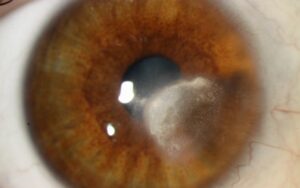
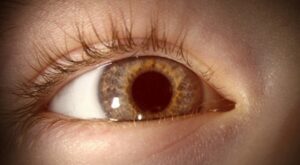
Staphylococcal blepharitis is an infection and hypersensitivity reaction of the eyelid margin and lashes.
It is also a very common cause of red, itchy, crusted lids, and it often returns without regular care.
The treatment is simple, but long term, so explaining the disease to the patient is half the treatment.
What Causes Staphylococcal Blepharitis?
Staphylococcus aureus and coagulase-negative staphylococci live on the lid margin of many healthy people.
In some patients, the bacteria multiply and release toxins, and the body then reacts to them with inflammation of the lid margin and the surface of the eye (see blepharitis).
Also, risk factors include rosacea, seborrheic dermatitis, atopy, and poor lid hygiene.
Typical Symptoms
- Burning, itching, and a gritty feeling, worse in the morning
- Crusting of the lashes, and sticking of the lids on waking
- Red and thickened lid margins
- Loss of lashes or misdirection, in long-standing disease
- Recurrent styes and chalazia (see hordeolum and chalazion)
All-fit Slit-Lamp Adapter
Record and share exactly what you see at the slit lamp. One adapter fits any slit lamp or surgical microscope — and any smartphone.
From Choroida — the team behind this siteStaphylococcal Blepharitis: Signs on Examination
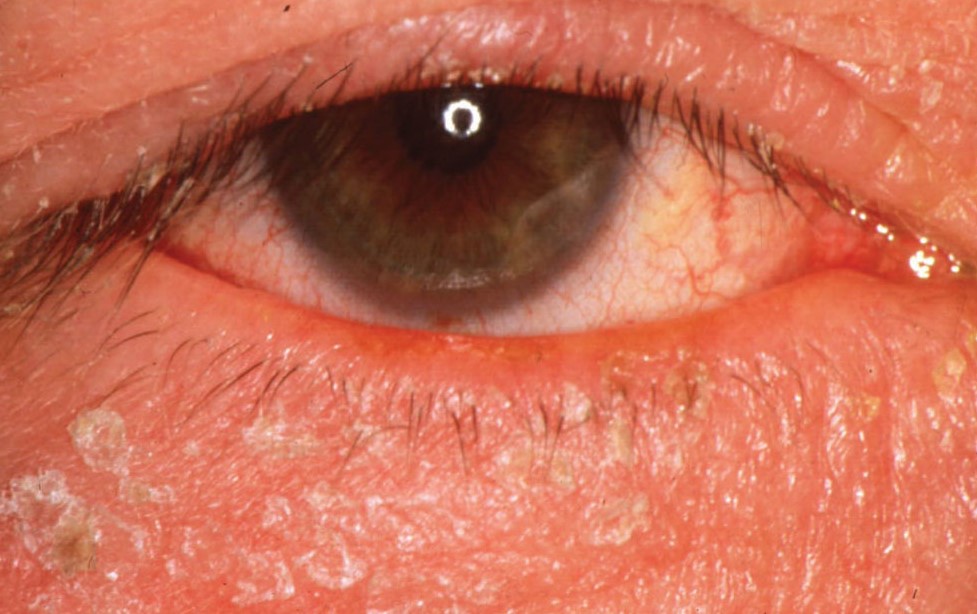
- Collarettes: hard, sleeve-like crusts around the base of the lashes, which are typical of staphylococcal disease
- Hard scales and crusts on the lid margin
- Telangiectasia, a hyperemic, thickened margin
- Broken, missing, or white lashes
- Corneal involvement: punctate staining, marginal infiltrates, and phlyctenules from hypersensitivity (see staphylococcal marginal keratitis)
Collarettes differ from the cylindrical dandruff seen in Demodex, which wraps around the lash like a sleeve of waxy material (see Demodex blepharitis).
Differential Diagnosis of Staphylococcal Blepharitis
- Seborrheic blepharitis, with greasy scales and no collarettes
- Demodex blepharitis, with cylindrical dandruff
- Meibomian gland dysfunction, the posterior form, which often coexists (see meibomian gland dysfunction)
- Allergic and contact dermatitis
- Sebaceous carcinoma, in one-sided, persistent lesions with loss of lashes that do not respond to treatment (see sebaceous carcinoma of the eyelid)
Treatment for Staphylococcal Blepharitis
- Lid hygiene: warm compresses for a few minutes, followed by gentle scrubbing of the lash base with a lid cleanser or diluted baby shampoo, once or twice a day
- Topical antibiotic ointment: bacitracin, erythromycin, or azithromycin on the lid margin, applied for a few weeks
- Topical steroid: a short course of a low-dose drop or ointment for severe inflammation or corneal involvement
- Oral antibiotics: doxycycline or azithromycin for resistant cases, especially in rosacea or meibomian gland disease (see ocular rosacea)
- Artificial tears, for associated dry eye
Cochrane review found that no single treatment was clearly better than the others, and lid hygiene remains the base of care (see the references).
Making the Plan Work
- Give a written routine, so that the daily time stays short
- Show the patient how to scrub, and then ask them to do it in front of you
- Warn that symptoms may flare before they improve, and that treatment takes weeks
- Explain that the disease is chronic and that hygiene must continue after the symptoms settle
- Treat the partner or the family if there is a link to skin disease
Complications
Without care, the lid margin can scar, the lashes can also turn inward, and the cornea can develop infiltrates and vascularization.
In addition, recurrent chalazia may need treatment with injection or surgery.
Patients should return if they have pain, a rapidly changing lesion, or reduced vision.
A Sample Daily Routine
- In the morning and evening, place a warm, clean cloth over closed lids for five minutes
- Dip a cotton bud or a lid wipe in a mild cleanser, and scrub along the base of the lashes of the upper and lower lids, with the eyes closed
- Rinse with clean water, and then pat dry
- Apply the antibiotic ointment to the lid margin at night, if prescribed
- Wash hands before and after, and discard used cotton buds
Most patients can do this in less than five minutes, and many also benefit from a reminder linked to brushing teeth.
Antibiotic Choices and Resistance
Local ointments are safe, but long-term use may lead to resistance, so they are used in courses and not continuously.
Also, azithromycin, in a gel or oral form, has anti-inflammatory effects on the glands and the lid margin and is useful in mixed disease.
Doxycycline is also used in a low dose for several weeks to months in patients with rosacea or gland disease, and is avoided in pregnancy and in children.
When to Review
- After two to four weeks to check compliance and response
- Every few months in chronic cases
- Earlier if the patient has pain, redness of the eye, a corneal spot, or sudden changes
Document the findings with a photograph, so that progress can be seen at later visits.


Document what you see
Two smartphone imaging tools built for everyday clinic use — one for the slit lamp, one for the fundus.
From Choroida — the team behind this siteReferences
- Lindsley K, Matsumura S, Hatef E, Akpek EK. Interventions for chronic blepharitis. Cochrane Database Syst Rev. 2012;(5):CD005556.
- Amescua G, Akpek EK, Farid M, et al. Blepharitis Preferred Practice Pattern. Ophthalmology. 2019;126:P56-P93.
- Nichols KK, Foulks GN, Bron AJ, et al. The international workshop on meibomian gland dysfunction: executive summary. Invest Ophthalmol Vis Sci. 2011;52:1922-1929.
- American Academy of Ophthalmology. Basic and Clinical Science Course, Section 8: External Disease and Cornea. AAO; current edition.

Writes and reviews the clinical articles on Educate. Every post is checked against peer-reviewed sources before it goes live.