The DREAM study (Dry Eye Assessment and Management) was a large randomized trial that tested omega-3 fatty acid supplements in moderate to severe dry eye.
It found no benefit over an olive oil placebo, so it changed the advice that many clinicians were giving to patients (see dry eye disease).
Design of the DREAM Study
The trial enrolled 535 patients with moderate to severe dry eye symptoms and signs, who were randomized in a two-to-one ratio.
- Omega-3 group: 3,000 milligrams a day of fish-derived EPA and DHA, in five capsules
- Placebo group: 5,000 milligrams of olive oil, in five capsules
In addition, the treatment lasted 12 months.
The primary outcome was the change in the Ocular Surface Disease Index, a symptom score (see the references).
DREAM Study: Main Results
Also, the OSDI fell by about 14 points in the omega-3 group and 12.5 in the placebo group.
The difference was not significant.
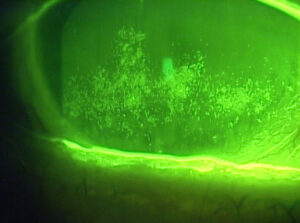
Secondary outcomes, including tear break-up time, corneal staining, conjunctival staining, and Schirmer values, also showed no difference between groups.
Both groups improved, which can also reflect a placebo effect, regression to the mean, or the effect of the eye drops that patients continued to use.
All-fit Slit-Lamp Adapter
Record and share exactly what you see at the slit lamp. One adapter fits any slit lamp or surgical microscope — and any smartphone.
From Choroida — the team behind this siteWhy the Result Surprised Many
Earlier small trials and observational data suggested that omega-3 intake lowered dry eye risk, so expectations were high.
Fish oil was widely used, and many clinicians recommended it, so a clear negative result in a big trial was a shock (see the references).
DREAM Study: Possible Explanations
- The placebo, olive oil, may also itself be beneficial
- The dose and form may not be the best
- Patients were already on treatment
- Those with meibomian gland disease might also respond differently
- Dry eye is a mixed condition, and one supplement may not help all types
Safety
Omega-3 supplements were safe in the study, although some patients reported mild gastrointestinal effects and a fishy taste.
They have effects on bleeding and may also need caution in patients on blood thinners.
DREAM Study: Other Evidence From Systematic Reviews
A Cochrane review concluded that omega-3 and omega-6 fatty acids have little or no benefit in dry eye, with low to moderate certainty (see the references).
Also, the TFOS DEWS II report listed them as having mixed evidence (see the references).
What to Tell Patients
- Diet rich in fish is good for health, and there is no harm in it
- Supplements for dry eye are not proven to help
- Treatments that have a better record include lubricants, lid care, anti-inflammatory drops, and managing the environment (see meibomian gland dysfunction)
If patients are already taking fish oil and feel better, they can continue.

DREAM Study: Practical Use
Spend time on proven treatments, and be clear about the limits of supplements, so that patients do not spend money on products that may not work.
An Example Case
A 52-year-old woman takes fish oil capsules at 2 grams a day for dry eye, on the advice of a friend, and still has burning in the afternoon.
Her examination shows meibomian gland dysfunction and mild staining, and her OSDI is 34.
After the discussion of the DREAM results, she keeps eating fish but stops the expensive capsules, starts warm compresses and lid hygiene, and adds a preservative-free lubricant.
Her score falls to 18 in three months.
Practical Steps in the Clinic
- Ask every dry eye patient about supplements and expectations
- Explain that evidence for omega-3 is weak, so give priority to proven measures
- Treat the lids, the tear film, and inflammation, based on the findings (see meibomian gland dysfunction)
- Review the outcome with a symptom score at each visit
Counselling Patients
Say that the study did not find an advantage over placebo, that the supplements are generally safe, and that a patient who feels better with them may continue, after discussing other drugs.
Also, remind patients that a healthy diet with oily fish is good for general health.
Key Points to Remember
- No difference from olive oil in symptoms or signs
- Cochrane review reached a similar conclusion
- Place treatment emphasis on proven therapies
- Placebo responses in dry eye trials are large
Limits of the Study
The study tested one dose and one formulation of omega-3, while the participants had moderate to severe disease that was often long-standing.
It cannot exclude a benefit for mild disease or for a subgroup.
It also does not apply to other supplements.
For the latest studies, see the PubMed results for DREAM study.


Document what you see
Two smartphone imaging tools built for everyday clinic use — one for the slit lamp, one for the fundus.
From Choroida — the team behind this siteReferences
- Dry Eye Assessment and Management Study Research Group. n-3 fatty acid supplementation for the treatment of dry eye disease. N Engl J Med. 2018;378:1681-1690.
- Downie LE, Ng SM, Lindsley KB, Akpek EK. Omega-3 and omega-6 polyunsaturated fatty acids for dry eye disease. Cochrane Database Syst Rev. 2019;12:CD011016.
- Jones L, Downie LE, Korb D, et al. TFOS DEWS II management and therapy report. Ocul Surf. 2017;15:575-628.
- American Academy of Ophthalmology. Basic and Clinical Science Course, Section 8: External Disease and Cornea. AAO; current edition.

Writes and reviews the clinical articles on Educate. Every post is checked against peer-reviewed sources before it goes live.