Sustained-release glaucoma implants release a prostaglandin analog inside the eye for months, so the patient does not need daily drops.
Also, the idea attacks a main reason for glaucoma progression, which is poor adherence to treatment.
Two intracameral implants have reached the clinic, and others are also in development (see primary open-angle glaucoma).
The Problem Sustained-Release Glaucoma Implants Solve
Glaucoma needs lifelong treatment, and many patients miss doses, instill drops incorrectly, or stop because of side effects.
Surface irritation, redness, and cost add to the problem, and nonadherence also contributes to progression of visual field loss.
A steady supply of drug from an implant removes the need for daily action.
Sustained-Release Glaucoma Implants: Bimatoprost Implant
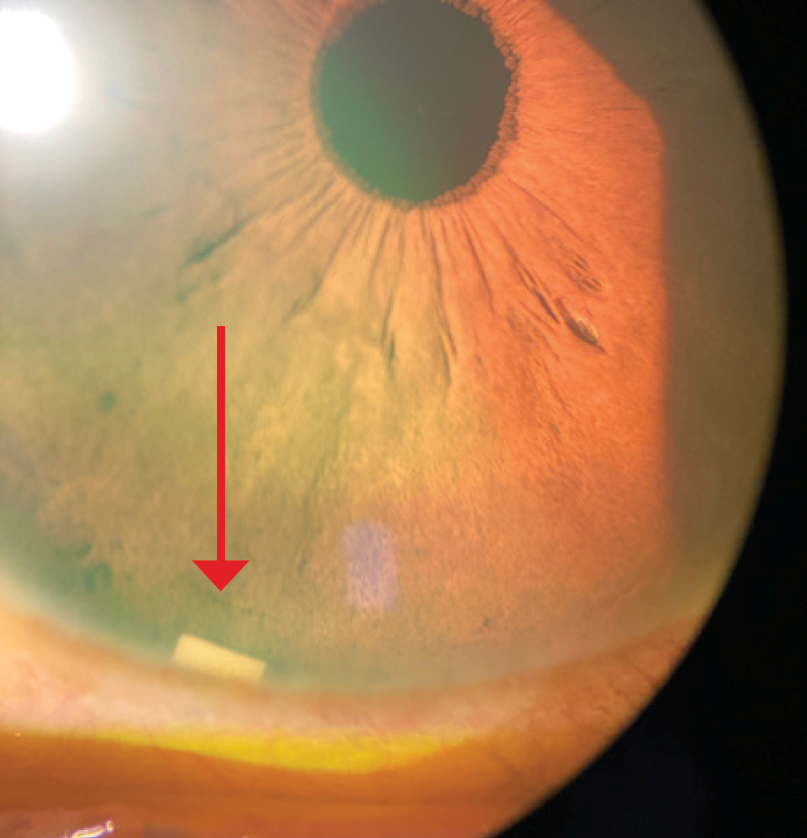
The bimatoprost sustained-release implant is a biodegradable rod placed in the anterior chamber, through a small needle, in the clinic or operating room.
- It releases the drug for several months as it dissolves
- Phase 3 trials showed noninferior pressure lowering to twice-daily timolol drops over the first months (see the references)
- The United States approves it for single use, because repeated treatment raised concern about corneal endothelial loss
In addition, eyes with a low endothelial cell count, narrow angles, or a previous corneal transplant are not suitable.
All-fit Slit-Lamp Adapter
Record and share exactly what you see at the slit lamp. One adapter fits any slit lamp or surgical microscope — and any smartphone.
From Choroida — the team behind this siteTravoprost Implant
The travoprost intracameral implant is a small device that sits in the angle and releases drug over a long period, with the potential for months to years of effect.
Clinical trials showed pressure lowering comparable to timolol, and surgeons can place the device during cataract surgery or alone.
Long-term safety data continue to accumulate.
Sustained-Release Glaucoma Implants: Other Approaches Under Study
- Drug-eluting punctal plugs that release a prostaglandin
- Contact lenses that deliver drugs
- Drug-releasing rings and subconjunctival depots
- Biodegradable microspheres and hydrogels
Who May Benefit?
- Patients with mild to moderate open-angle glaucoma who struggle with drops
- Those with surface disease worsened by preserved drops
- Patients with dexterity problems, memory loss, or limited access to care
- Patients undergoing cataract surgery, in whom an implant can be placed in the same session
Sustained-Release Glaucoma Implants: Limits and Safety
- Corneal endothelial loss with some devices, so baseline cell counts and monitoring are advised
- Inflammation, pressure rises, and hyperemia early after placement
- Migration of the implant into the angle or the cornea
- Duration varies, and some eyes need additional treatment
Implants do not cure glaucoma, and pressure, optic nerve, and field must still be followed (see goldmann applanation tonometry).
Choosing Between Options
- Drops remain the standard for most patients
- Laser trabeculoplasty is an alternative that avoids drops for a time (see selective laser trabeculoplasty)
- Implants add another option, and fit patients who prefer not to use daily drops
Sustained-Release Glaucoma Implants: Counselling
Explain that an implant lowers pressure for months, that it is not a permanent cure, and that follow-up is as important as before.
Discuss the plan for when the implant effect ends.
An Example Case
A 74-year-old man with mild glaucoma has tremor and forgets drops, with pressure above target.
After assessment of his endothelial cell count and angle, the doctor places an intracameral implant in the clinic, and his pressure falls for several months without daily drops.
When the effect fades, he returns for review, and they discuss options such as laser or another treatment.
Preoperative Checklist
- Confirm an open angle on gonioscopy (see gonioscopy)
- Check the corneal endothelial cell count with specular microscopy
- Review previous intraocular surgery and corneal disease
- Explain what will happen when the implant stops working
What Research May Bring
Researchers are testing longer-acting platforms, drugs from other classes, and devices that can be refilled.
The aim is to make steady treatment independent of patient behavior, which would close a main gap in glaucoma care.
Patient Questions
Patients ask whether an implant means they can stop all treatment.
The answer is that some will need drops later, that follow-up continues, and that the aim is steady pressure control with fewer drops.
Discuss costs and the plan if the implant needs to be repeated.
Monitoring After Placement
Check the pressure at one day, one week, and one month, and then every few months, with gonioscopy to confirm the position of the implant.
Measure corneal endothelial cell density at planned intervals when the label advises it, and look for corneal edema.
Record the date of placement, so that you anticipate the end of the expected effect and plan the next step in time.


Document what you see
Two smartphone imaging tools built for everyday clinic use — one for the slit lamp, one for the fundus.
From Choroida — the team behind this siteReferences
- Medeiros FA, Walters TR, Kolko M, et al. Phase 3, randomized, 20-month study of bimatoprost implant in open-angle glaucoma and ocular hypertension (ARTEMIS 1). Ophthalmology. 2020;127:1627-1641.
- Lewis RA, Christie WC, Day DG, et al. Bimatoprost sustained-release implants for glaucoma therapy: 6-month results from a phase I/II clinical trial. Am J Ophthalmol. 2017;175:137-147.
- Kang-Mieler JJ, Rudeen KM, Liu W, Mieler WF. Advances in ocular drug delivery systems. Eye (Lond). 2020;34:1371-1379.
- American Academy of Ophthalmology. Basic and Clinical Science Course, Section 10: Glaucoma. AAO; current edition.

Writes and reviews the clinical articles on Educate. Every post is checked against peer-reviewed sources before it goes live.