Pharmacologic mydriasis is a dilated, poorly reactive pupil caused by a drug acting on the iris muscles.
It usually presents as a sudden, unilateral big pupil in a well patient. However, the picture can mimic a third nerve palsy, so a structured exam settles most cases within an hour.
How Pharmacologic Mydriasis Develops
Two drug classes cause it. First, anticholinergic agents block muscarinic receptors in the iris sphincter and ciliary muscle, and as a result the pupil becomes large and accommodation fails.
Second, adrenergic agents stimulate the iris dilator, and this dilation is usually milder because the sphincter still works. Neither mechanism involves the third nerve itself.
Common Culprits of Pharmacologic Mydriasis
Most exposures are accidental, so ask direct questions.
- Scopolamine patches for motion sickness, transferred from finger to eye
- Ipratropium nebulizers with a loose face mask
- Glycopyrronium wipes for hyperhidrosis
- Plants such as jimsonweed, angel’s trumpet and deadly nightshade
- Cycloplegic drops borrowed from a relative
- Phenylephrine or oxymetazoline nasal sprays and drops
Also, ask about work exposure, for example in nurses, pharmacists and gardeners.
All-fit Slit-Lamp Adapter
Record and share exactly what you see at the slit lamp. One adapter fits any slit lamp or surgical microscope — and any smartphone.
From Choroida — the team behind this siteWhat the Patient Reports
Patients often notice the big pupil in a mirror, and glare is common because the pupil cannot narrow in bright light. Near blur is typical with anticholinergic agents, while ptosis, double vision and headache are absent. Their presence points toward another diagnosis.
Slit Lamp Signs in Pharmacologic Mydriasis
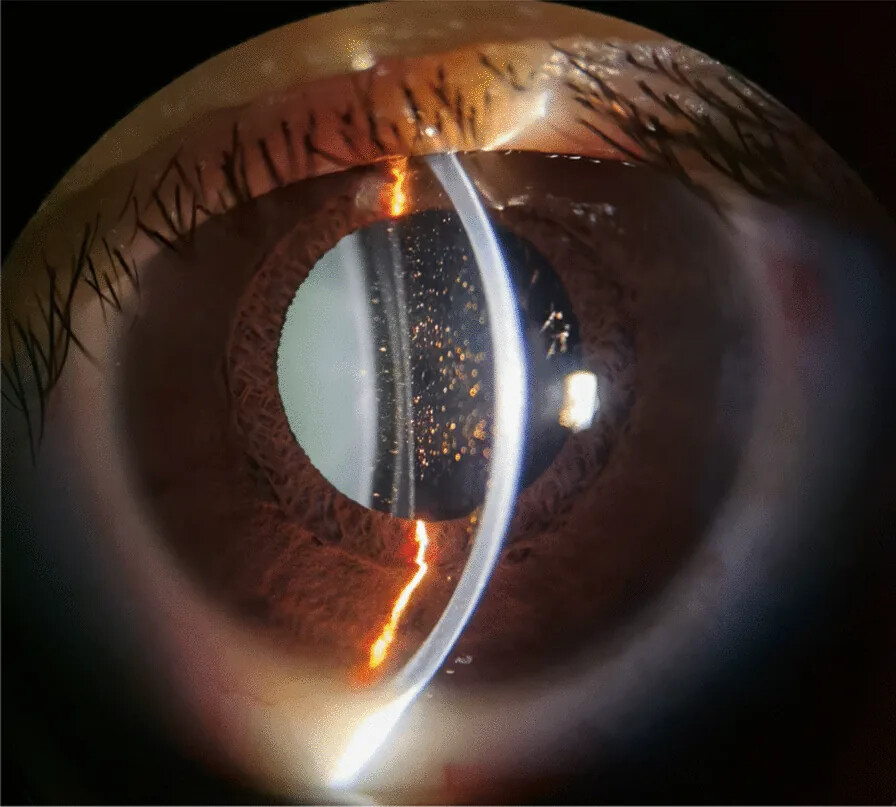
Measure both pupils in light and dark first. The affected pupil is often very large, round and unreactive to light and near, and unlike an Adie pupil, it shows no segmental sphincter movements. Then, check the sphincter for tears, transillumination defects and synechiae, while adrenergic cases may also show conjunctival blanching and mild lid retraction.
Ruling Out a Third Nerve Palsy
Next, examine lid position and motility in all gazes. A compressive third nerve palsy usually brings ptosis or a motility deficit with the pupil. An isolated dilated pupil is therefore rarely the only sign of an aneurysm, but rare reports exist, so testing still matters.
The Pilocarpine Test
Thompson and colleagues described this simple test in 1971. Instill 1% pilocarpine into both eyes, so the fellow eye serves as a control. Avoid applanation or other corneal manipulation beforehand, because it alters drug penetration.
Then, compare the pupils after 30 to 45 minutes in the same light. A normal or denervated sphincter constricts briskly.
Reading the Result in Pharmacologic Mydriasis
A blocked pupil stays large or constricts poorly. Good constriction excludes anticholinergic blockade and points to a neural or iris cause. Partial constriction can occur when the drug is wearing off.
In addition, adrenergic mydriasis usually constricts, because sphincter receptors remain free. Therefore, read the result alongside the history, and document pupil sizes and timing for later comparison.
Dilute Pilocarpine and Tonic Pupils
Some examiners start with dilute pilocarpine, about 0.1%. A tonic pupil constricts to it through denervation supersensitivity (see Adie tonic pupil). A pharmacologically blocked pupil does not respond, and then 1% pilocarpine completes the workup.
Structural Mimics
Sphincter damage also resists pilocarpine, so ask about blunt injury and surgery (see traumatic mydriasis). Look for margin notches, iridodonesis and angle recession. Also, exclude acute angle closure, which brings pain, redness and high pressure.
When Imaging Is Needed
Order urgent vascular imaging when the pupil constricts to 1% pilocarpine without a local cause, and also image any patient with ptosis, ophthalmoplegia, headache or neurologic signs. CT or MR angiography can exclude a posterior communicating artery aneurysm. Local protocols decide which test is fastest, while a confirmed block in a well patient rarely needs imaging.
Course of Pharmacologic Mydriasis
The pupil recovers as the drug clears. Tropicamide fades within hours, while atropine and scopolamine can last several days. Plant alkaloids vary with the dose, so review patients whose pupils fail to recover.
Systemic Toxicity
Bilateral mydriasis after plant or patch exposure may signal systemic toxicity. For example, look for dry mouth, flushed skin, tachycardia and confusion. These patients need emergency medical care, and the eye finding is only one part of the picture, while children are especially vulnerable.
Counseling in Pharmacologic Mydriasis
No drop reverses the block quickly, so first remove the source and advise careful hand washing. Then, offer sunglasses for glare and reading glasses for near blur, explain that the effect is temporary and benign, and advise against driving while glare persists.
Pitfalls to Avoid
- Do not test only one eye
- Never read the response too early
- Do not accept a negative history without asking about patches and plants
- Never skip lid and motility checks
- Do not forget that sphincter damage resists pilocarpine


Document what you see
Two smartphone imaging tools built for everyday clinic use — one for the slit lamp, one for the fundus.
From Choroida — the team behind this siteReferences
- Thompson HS, Newsome DA, Loewenfeld IE. The fixed dilated pupil: sudden iridoplegia or mydriatic drops? A simple diagnostic test. Arch Ophthalmol. 1971;86:21-27.
- Kawasaki A. Approach to the patient with abnormal pupils. Curr Opin Ophthalmol. 2005;16:395-400.
- Wilhelm H. Disorders of the pupil. Handb Clin Neurol. 2011;102:427-466.
- Salmon JF. Kanski’s Clinical Ophthalmology: A Systematic Approach. 9th ed. Elsevier; 2020.
- American Academy of Ophthalmology. Basic and Clinical Science Course, Section 5: Neuro-Ophthalmology. San Francisco: AAO; 2023.
Test yourself
A few questions straight from this article.
-
How do anticholinergic agents cause pharmacologic mydriasis?
Muscarinic blockade in the iris sphincter and ciliary muscle makes the pupil large and accommodation fail, and the third nerve itself is not involved. -
Why is adrenergic pharmacologic mydriasis usually milder than anticholinergic mydriasis?
Adrenergic agents stimulate the iris dilator rather than blocking the sphincter, so the sphincter keeps working and the dilation is usually milder. -
Which inhaled exposure is a recognized accidental cause of pharmacologic mydriasis?
Most exposures are accidental, and an ipratropium nebulizer with a loose face mask is a listed source, so direct questions are needed to uncover it. -
In a patient with a sudden big pupil, which accompanying symptoms point away from pharmacologic mydriasis?
Glare and near blur are typical, but ptosis, double vision and headache are absent in pharmacologic mydriasis and their presence points toward another diagnosis. -
Which slit lamp feature separates a pharmacologically dilated pupil from an Adie pupil?
The affected pupil is often very large, round and unreactive to light and near, and unlike an Adie pupil it shows no segmental sphincter movements. -
In the pilocarpine test for pharmacologic mydriasis, how long after instilling 1% pilocarpine are the pupils compared?
1% pilocarpine goes into both eyes so the fellow eye acts as a control, and the pupils are compared after 30 to 45 minutes in the same light. -
How does an anticholinergically blocked pupil respond to 1% pilocarpine?
A blocked pupil stays large or constricts poorly, although partial constriction can occur when the drug is wearing off, so the result is read alongside the history. -
Why does a tonic pupil constrict to dilute pilocarpine, about 0.1%, unlike a pharmacologically blocked pupil?
A tonic pupil responds to dilute pilocarpine through denervation supersensitivity, whereas a pharmacologically blocked pupil does not respond. -
Which structural mimic of pharmacologic mydriasis also resists pilocarpine?
Sphincter damage also resists pilocarpine, so ask about blunt injury and surgery and look for margin notches, iridodonesis and angle recession. -
Which agents can keep a pharmacologically dilated pupil large for several days?
The pupil recovers as the drug clears: tropicamide fades within hours, while atropine and scopolamine can last several days.

Writes and reviews the clinical articles on Educate. Every post is checked against peer-reviewed sources before it goes live.