RVO in young patients, usually defined as retinal vein occlusion before age 50, is uncommon but well recognized.
However, a young patient brings a different list of causes.
Therefore, the workup needs focus and clear clinical reasoning.
How Common Is RVO in Young Patients
Retinal vein occlusion becomes more frequent with each decade of life.
As a result, only a minority of patients present before 50.
In addition, young adults more often show perfused central occlusions with a milder course.
Fong and Schatz described this pattern in their review of central occlusion in young adults.
Classic Vascular Risk Factors
Hypertension, hyperlipidemia and diabetes still appear in many young patients.
Therefore, measure blood pressure in clinic before you order rare tests.
A new hypertension diagnosis may explain the whole event.
Fundus Explorer Pro
Photograph the retinal findings described here with the phone already in your pocket — 22 D optics and built-in illumination in one handheld unit.
From Choroida — the team behind this siteInflammatory Causes of RVO in Young Adults
Retinal vasculitis can occlude veins and mimic a primary thrombosis.
Look for vitreous cells, venous sheathing and leakage beyond the occluded segment.
- Behçet disease
- Sarcoidosis
- Systemic lupus erythematosus
- Tuberculosis and syphilis
- HIV-related vasculopathy
Bilateral or multifocal disease strongly suggests inflammation.
Hematologic Causes
Hyperviscosity slows venous flow and therefore promotes thrombosis.
For example, polycythemia, leukemia and myeloma can all produce this picture.
Bilateral dilated veins with scattered hemorrhages call for a blood count.
Hormonal Triggers of RVO in Young Women
Combined oral contraceptives raise venous thrombotic risk and appear repeatedly in case series.
Pregnancy and the postpartum period create a similar prothrombotic state.
Then, discuss stopping the estrogen product with the prescribing doctor.
Ocular Factors
Raised intraocular pressure is a recognized local risk factor.
Therefore, measure pressure in both eyes and examine the disc and angle.
A crowded disc or disc drusen may also predispose to central occlusion.
Papillophlebitis or True Occlusion
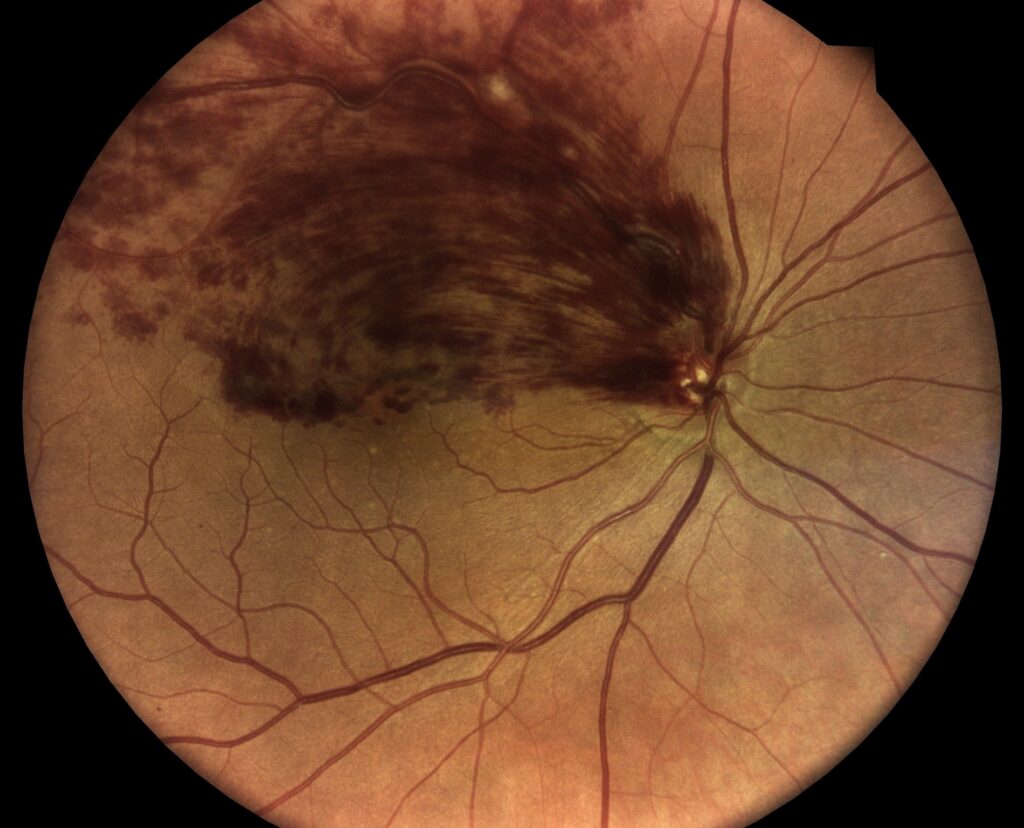
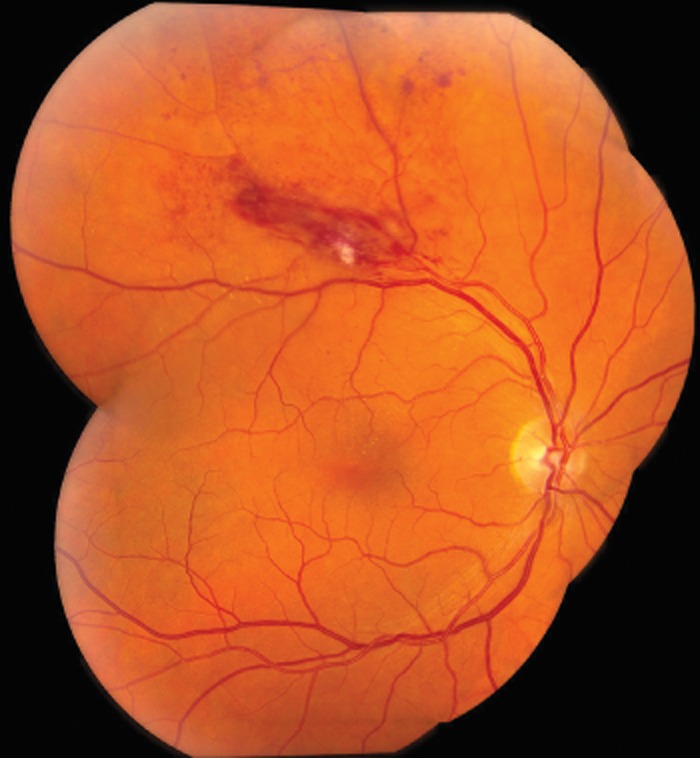
Papillophlebitis presents with disc swelling, venous engorgement and hemorrhages in a healthy young adult.
Many authors regard it as a mild central occlusion with disc inflammation (see papillophlebitis).
Because the outlook is usually favorable, the label mainly shapes counseling.
History Taking in RVO in Young Patients
- Prior venous thrombosis, stroke or miscarriage
- Family history of clots
- Oral or genital ulcers, rash or joint pain
- Contraceptives, pregnancy or hormone use
- Fever, night sweats, weight loss or easy bruising
Examination and Imaging
Examine both fundi, because bilateral involvement changes the differential.
Fluorescein angiography shows nonperfusion and any vasculitic leakage.
Meanwhile, OCT quantifies macular edema and guides treatment.
Baseline Tests for RVO in Young Adults
- Full blood count
- HbA1c and lipid profile
- ESR or C-reactive protein
- Renal function and plasma homocysteine
Then, add syphilis serology and chest imaging when inflammation seems likely.
When Thrombophilia Testing Is Justified
Meta-analyzes link hyperhomocysteinemia and antiphospholipid antibodies with RVO.
However, the link with inherited factors such as factor V Leiden is weaker.
Therefore, reserve thrombophilia panels for bilateral disease, prior thrombosis, strong family history or absent vascular risk (see thrombophilia testing).
Antiphospholipid testing deserves priority after pregnancy loss (see antiphospholipid syndrome).
Tests With Little Yield
Broad panels for every patient rarely change management.
In addition, samples taken during anticoagulation or acute illness may mislead.
So order each test to answer a clear question.
Treating RVO in Young Patients
Treatment follows the same principles used in older patients.
Anti-VEGF injections treat macular edema, while laser treats neovascularization.
Steroid implants help some eyes, although young phakic patients face cataract and pressure risks.
However, the underlying cause also needs treatment, for example immunosuppression in vasculitis.
Routine anticoagulation lacks good evidence, so a hematologist should guide it.
Prognosis of RVO in Young Patients
Young patients often recover better vision than older ones.
Perfused occlusions and papillophlebitis carry the best outlook.
However, ischemic central occlusion can still cause neovascular glaucoma.
Recurrence or fellow eye involvement suggests a systemic cause.
Counseling the Patient
Explain that many young patients have an identifiable, treatable risk.
Also, warn that tests often return normal.
Encourage blood pressure control, smoking cessation and good hydration.
Finally, ask the patient to report new symptoms in either eye promptly.
Follow-Up in RVO in Young Adults
Review perfused central occlusions often in the first months, because ischemic conversion can occur.
Check the iris and angle for new vessels.
Then, repeat OCT to adjust injection intervals.
Coordinate care with the internist or rheumatologist when a systemic cause appears.
Pitfalls to Avoid
- Ordering a thrombophilia panel before checking blood pressure
- Missing vasculitis when cells or sheathing are present
- Forgetting to ask about contraceptives and pregnancy
- Starting anticoagulation without a hematology opinion

Document what you see
Two smartphone imaging tools built for everyday clinic use — one for the slit lamp, one for the fundus.
From Choroida — the team behind this siteReferences
- Fong AC, Schatz H. Central retinal vein occlusion in young adults. Surv Ophthalmol. 1993;37:393-417.
- Janssen MC, den Heijer M, Cruysberg JR, Wollersheim H, Bredie SJ. Retinal vein occlusion: a form of venous thrombosis or a complication of atherosclerosis? A meta-analysis of thrombophilic factors. Thromb Haemost. 2005;93:1021-1026.
- Lahey JM, Tunç M, Kearney J, et al. Laboratory evaluation of hypercoagulable states in patients with central retinal vein occlusion who are less than 56 years of age. Ophthalmology. 2002;109:126-131.
- Hayreh SS, Zimmerman MB, Podhajsky P. Incidence of various types of retinal vein occlusion and their recurrence and demographic characteristics. Am J Ophthalmol. 1994;117:429-441.
- American Academy of Ophthalmology. Basic and Clinical Science Course, Section 12: Retina and Vitreous. San Francisco: AAO.

Writes and reviews the clinical articles on Educate. Every post is checked against peer-reviewed sources before it goes live.