Digital eye strain, also called computer vision syndrome, is a group of eye and visual symptoms that arise during or after prolonged screen use.
It is very common in students and office workers.
Most of the time it is a benign problem that can also be reduced by correcting its causes (see dry eye disease).
Symptoms of Digital Eye Strain
- Tired, aching, or burning eyes
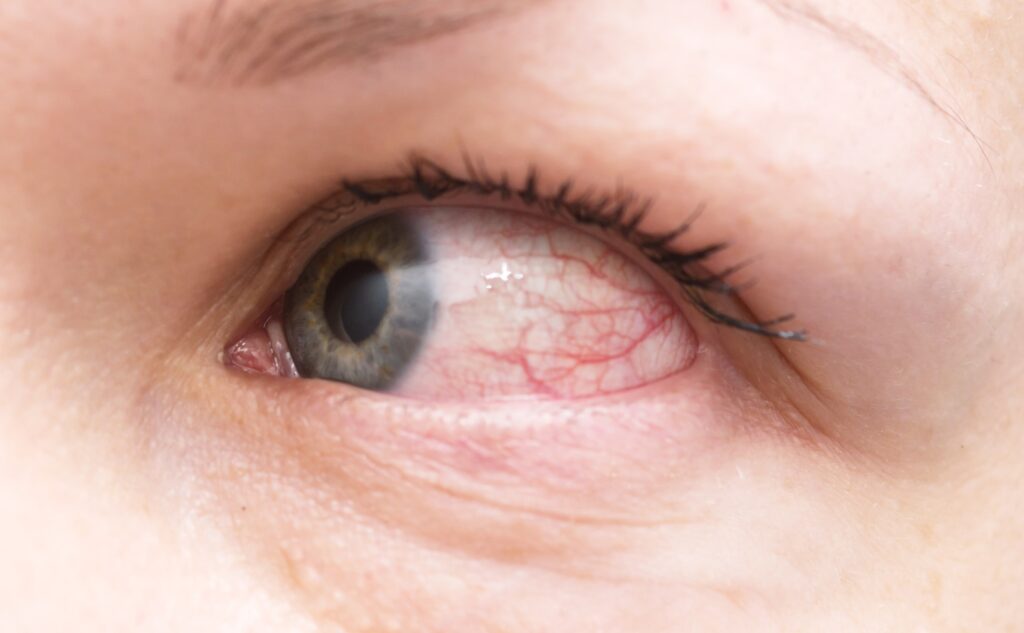
- Dryness, redness, and a gritty feeling
- Blurred or fluctuating vision, and double vision at near
- Headache, neck, and shoulder pain
- Light sensitivity
Symptoms tend to peak at the end of the workday and ease after rest.
Causes of Digital Eye Strain
- Reduced blinking: the blink rate falls from about 15 to 20 per minute to roughly 5 to 7 during screen use, with more incomplete blinks (see the references)
- Near focus demand: sustained accommodation and convergence for hours
- Uncorrected refractive error or presbyopia
- Glare, poor lighting, and screen contrast
- Poor posture and screen position
- Binocular vision problems such as convergence insufficiency (see convergence insufficiency)
All-fit Slit-Lamp Adapter
Record and share exactly what you see at the slit lamp. One adapter fits any slit lamp or surgical microscope — and any smartphone.
From Choroida — the team behind this siteEvaluation for Digital Eye Strain
First, take a history of screen time, symptoms, and the work setup.
Also, check refraction, accommodation, convergence, binocular balance, and the ocular surface, and look for lid disease (see meibomian gland dysfunction).
Even small uncorrected errors, such as astigmatism or low hyperopia, can cause symptoms at the screen.
Digital Eye Strain: Treatment of the Causes
- Correct refractive error, with a prescription for the working distance if needed (see presbyopia)
- Treat dry eye and lid disease, with lubricants, warm compresses, and lid hygiene
- Treat binocular problems, with vision therapy or prisms
- Adjust the environment, with the screen below eye level, at about arm’s length, reduced glare, and a room light that matches the screen
Digital Eye Strain: The 20-20-20 Rule
Specifically, the rule says to look at something 20 feet away for 20 seconds every 20 minutes.
It is widely advised, and trials suggest that breaks and blink exercises can improve comfort, though strong evidence for a specific schedule is limited (see the references).
Blue Light Glasses
Many products claim to cut digital eye strain by filtering blue light, but the evidence is weak.
A Cochrane review and systematic reviews found no good evidence that blue light filtering lenses reduce eye strain or improve sleep or protect the retina in normal use (see the references).
Patients may prefer them, but they should not take the place of the steps above.
Lubricants and Supplements
Artificial tears help patients when symptoms of dryness appear during screen use, and preservative-free types are better for frequent use.
Omega-3 supplements, however, have not shown a benefit in large trials (see DREAM study).
Children and Teenagers
Screen time in children is linked to a higher risk of myopia and dry eye, while outdoor time is protective for myopia (see myopia control lenses and spectacles).
Encourage regular breaks, and an eye exam if symptoms persist.
When to See a Doctor
Persistent pain, double vision, or sudden changes in vision are not part of this syndrome, so they need a full examination.
An Example Case
A 31-year-old software developer complains of burning, blurred vision, and a headache after six hours at the computer.
Refraction shows -0.75 diopters of astigmatism that was never corrected, his blink rate on observation is 6 per minute.
There is mild meibomian gland dysfunction.
He gets glasses for the screen, learns to blink fully and takes short breaks, moves his screen below eye level, and uses warm compresses.
His symptoms fall by half in a month.
Practical Steps in the Clinic
- Ask about the workstation, lighting, and hours of use
- Check the refraction and binocular vision with care
- Treat the ocular surface before blaming the screen
- Offer a written plan with the main steps
- Review in four to six weeks
Counselling
Explain that screens do not damage the eye, but that long close work and reduced blinking cause fatigue and dryness.
Suggest practical changes, such as larger text, a matte screen, and outdoor breaks, and avoid selling products without evidence.
Key Points to Remember
- Reduced blinking and near focus are the main causes
- Correct small refractive errors and treat dry eye
- Blue light glasses do not reduce symptoms in trials
- Persistent or severe symptoms need a full eye examination
Workplace Measures
Employers can help with adjustable desks, glare control, and regular breaks.
Simple changes, such as screen placement and lighting, cost little and can raise comfort and productivity, and they are worth including in a wellness program.


Document what you see
Two smartphone imaging tools built for everyday clinic use — one for the slit lamp, one for the fundus.
From Choroida — the team behind this siteReferences
- Sheppard AL, Wolffsohn JS. Digital eye strain: prevalence, measurement and amelioration. BMJ Open Ophthalmol. 2018;3:e000146.
- Singh S, McGuinness MB, Anderson AJ, Downie LE. Interventions for the management of computer vision syndrome: a systematic review and meta-analysis. Ophthalmology. 2022;129:1192-1215.
- Lawrenson JG, Hull CC, Downie LE. The effect of blue-light blocking spectacle lenses on visual performance, macular health and the sleep-wake cycle: a systematic review of the literature. Ophthalmic Physiol Opt. 2017;37:644-654.
- American Academy of Ophthalmology. Basic and Clinical Science Course, Section 3: Clinical Optics. AAO; current edition.

Writes and reviews the clinical articles on Educate. Every post is checked against peer-reviewed sources before it goes live.