
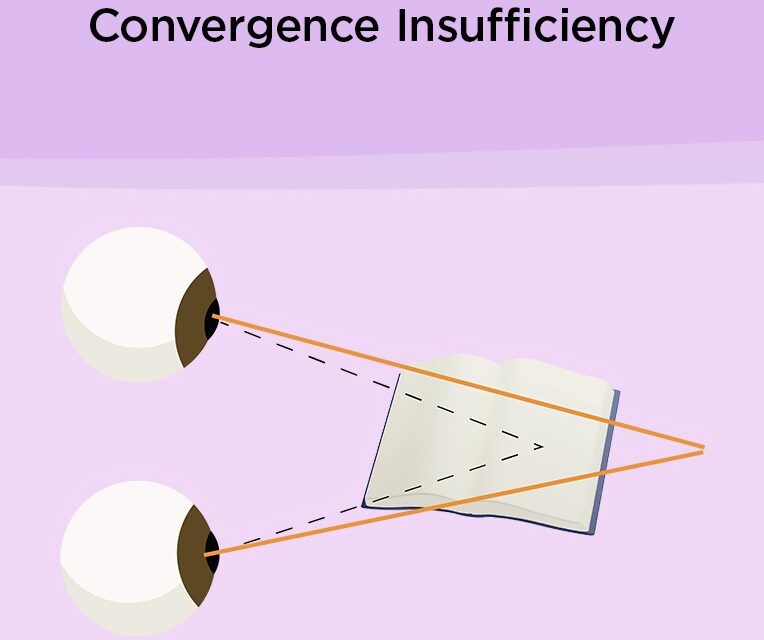
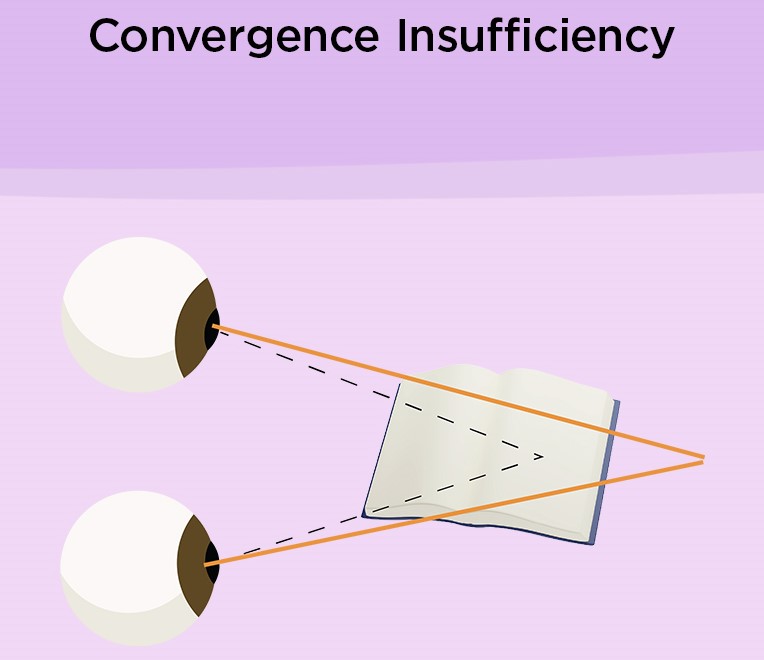
Convergence insufficiency is a common binocular vision disorder in which the eyes have difficulty turning inward together to maintain single vision during near work.
It is easy to miss on a standard eye exam precisely because distance vision and even basic near acuity can be entirely normal.
The deficit is specifically in sustained near fusional effort, which most routine screening exams simply do not test in a way that reveals the problem, making this one of the more commonly overlooked treatable causes of near-work discomfort in both children and adults.
Why It’s Often Missed
Because visual acuity at both distance and near is typically normal, and because the deficit only becomes apparent with sustained near tasks rather than a brief glance at an eye chart, convergence insufficiency is frequently overlooked in routine screening, in school-age children whose reading difficulties get attributed to attention problems or learning disabilities rather than a treatable binocular vision issue.
Specifically asking about symptoms during reading or screen use, and specifically testing near point of convergence, is what actually reveals the diagnosis.
This is especially relevant in a child who has already been evaluated for a learning or attention disorder without improvement, where an unexamined convergence deficit may be the actual, treatable driver of the reported academic struggles.
Clinical Presentation
- Eye strain, headaches, or discomfort specifically during or after sustained near work (reading, computer use, homework)
- Words appearing to “swim” or move on the page during reading
- Intermittent double vision with near tasks, though this is not present in all patients
- Difficulty concentrating on or completing near work, sometimes leading to avoidance of reading — a pattern that in children is frequently misattributed to attention-deficit disorder or a learning disability rather than recognized as a visual symptom
- Symptoms characteristically worsen as the near task continues (fatigue-dependent) and improve with rest, distinguishing this pattern from a static refractive problem
All-fit Slit-Lamp Adapter
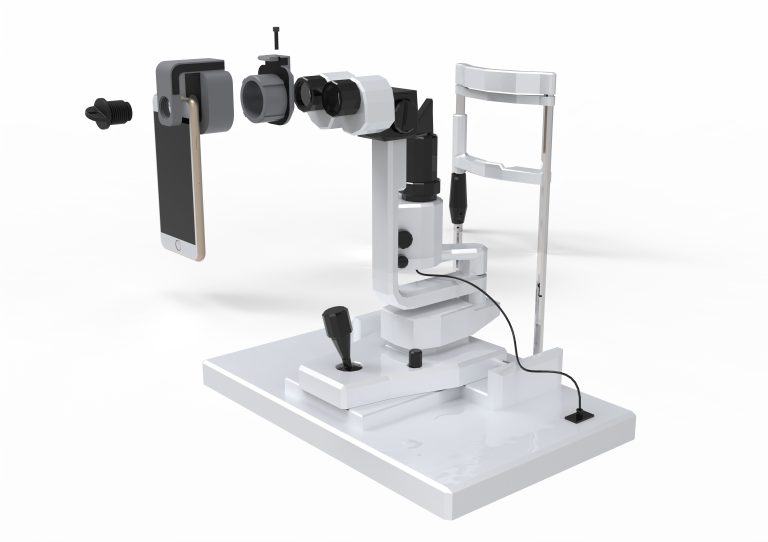
Record and share exactly what you see at the slit lamp. One adapter fits any slit lamp or surgical microscope — and any smartphone.
From Choroida — the team behind this siteExam Findings
- A receded near point of convergence — the point at which a target, brought progressively closer to the patient’s face, can no longer be maintained as a single image and breaks into double vision; a near point of convergence greater than about 6 cm is generally considered abnormal, though normative values vary somewhat by testing method
- Reduced positive fusional vergence amplitudes at near, reflecting reduced convergence reserve
- Exophoria at near that is greater than at distance, on cover testing
- Normal ocular alignment at distance in most cases, distinguishing this from a true, constant strabismus
- Otherwise normal ocular exam, including normal visual acuity at both distance and near
Differential Diagnosis
- Uncorrected refractive error, particularly hyperopia — can produce similar near-work symptoms and should be corrected first, since uncorrected hyperopia can itself contribute to accommodative and convergence stress
- Accommodative insufficiency or accommodative dysfunction — a related but distinct problem with the focusing (rather than convergence) system, sometimes coexisting with convergence insufficiency
- Intermittent exotropia — a more significant, often visible ocular misalignment, discussed in its own dedicated article on this site, representing a different point on the spectrum of divergence-excess binocular dysfunction
- Dry eye disease — can produce overlapping symptoms of eye strain and discomfort with sustained visual tasks, worth excluding or addressing alongside any binocular vision workup
Diagnostic Evaluation
Near point of convergence testing, near and distance cover testing, and measurement of fusional vergence amplitudes together establish the diagnosis.
A comprehensive refraction should be performed to exclude or correct any contributing uncorrected refractive error before attributing symptoms purely to convergence insufficiency, since correcting a coexisting refractive error alone can meaningfully improve symptoms even before any specific convergence therapy begins.
In children with reading difficulty and attention concerns, screening specifically for convergence insufficiency is worthwhile before or alongside any evaluation for a primary attention or learning disorder, given how treatable the visual component is when present.
Management
Vision therapy — a structured program of convergence exercises, whether office-based, home-based, or a combination — is the treatment with the strongest evidence base, and has been shown in randomized controlled trials to be more effective than simple home pencil push-up exercises alone or placebo treatment for symptomatic convergence insufficiency in both children and adults.
Base-in prism reading glasses can provide symptomatic relief for patients unable to complete or access formal vision therapy, though they do not address the underlying convergence deficit the way active therapy does, functioning more as a compensatory than curative measure — a reasonable option when access to structured therapy is limited or the patient cannot commit to the required exercises.
Correcting any significant uncorrected refractive error is an important first step regardless of the chosen approach to the convergence issue itself, because untreated refractive error can both contribute to and mask the true severity of the underlying convergence problem.
Most patients, particularly children treated with structured office-based vision therapy, show substantial symptomatic improvement, generally judged by resolution of symptoms and normalization of near point of convergence and vergence amplitudes on follow-up testing.
Adherence to a structured therapy program over the recommended course of weeks is genuinely important to outcome, and setting realistic expectations about the time commitment involved at the outset helps families and adult patients alike follow through rather than abandoning treatment early.
Document what you see
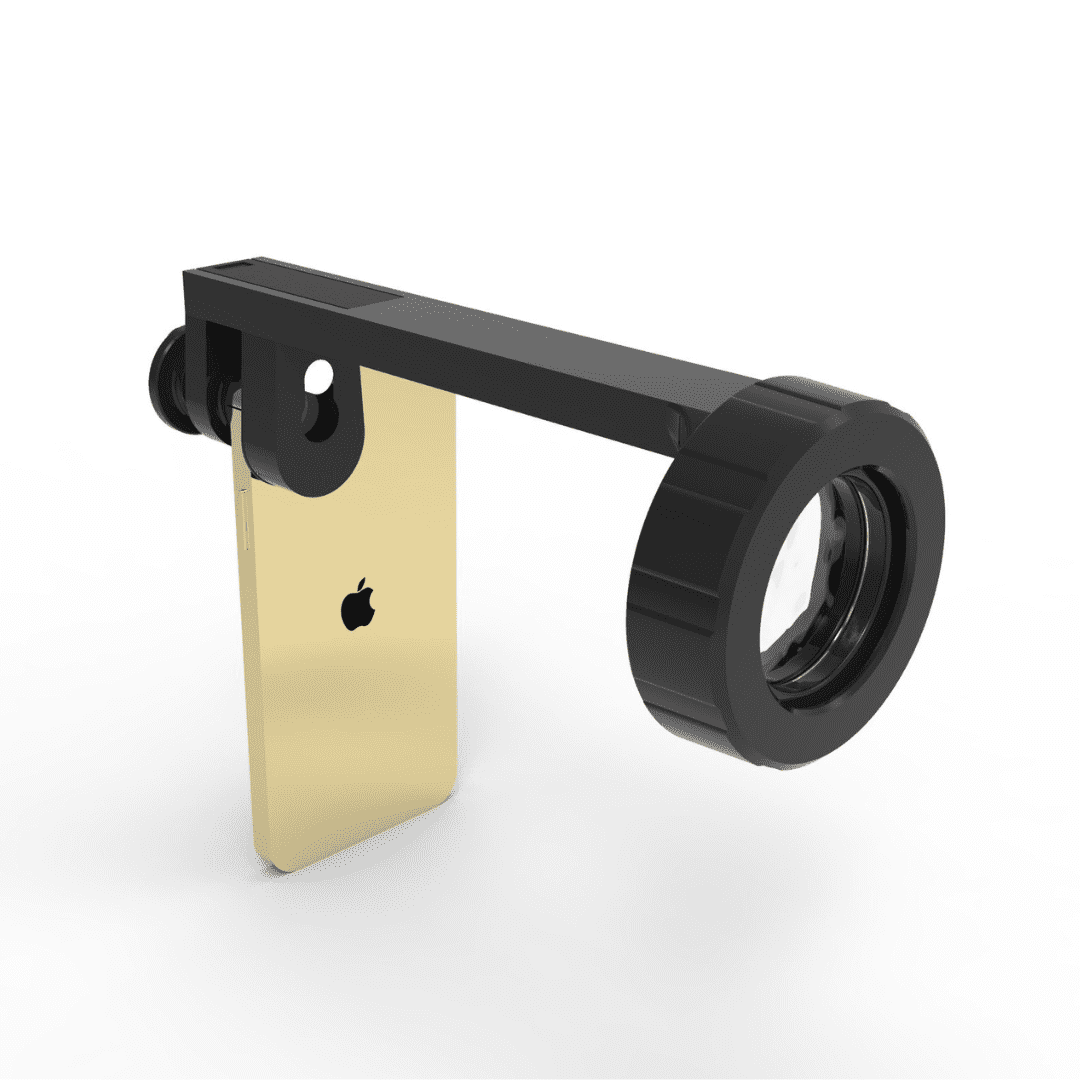
Two smartphone imaging tools built for everyday clinic use — one for the slit lamp, one for the fundus.
From Choroida — the team behind this siteReferences
- Convergence Insufficiency Treatment Trial (CITT) Study Group. Randomized clinical trial of treatments for symptomatic convergence insufficiency in children. Archives of Ophthalmology.
- Rouse MW, Borsting E, Hyman L, et al. Frequency of convergence insufficiency among fifth and sixth graders. Optometry and Vision Science.
- American Academy of Ophthalmology. Basic and Clinical Science Course, Section 6: Pediatric Ophthalmology and Strabismus.
Test yourself
A few questions straight from this article.
-
Why is convergence insufficiency so often missed on a routine eye examination?
Visual acuity at distance and near is typically normal, and the deficit only appears with sustained near tasks, which routine screening does not test in a way that reveals the problem. -
What near point of convergence value is generally considered abnormal in convergence insufficiency?
A near point of convergence receded beyond about 6 cm is generally considered abnormal, although normative values vary somewhat by testing method. -
What does cover testing typically show in convergence insufficiency?
Cover testing shows exophoria at near that exceeds the distance measurement, while ocular alignment at distance is normal in most cases, distinguishing this from a true constant strabismus. -
Which vergence measurement is characteristically reduced in convergence insufficiency?
Positive fusional vergence amplitudes at near are reduced, reflecting diminished convergence reserve available to sustain single binocular vision during near work. -
How do the symptoms of convergence insufficiency behave during a prolonged reading session?
Symptoms are characteristically fatigue-dependent, worsening as the near task continues and improving with rest, which distinguishes the pattern from a static refractive problem. -
In school-age children, convergence insufficiency is most often misattributed to which problem?
Reading avoidance and difficulty completing near work are frequently attributed to attention-deficit disorder or a learning disability rather than recognised as a treatable binocular vision problem. -
Which refractive condition should be corrected before attributing near-work symptoms solely to convergence insufficiency?
Uncorrected hyperopia can produce similar near-work symptoms and contribute to accommodative and convergence stress, so comprehensive refraction and correction come first. -
Which treatment for symptomatic convergence insufficiency has the strongest evidence base?
Structured vision therapy, office-based, home-based or combined, has been shown in randomised controlled trials to outperform pencil push-up exercises alone or placebo in both children and adults. -
What role do base-in prism reading glasses play in convergence insufficiency?
Base-in prism reading glasses are compensatory rather than curative; they relieve symptoms for patients who cannot access or complete formal vision therapy but do not address the underlying deficit. -
How is successful treatment of convergence insufficiency judged at follow-up?
Outcome is generally judged by resolution of symptoms together with normalisation of the near point of convergence and vergence amplitudes on follow-up testing.
