Abetalipoproteinemia is a rare recessive disease that blocks the transport of dietary fat.
It leads to deficiency of fat-soluble vitamins and a progressive retinopathy.
Therefore, early recognition and vitamin therapy can protect vision.
What Abetalipoproteinemia Is
The disease results from mutations in the gene for microsomal triglyceride transfer protein.
Without this protein, the body cannot assemble apolipoprotein B particles.
Also, chylomicrons and very low density lipoproteins are absent.
As a result, fat and fat-soluble vitamins are poorly absorbed.
Historical Background
Bassen and Kornzweig described the syndrome in 1950.
They noted acanthocytes in the blood and an atypical retinitis pigmentosa.
Also, the name Bassen-Kornzweig syndrome persists.
Therefore, the eye findings led to the discovery.
Fundus Explorer Pro
Photograph the retinal findings described here with the phone already in your pocket — 22 D optics and built-in illumination in one handheld unit.
From Choroida — the team behind this siteClinical Features of Abetalipoproteinemia
Infants show fat malabsorption with diarrhea and failure to thrive.
Later features include ataxia, neuropathy and acanthocytosis.
Also, low cholesterol and low triglycerides are typical.
As a result, the diagnosis is often made by a pediatrician or gastroenterologist.
Why Vitamin Deficiency Damages the Retina
Vitamin A supports the visual cycle in photoreceptors.
Vitamin E protects membranes from oxidative damage.
Also, both are carried by lipoproteins that are absent.
Therefore, the retina and nerves degenerate.
Retinal Findings
Night blindness is an early symptom.
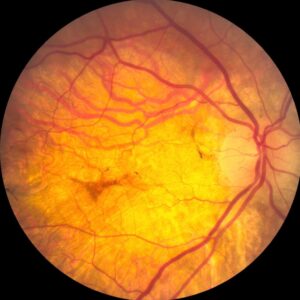
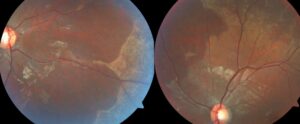
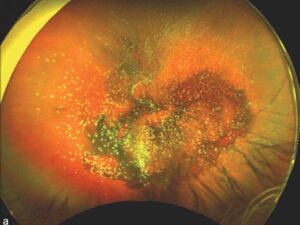
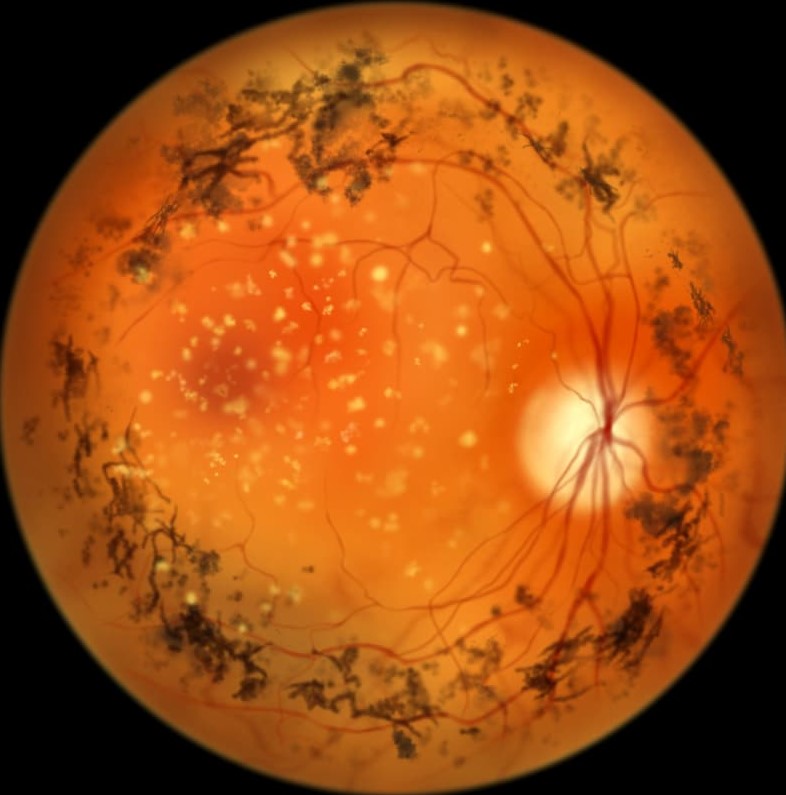
The fundus shows pigment mottling, then bone spicule changes and vessel attenuation.
Also, the macula is spared early and involved later.
As a result, the picture resembles retinitis pigmentosa.
Electroretinogram
The electroretinogram shows reduced rod and later cone responses.
Responses can improve with vitamin therapy in early disease.
Also, serial tests track progression.
Therefore, record a baseline at diagnosis.
Differentiating from Retinitis Pigmentosa
Acanthocytes and fat malabsorption point to abetalipoproteinemia.
Low cholesterol and absent apolipoprotein B confirm it.
Also, patients with retinitis pigmentosa have normal lipids (see retinitis pigmentosa).
In addition, ataxia suggests a systemic cause.
Other Causes of Pigmentary Retinopathy with Neuropathy
Refsum disease and mitochondrial disorders share some features.
Vitamin E deficiency from other causes also produces ataxia and retinopathy.
Also, Kearns-Sayre syndrome shows retinopathy with ophthalmoplegia.
Therefore, lipid studies and genetics narrow the diagnosis.
Laboratory Diagnosis of Abetalipoproteinemia
Blood films show acanthocytes.
Serum lipids show very low cholesterol and triglycerides, and apolipoprotein B is absent.
Also, genetic testing finds mutations in the transfer protein gene.
As a result, the diagnosis is clear.
Vitamin Treatment of Abetalipoproteinemia
Chowers and colleagues reported that combined vitamin A and E therapy slowed retinal degeneration.
Doses are high and must be individualized.
Also, treatment should start early and continue for life.
Therefore, early diagnosis is critical to preserve vision.
Diet
A low-fat diet reduces diarrhea.
Essential fatty acids and other vitamins need supplementation.
Also, a dietitian should guide the plan.
In addition, avoid long-chain fats in large amounts.
Monitoring Abetalipoproteinemia
Check vitamin levels, liver function and the neurologic exam.
Examine the eyes every year with electroretinography and fundus imaging.
Also, watch for hepatic complications.
Therefore, a team approach is best.
Prognosis in Abetalipoproteinemia
Treated patients may keep good vision for many years.
Untreated patients lose vision and mobility in adulthood.
Also, early start of therapy is the main factor.
As a result, newborn recognition makes a difference.
Genetic Counseling
The disease is recessive, and carriers are healthy.
Parents of an affected child have a 25 percent risk in each pregnancy.
Also, prenatal testing is possible in known families.
In addition, offer counseling to relatives.
Pitfalls to Avoid
- Do not label pigmentary retinopathy as retinitis pigmentosa without checking lipids
- Never delay vitamin therapy after diagnosis
- Do not stop monitoring when vision seems stable
- Never forget the neurologic follow-up
Genetics of the Transfer Protein Gene
The MTTP gene encodes the large subunit of the transfer protein.
Many different mutations cause loss of function.
Also, the disease is more frequent where marriage between relatives is common.
Therefore, family history and consanguinity are useful clues.
Hypobetalipoproteinemia
Heterozygous mutations in APOB cause hypobetalipoproteinemia.
Some patients show milder vitamin deficiency and retinopathy.
Also, homozygous cases resemble abetalipoproteinemia.
As a result, test both genes when lipids are low.
Role of the Ophthalmologist
The eye doctor may be first to see the child with night blindness.
A fundus examination and an electroretinogram start the work-up.
Also, a note of diarrhea and poor growth should prompt blood tests.
Therefore, ask about gut symptoms.
Vitamin K and Other Deficiencies
Vitamin K deficiency can cause bleeding.
Vitamin D and essential fatty acids may also be low.
Also, check clotting and bone health.
In addition, supplement under specialist guidance.


Document what you see
Two smartphone imaging tools built for everyday clinic use — one for the slit lamp, one for the fundus.
From Choroida — the team behind this siteReferences
- Bassen FA, Kornzweig AL. Malformation of the erythrocytes in a case of atypical retinitis pigmentosa. Blood. 1950;5:381-387.
- Chowers I, Banin E, Merin S, Cooper M, Granot E. Long-term assessment of combined vitamin A and E treatment for the prevention of retinal degeneration in abetalipoproteinaemia and hypobetalipoproteinaemia patients. Eye (Lond). 2001;15:525-530.
- Berriot-Varoqueaux N, Aggerbeck LP, Samson-Bouma M, Wetterau JR. The role of the microsomal triglyceride transfer protein in abetalipoproteinemia. Annu Rev Nutr. 2000;20:663-697.
- Lee J, Hegele RA. Abetalipoproteinemia and homozygous hypobetalipoproteinemia: a framework for diagnosis and management. J Inherit Metab Dis. 2014;37:333-339.
Test yourself
A few questions straight from this article.
-
Mutations in which gene cause abetalipoproteinemia?
Abetalipoproteinemia results from mutations in the gene for microsomal triglyceride transfer protein (MTTP); heterozygous APOB mutations instead cause hypobetalipoproteinemia. -
Which lipoproteins are absent in abetalipoproteinemia?
Without the transfer protein the body cannot assemble apolipoprotein B particles, so chylomicrons and VLDL are absent and fat-soluble vitamins are poorly absorbed. -
Which red cell abnormality on the blood film is typical of abetalipoproteinemia?
Blood films show acanthocytes, which Bassen and Kornzweig noted alongside an atypical retinitis pigmentosa. -
How is the macula affected in abetalipoproteinemia retinopathy?
The fundus shows pigment mottling, then bone spicules and vessel attenuation; the macula is spared early and involved later. -
What does the electroretinogram show in abetalipoproteinemia?
The ERG shows reduced rod and later cone responses, which can improve with vitamin therapy in early disease. -
Which laboratory result separates abetalipoproteinemia from retinitis pigmentosa?
Low cholesterol and absent apolipoprotein B confirm abetalipoproteinemia, whereas patients with retinitis pigmentosa have normal lipids. -
Which disorder causes pigmentary retinopathy together with ophthalmoplegia?
Among other causes of pigmentary retinopathy with systemic signs, Kearns-Sayre syndrome shows retinopathy with ophthalmoplegia. -
Which treatment slows retinal degeneration in abetalipoproteinemia?
Combined vitamin A and E therapy slowed retinal degeneration; doses are high and individualized, and treatment should start early and continue for life. -
What is the recurrence risk for parents of a child with abetalipoproteinemia in each pregnancy?
The disease is recessive with healthy carriers, so parents of an affected child have a 25 percent risk in each pregnancy. -
What is the main factor in visual prognosis in abetalipoproteinemia?
Treated patients may keep good vision for many years, untreated patients lose vision and mobility in adulthood, and early start of therapy is the main factor.

Writes and reviews the clinical articles on Educate. Every post is checked against peer-reviewed sources before it goes live.