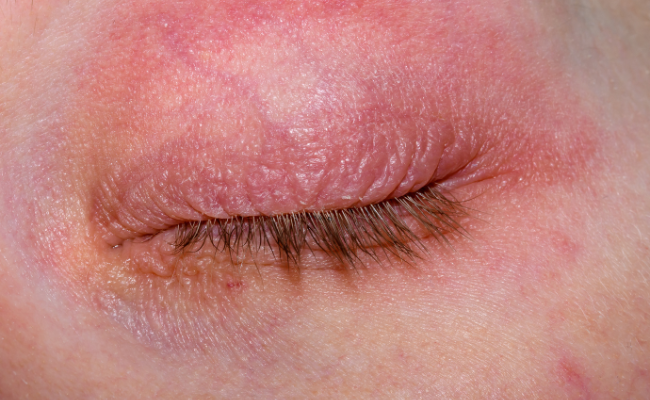
Eyelid contact dermatitis is inflammation of the eyelid skin caused by contact with an allergen or an irritant, and it is a frequent cause of red, itchy, scaly lids.
The skin of the eyelids is the thinnest of the body and is easily damaged, so even a small amount of an allergen can cause a reaction.
Also, finding the offending agent is the key to cure.
Why Eyelid Contact Dermatitis Occurs
The eyelid skin is thin, has little protective keratin, and is frequently rubbed.
Many substances also reach it, some applied directly and others carried by the hands, by hair, or by the air.
The skin barrier is also easily damaged by rubbing, and a damaged barrier lets allergens and irritants penetrate more easily.
Doctors also classify contact dermatitis as irritant, caused by direct damage to the skin, and allergic, caused by a delayed immune reaction in a sensitized patient.
Common Causes
- Cosmetics: mascara, eyeliner, eyeshadow, and removers, with preservatives and fragrances as the main allergens
- Eye drops: neomycin and other antibiotics, benzalkonium chloride, brimonidine, atropine, and some glaucoma drops (see toxic epitheliopathy from preservatives)
- Metals: nickel in eyelash curlers, tweezers, and spectacle frames
- Nail polish and hair products: transferred to the lids by the hands, with resins and dyes as allergens
- Hair dye and other chemicals: paraphenylenediamine and related compounds
- Contact lens solutions and cleaning products
- Latex and rubber chemicals, and plants and airborne allergens
Frequent washing, makeup removers, eye rubbing, and exposure to wind and dry air may cause irritant dermatitis.
All-fit Slit-Lamp Adapter
Record and share exactly what you see at the slit lamp. One adapter fits any slit lamp or surgical microscope — and any smartphone.
From Choroida — the team behind this siteClinical Features of Eyelid Contact Dermatitis
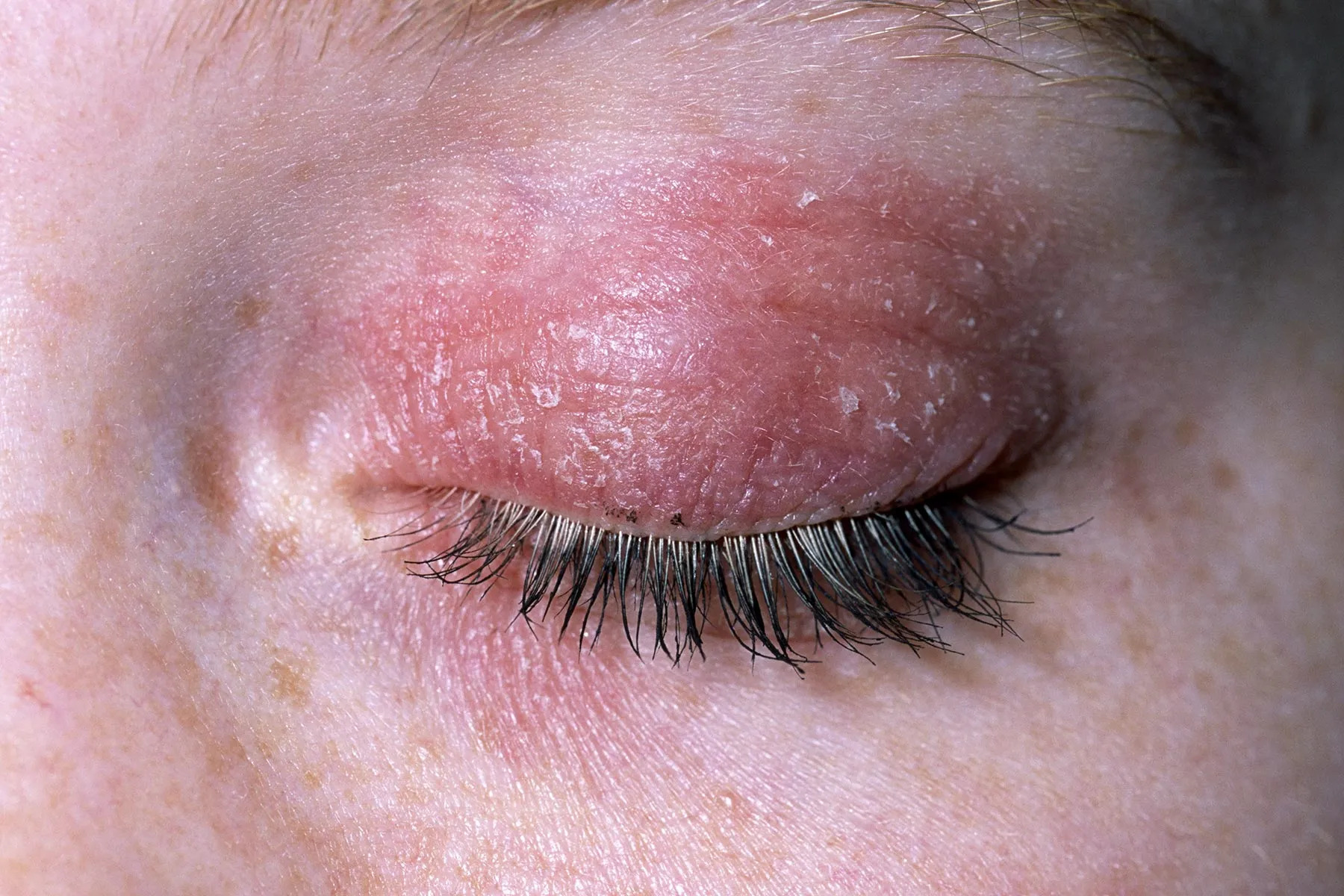
- Itching, redness, scaling, and swelling of the lids, often bilateral
- Thickened, fissured, or lichenified skin in chronic cases
- Eczematous vesicles or weeping in acute allergic reactions
- Involvement of the lids with sparing of the lid margin in many cases
- Symptoms that follow exposure and improve when the allergen is removed
The pattern gives clues: products carried by the hands may cause dermatitis on the upper lids, and contact with drops on the lower lid.
Differential Diagnosis of Eyelid Contact Dermatitis
- Atopic dermatitis, often with lesions elsewhere and a history of eczema
- Seborrheic dermatitis and blepharitis, with greasy scaling at the lashes (see blepharitis)
- Rosacea, with telangiectasia and papules
- Herpes zoster and herpes simplex, with vesicles in a distribution along a dermatome (see herpes zoster ophthalmicus)
- Dermatomyositis and angioedema, with different features
- Preseptal cellulitis and other infections (see preseptal cellulitis)
Evaluation for Eyelid Contact Dermatitis
Take a detailed history of all products used on the face, the hair, and the eyes, including drops, cosmetics, and occupational exposures.
Also, look at the pattern of skin involvement, and at the rest of the skin.
Patch testing identifies the allergen in allergic contact dermatitis, with a standard series and the patient’s own products when needed.
Dermatologists also perform it and read it at 48 and 96 hours.
Treatment
- Remove the cause: stop all suspected products and change to hypoallergenic ones
- Cool compresses for acute weeping lesions
- Topical corticosteroids, of low potency, for a short period on the thin skin, to avoid atrophy and glaucoma
- Topical calcineurin inhibitors, such as tacrolimus or pimecrolimus, as steroid-sparing agents for chronic cases
- Emollients and barrier protection, with fragrance-free products
- Oral antihistamines for itching, and oral steroids only for severe cases
- Treat infection if there are signs of secondary infection
Use preservative-free drops when you suspect drop allergy, and review the glaucoma or dry eye regimen.
Counselling
Explain that identification of the cause is the key and that avoidance prevents recurrence.
Also, advise a simple routine: avoid eye makeup during the recovery, wash with mild cleansers, and avoid rubbing the eyes.
Refer to a dermatologist for patch testing when the cause is unclear or the dermatitis persists.
Practical Advice for Cosmetics
- Replace mascara and eyeliner every three months, and avoid sharing them
- Test new products on the forearm for a few days before applying to the lids
- Choose products labeled free of fragrance and with few preservatives
- Remove makeup gently, with a mild cleanser, and avoid rubbing
- Wash hands before touching the eyelids, since nail products and hair dye can be transferred
Eye Drop Allergy
Allergic reactions to topical drugs may appear weeks to years after starting the drug, and the first sign may be eyelid skin changes and conjunctival redness.
In addition, switch to preservative-free formulations or another active ingredient, and consider patch testing to identify the culprit.
Do not simply increase the dose of steroid, since this can mask the reaction and prolong the problem.
Keep a record of the products that the patient has stopped and of the response, because a clear improvement after removing an agent is itself strong evidence of the cause.
Remind patients that reactions can also develop to products used for years, so a long period of safe use does not exclude allergy.
For the latest studies, see the PubMed results for eyelid contact dermatitis.

Document what you see
Two smartphone imaging tools built for everyday clinic use — one for the slit lamp, one for the fundus.
From Choroida — the team behind this siteReferences
- Guin JD. Eyelid dermatitis: experience in 203 cases. J Am Acad Dermatol. 2002;47:755-765.
- Rietschel RL, Fowler JF Jr. Fisher’s Contact Dermatitis. 6th ed. BC Decker; 2008.
- Salmon JF. Kanski’s Clinical Ophthalmology: A Systematic Approach. 9th ed. Elsevier; 2020.
- American Academy of Ophthalmology. Basic and Clinical Science Course, Section 7: Oculofacial Plastic and Orbital Surgery. AAO; current edition.

Writes and reviews the clinical articles on Educate. Every post is checked against peer-reviewed sources before it goes live.