
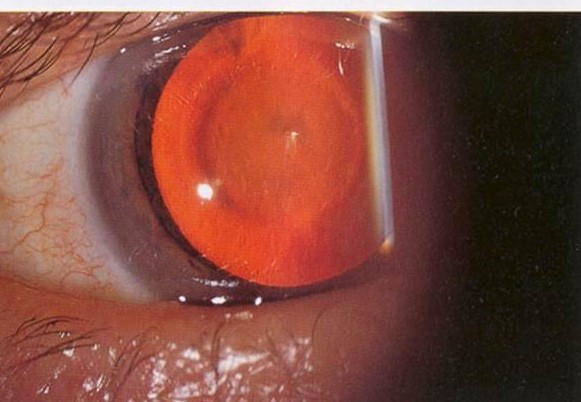
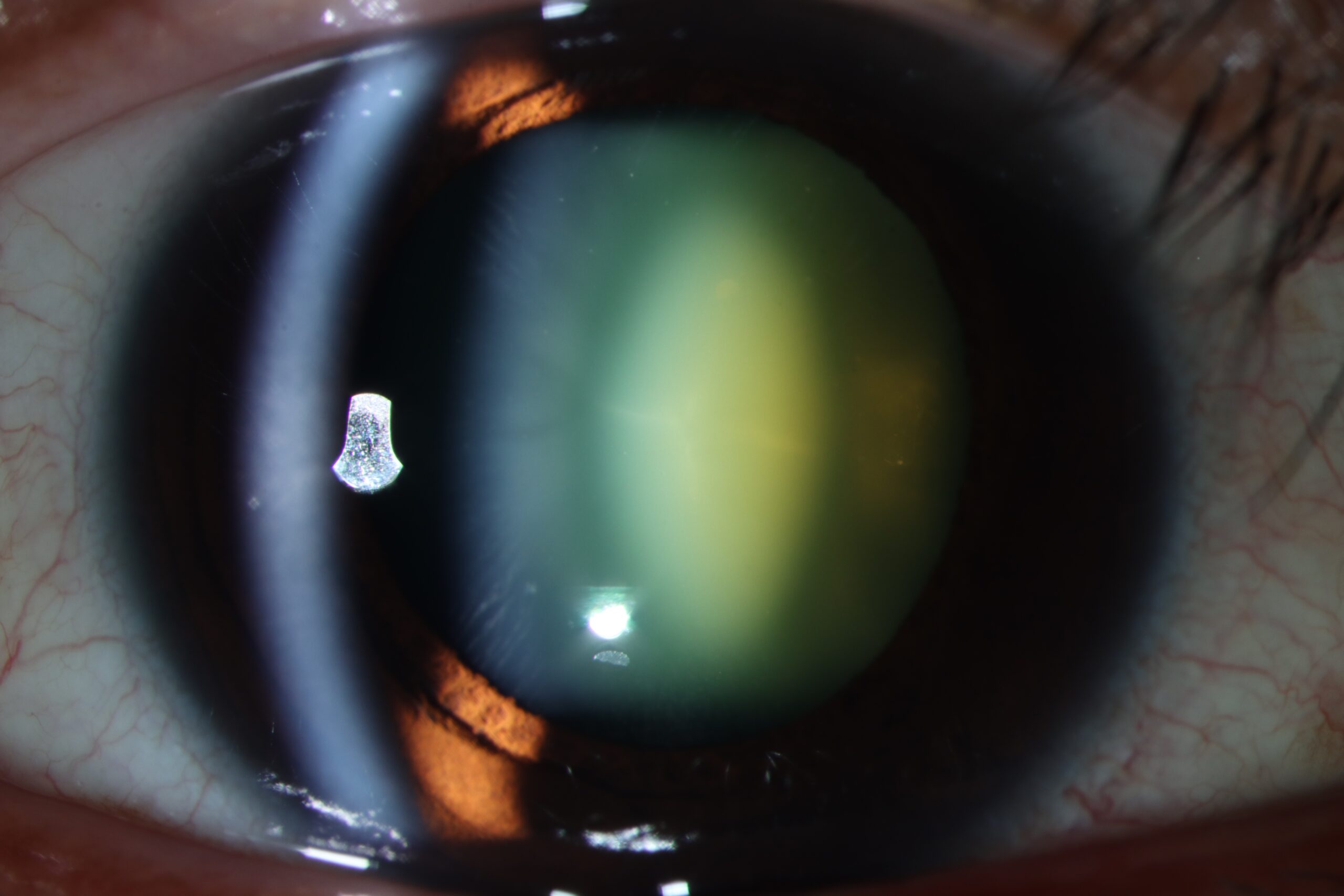
An oil-droplet cataract is a central opacity in the lens of an infant, so named because on retroillumination it looks like a drop of oil in water, with a clear, shiny, convex outline.
It is one of the classic ocular signs of galactosemia, and one of the few cataracts in children that can regress when the underlying metabolic disorder is treated.
What causes it
Galactosemia is an inherited disorder of galactose metabolism.
In classic galactosemia, caused by galactose-1-phosphate uridyltransferase deficiency, and in galactokinase deficiency, galactose accumulates in the blood after milk is ingested.
In the lens, the enzyme aldose reductase converts galactose to galactitol, a sugar alcohol that cannot leave the cell.
Galactitol draws water into the lens fibers by osmosis, the fibers swell and rupture, and the lens becomes opaque.
The mechanism resembles what happens in diabetic cataract, in which sorbitol accumulates in the lens (see snowflake cataract).
How it appears
- A central, round, translucent area in the nucleus, with a shiny rim that stands out against the red reflex
- It can be seen in the first weeks of life and may be bilateral
- Parents may notice that the pupil looks gray, or an infant may fail to fixate
- With time, if the diet is not corrected, the opacity spreads and becomes a dense nuclear or lamellar cataract
All-fit Slit-Lamp Adapter
Record and share exactly what you see at the slit lamp. One adapter fits any slit lamp or surgical microscope — and any smartphone.
From Choroida — the team behind this siteAssociated findings
Classic galactosemia is a life-threatening disease in the newborn, with vomiting, jaundice, poor feeding, hepatomegaly, sepsis (especially due to E. coli), and failure to thrive.
Many countries screen newborns for it.
Galactokinase deficiency usually causes cataract alone, without the severe systemic illness, so a child with cataract and no other findings can be the first presentation.
Diagnosis
- Red-cell galactose-1-phosphate uridyltransferase assay
- Urine tested for reducing substances, which will be positive for galactose and negative on a glucose-specific dipstick
- Measurement of erythrocyte galactokinase in suspected deficiency
- DNA analysis for the common mutations
A child with a new cataract in infancy should have metabolic testing, as well as screening for infection, trauma, and genetic causes (see leukocoria differential).
Treatment
The key step is immediate removal of galactose and lactose from the diet.
Infants are placed on soy-based or elemental formula, and the diet is continued for life.
When the diagnosis is made in the first weeks of life and the diet is strict, early lens changes can clear completely, and surgery may be avoided.
Once the lens has become dense, cataract extraction is needed, with the usual management of amblyopia.
What the parents are told
Parents of an infant with a new cataract are understandably anxious. Explain that cataract in a baby has several causes, that a blood and urine test will look for a metabolic one, and that galactosemia, if present, can be treated with diet. Emphasize that a test result may take a few days, and that the baby should be switched to a lactose-free formula as soon as the diagnosis is suspected and until the result is known, in consultation with the pediatric team.
Follow-up of the lens
After dietary correction, review the lens regularly. Early opacities may clear within weeks. Dense opacities that remain need surgery, and the timing should be set by the visual axis involvement and by the child's general condition. Amblyopia treatment begins as soon as the optical situation is clear.
Lifelong issues
Even with careful diet, some patients develop problems such as learning difficulties, speech disorders, and ovarian insufficiency in girls. The ophthalmologist is part of a team and should know the child's general medical plan, because the eye findings can be the first step in getting a child to the right specialist.
Other metabolic and genetic causes of infant cataract
When a baby has cataract, consider galactosemia, hypoglycemia, hypocalcemia, Lowe syndrome, Alport syndrome, and chromosomal syndromes. Intrauterine infections such as rubella, cytomegalovirus, and toxoplasmosis are also on the list. A pediatrician and, where available, a metabolic specialist should be involved from the start, because the cataract may be the first sign of a treatable systemic disease (see leukocoria differential).
Why speed matters
Dietary treatment is most effective when started in the first days of life, before the lens has been injured over weeks. For this reason, do not wait for a surgical date before arranging the metabolic work-up.
Prognosis
Visual prognosis is very good when the diagnosis is early and compliance is good.
Even so, long-term complications of classic galactosemia, such as speech delay, learning difficulty, and ovarian insufficiency, persist in many patients despite diet, so the ophthalmologist’s role is to help make the diagnosis and then support multidisciplinary follow-up.

Document what you see
Two smartphone imaging tools built for everyday clinic use — one for the slit lamp, one for the fundus.
From Choroida — the team behind this siteReferences
- Kinoshita JH. Cataracts in galactosemia. The Jonas S. Friedenwald Memorial Lecture. Invest Ophthalmol. 1965;4:786-799.
- Segal S, Berry GT. Disorders of galactose metabolism. In: Scriver CR, et al., eds. The Metabolic and Molecular Bases of Inherited Disease. 8th ed. New York: McGraw-Hill; 2001:1553-1587.
- Bosch AM. Classical galactosaemia revisited. J Inherit Metab Dis. 2006;29:516-525.
- Berry GT. Classic galactosemia and clinical variant galactosemia. GeneReviews. Seattle: University of Washington; 2000 [updated 2021].
