
Case Study
A 24-year-old woman with a ten-year history of poorly controlled Type 1 diabetes mellitus presented with complaints of progressively worsening blurred vision and glare sensitivity over three months.
She reported difficulties in recognizing faces and reading, significantly impacting her daily life. Her blood glucose levels had been erratic, with a recent HbA1c of 12%.
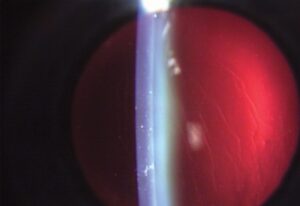
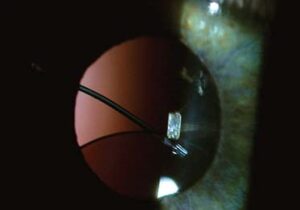
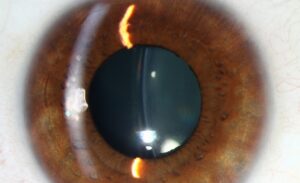
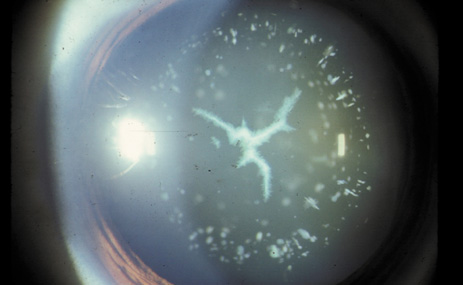
On examination, bilateral snowflake-like opacities were observed in the lens cortex on slit-lamp examination. Fundoscopy revealed no diabetic retinopathy.
Optical coherence tomography (OCT) of the retina was normal. Given the rapid progression of her visual symptoms, cataract surgery with intraocular lens implantation was performed.
Postoperatively, her uncorrected visual acuity improved to 20/20 in both eyes. She was referred to a diabetologist for better glycemic control.
Disease entity
Snowflake cataract is a rare and visually significant lens opacity primarily seen in young individuals with poorly controlled diabetes mellitus.
First described in the 19th century, it is characterized by its distinct snowflake-like appearance within the cortical layers of the lens.
The condition is notable for its rapid progression compared to other forms of cataracts.
Unlike age-related cataracts, snowflake cataracts are closely tied to systemic hyperglycemia, making their management dependent not only on surgical intervention but also on stringent diabetic control.
The condition emphasizes the interplay between systemic metabolic dysfunction and ocular health.
All-fit Slit-Lamp Adapter
Record and share exactly what you see at the slit lamp. One adapter fits any slit lamp or surgical microscope — and any smartphone.
From Choroida — the team behind this sitePathophysiology
The pathogenesis of snowflake cataracts revolves around the biochemical effects of hyperglycemia on the lens:
- Polyol Pathway Activation
- Glucose enters the lens via facilitated diffusion and is converted into sorbitol by aldose reductase.
- Sorbitol, being osmotically active and poorly diffusible, accumulates within the lens, leading to water influx and osmotic stress.
- Oxidative Stress
- Chronic hyperglycemia results in the generation of reactive oxygen species (ROS).
- ROS causes oxidative damage to lens proteins and lipids, leading to structural instability and cataract formation.
- Protein Denaturation and Aggregation
- High glucose concentrations disrupt lens protein folding, resulting in aggregation and opacification.
- Lens Metabolism Disruption
- Hyperglycemia alters the ionic and metabolic balance of lens fibers, exacerbating damage and opacity formation.
Epidemiology
- Incidence and Prevalence:
Snowflake cataracts are rare and primarily seen in young patients with uncontrolled Type 1 or Type 2 diabetes. - Geographic and Ethnic Variability:
The condition is reported globally but may be more frequently observed in regions with limited access to healthcare or insulin therapy. - Risk Factors:
- Poor glycemic control (HbA1c >9%)
- Duration of diabetes, especially in juvenile-onset cases
- Lack of timely diabetes management or education
Clinical Features
Snowflake cataracts present with the following symptoms and signs:
- Symptoms:
- Progressive, bilateral visual impairment
- Increased sensitivity to bright light and glare
- Difficulty with near and distance vision
- Rapid onset of visual symptoms compared to age-related cataracts
- Signs:
- Slit-Lamp Examination:
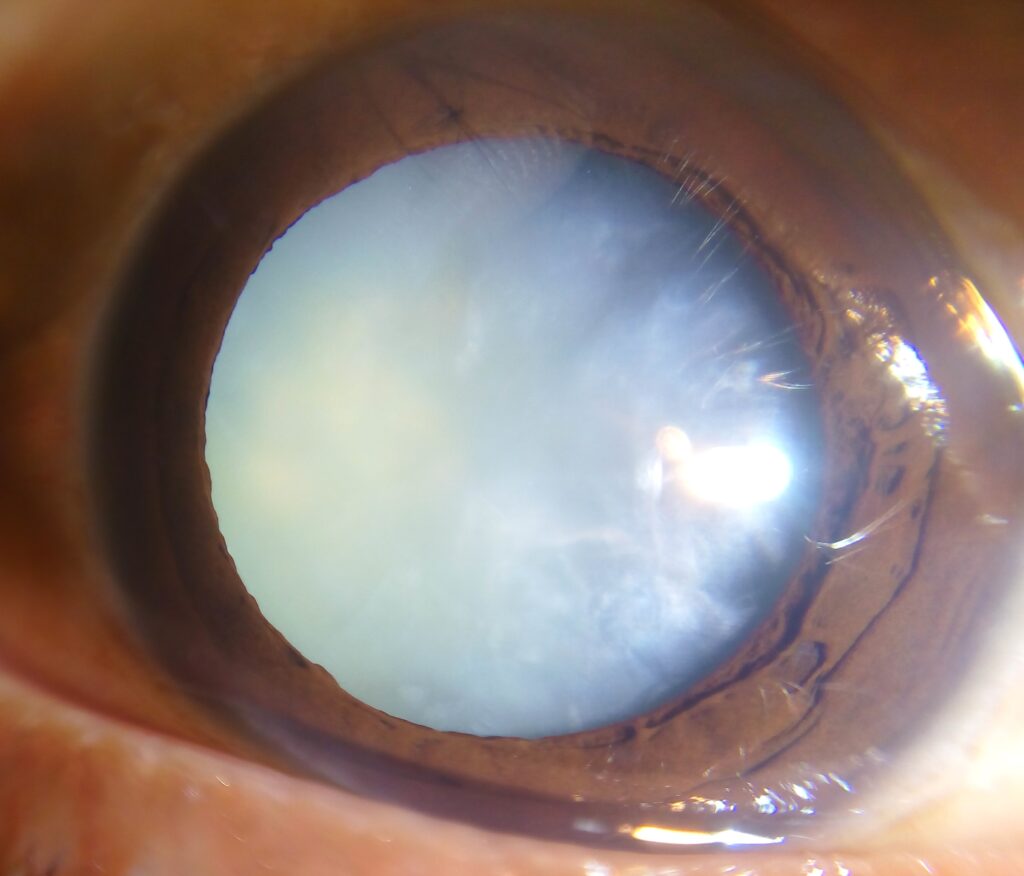
- Multiple snowflake-shaped opacities scattered in the lens cortex
- White or gray opacities with a crystalline appearance
- Fundoscopy:
- Typically normal unless coexisting diabetic retinopathy is present
- Slit-Lamp Examination:
Examination Findings
- Visual Acuity Testing: Reduced bilateral acuity proportional to the cataract severity
- Slit-lamp Biomicroscopy: Distinctive snowflake-shaped opacities localized in the cortical region of the lens
- Additional Testing:
- Optical Coherence Tomography (OCT) to rule out diabetic macular edema
- Fundus photography to evaluate for diabetic retinopathy
Differential Diagnosis
- Age-related cortical cataracts
- Diabetic myopia (due to lens swelling)
- Posterior subcapsular cataracts (seen in diabetes)
- Christmas tree cataract
- Drug-induced cataracts (e.g., steroids)
Diagnosis
The diagnosis of snowflake cataract is clinical, relying on slit-lamp findings in a patient with poorly controlled diabetes. Supporting diagnostic measures include:
- Blood glucose and HbA1c testing to confirm poor glycemic control
- Exclusion of other causes of cortical lens opacities
Management
Treatment strategies for snowflake cataracts focus on improving vision through surgical and medical interventions:
- Surgical Management:
- Phacoemulsification with intraocular lens implantation is the definitive treatment.
- Early surgical intervention is often necessary due to the rapid progression of lens opacities.
- Diabetes Management:
- Intensive blood glucose control through insulin or oral hypoglycemic agents
- Dietary modifications and lifestyle changes
- Regular endocrinology follow-ups
- Patient Education:
- Emphasis on the importance of diabetes management to prevent recurrence
- Awareness about potential long-term complications such as retinopathy
- Postoperative Care:
- Monitoring for surgical complications such as posterior capsule opacification (PCO)
- Regular screening for diabetic retinopathy
Prognosis
Patients with snowflake cataracts typically experience excellent visual recovery after cataract surgery, provided diabetes is well-managed.

However, continued poor glycemic control may lead to recurrence or other ocular complications, such as diabetic retinopathy or macular edema.
Related Reading

Document what you see
Two smartphone imaging tools built for everyday clinic use — one for the slit lamp, one for the fundus.
From Choroida — the team behind this siteReferences
- Kinoshita, J. H. (1990). Mechanisms initiating cataract formation: Proctor Lecture. Investigative Ophthalmology & Visual Science, 31(5), 891-899.
- Brownlee, M. (2001). Biochemistry and molecular cell biology of diabetic complications. Nature, 414(6865), 813-820.
- Jeon, S., Lee, W. K., & Kim, Y. J. (2018). Outcomes of cataract surgery in young diabetic patients with snowflake cataracts. American Journal of Ophthalmology, 186, 97-103.
- Pollreisz, A., & Schmidt-Erfurth, U. (2010). Diabetic cataract—pathogenesis, epidemiology, and treatment. Journal of Ophthalmology, 2010, 608751.
- Jonas, J. B., & Panda-Jonas, S. (2014). Diabetes mellitus and cataract: Progression and management. Ophthalmology Clinics of North America, 27(4), 399-413.
- Spaide, R. F. (2018). Diabetic lens changes and their implications. Retina, 38(4), 708-716.
Test yourself
A few questions straight from this article.
-
Which patients typically develop a snowflake cataract?
Snowflake cataract is a rare lens opacity seen chiefly in young people with poorly controlled type 1 or type 2 diabetes, and it progresses faster than other cataracts. -
How does a snowflake cataract appear on slit-lamp examination?
The slit lamp shows multiple snowflake-shaped white or grey opacities with a crystalline appearance scattered through the lens cortex. -
Which enzyme drives the polyol pathway in snowflake cataract formation?
Glucose entering the lens is converted to sorbitol by aldose reductase; sorbitol is osmotically active and poorly diffusible, so it accumulates and draws in water, causing osmotic stress. -
How do reactive oxygen species contribute to snowflake cataract?
Chronic hyperglycaemia generates reactive oxygen species that damage lens proteins and lipids, producing the structural instability behind the opacity. -
Which HbA1c level is listed as a risk factor for snowflake cataract?
Poor glycaemic control with an HbA1c above 9% is a stated risk factor, together with duration of diabetes, especially juvenile-onset disease. -
How does snowflake cataract differ from an age-related cataract?
Unlike age-related cataract, snowflake cataract progresses rapidly and is closely tied to systemic hyperglycaemia, so management needs strict diabetic control as well as surgery. -
What does fundoscopy usually show in a patient with snowflake cataract?
Fundoscopy is typically normal unless diabetic retinopathy is also present; OCT is used to exclude diabetic macular oedema and fundus photography to look for retinopathy. -
What is the definitive treatment for snowflake cataract?
Phacoemulsification with intraocular lens implantation is the definitive treatment, and early surgery is often needed because the opacities progress so quickly. -
Which postoperative surveillance is needed after surgery for snowflake cataract?
Postoperative care means monitoring for surgical complications such as posterior capsule opacification and screening regularly for diabetic retinopathy. -
What visual outcome follows cataract surgery for snowflake cataract?
Patients typically achieve excellent visual recovery after cataract surgery provided the diabetes is well managed; persistent poor control invites further ocular complications.

Writes and reviews the clinical articles on Educate. Every post is checked against peer-reviewed sources before it goes live.