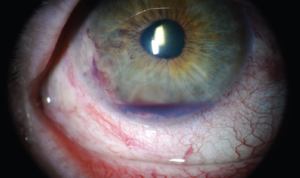
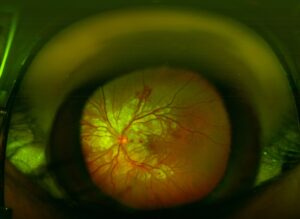
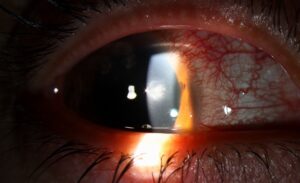
Superglue in eye exposure is a common eye emergency, usually from a mistaken bottle or a splash during repairs.
Cyanoacrylate glue sets within seconds and can bond the eyelids together.
However, permanent damage is uncommon when first aid is calm and correct.
What Happens With Superglue in Eye
Cyanoacrylate polymerizes when it touches water or moisture.
Therefore, it hardens quickly on the moist lid margin and lashes.
The tear film also limits firm bonding to the cornea and conjunctiva.
As a result, the glue usually forms loose clumps on the ocular surface.
These hard fragments act like a foreign body and can scratch the epithelium.
How Exposure Usually Occurs
Many glue tubes look like eye drop or contact lens solution bottles.
For example, patients may instill glue at night, believing it is a lubricant.
Children also reach glue during crafts or household repairs.
In addition, nail glue used for artificial nails is a frequent source.
All-fit Slit-Lamp Adapter
Record and share exactly what you see at the slit lamp. One adapter fits any slit lamp or surgical microscope — and any smartphone.
From Choroida — the team behind this siteSymptoms Patients Report
Most patients describe sudden stinging, tearing and an inability to open the eye.
Then foreign body sensation follows as the glue hardens.
Blurred vision often reflects tear film disruption or a corneal abrasion.
Severe pain, however, should raise concern for a larger epithelial defect.
Immediate First Aid for Superglue in Eye
First, wash the eye gently with lukewarm water or saline.
Next, hold a warm, damp cloth over the closed lids for several minutes.
Then seek eye care the same day, especially if the eye hurts (see ocular first aid).
What Not to Do With Superglue in Eye
- Never pull the eyelids apart by force
- Avoid cutting lashes with scissors near the eye at home
- Keep acetone, nail polish remover and other solvents away from the eye
- Do not rub the eye or press on the globe
- Skip tight patching before an examination
Separating Glued Eyelids in Clinic
Bonded lids usually open on their own within a few days as the lashes shed glue.
However, clinicians can speed separation with warm compresses and gentle traction.
Ophthalmic ointment along the lid margin also helps loosen the bond.
Trimming the lashes close to the glue line can free the lids quickly.
Examining the Eye After Exposure
Once the lids open, examine the eye at the slit lamp.
Check visual acuity first, then evert both upper lids.
Hard glue often hides in the upper fornix or along the tarsal plate.
Then stain with fluorescein and look for linear or geographic defects.
Corneal Abrasion and Superglue in Eye
Abrasion is the most common injury after glue exposure.
Poison center data suggest that hardened fragments rubbing the cornea cause most of these defects.
Treat it like any traumatic abrasion with lubricant and antibiotic ointment (see corneal abrasion).
Most defects heal within a few days.
Removing Glue From the Ocular Surface
Lift loose fragments with a moistened cotton tip or fine forceps.
However, avoid peeling glue firmly attached to the cornea.
The epithelium often sheds bonded glue as it turns over.
Therefore, patience protects the cornea better than aggressive removal.
Medical Glue Versus Household Superglue
Ophthalmologists use cyanoacrylate tissue adhesive deliberately to seal small corneal perforations.
Surgeons apply that product to a dried surface under controlled conditions (see glue for corneal perforation).
Household glue, by contrast, contains additives and is not sterile.
The chemical family is similar, yet the clinical context differs completely.
Chemical Toxicity Concerns
Cyanoacrylate does not behave like an alkali or acid burn.
Therefore, it rarely causes the limbal ischemia seen with chemical injuries.
Still, check pH if the label is unclear or another chemical was involved.
Irrigate until pH normalizes when doubt exists.
Superglue in Eye in Children
Young children cannot describe symptoms well and often resist examination.
As a result, the clinician may need a calm approach, topical anesthetic and a second attempt.
Also check for glue on the hands, lips and face.
Follow-Up After Superglue in Eye
Review patients with abrasions within one to two days.
Then confirm epithelial healing and the absence of infiltrate.
Residual glue on the lashes usually falls away within days.
New pain, discharge or reduced vision needs urgent review.
Prognosis
Most eyes recover fully without lasting visual loss.
Published case reports describe good outcomes with conservative care.
However, infection of an untreated abrasion can threaten vision.
Therefore, early examination still matters even when symptoms settle.
Counseling the Patient
Reassure the patient that the glue will release with time.
Explain why forcing the lids open can tear lashes and skin.
In addition, advise storing glue away from eye drops and medicines.
Separate storage reduces the risk of a repeat error.
Preventing Superglue in Eye Accidents
Keep glue in its original packaging, out of children’s reach.
Wear eye protection during repairs and nail work.
Also, never transfer glue into small dropper bottles.
Read the label before every eye drop instillation, especially at night.
For the latest studies, see the PubMed results for superglue in eye.


Document what you see
Two smartphone imaging tools built for everyday clinic use — one for the slit lamp, one for the fundus.
From Choroida — the team behind this siteReferences
- Dean BS, Krenzelok EP. Cyanoacrylates and corneal abrasion. J Toxicol Clin Toxicol. 1989;27:169-172.
- McLean CJ. Ocular superglue injury. J Accid Emerg Med. 1997;14:40-41.
- Bowling B. Kanski’s Clinical Ophthalmology: A Systematic Approach. 8th ed. Elsevier; 2016.
- American Academy of Ophthalmology. Basic and Clinical Science Course, Section 8: External Disease and Cornea. San Francisco: AAO; latest edition.

Writes and reviews the clinical articles on Educate. Every post is checked against peer-reviewed sources before it goes live.