
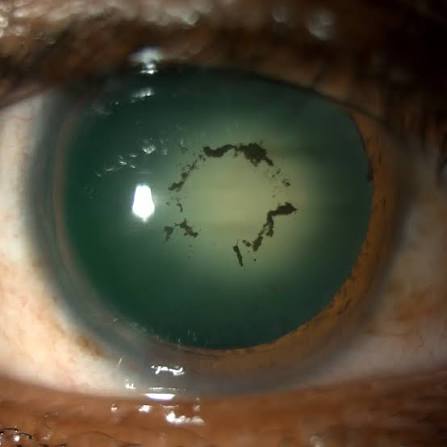
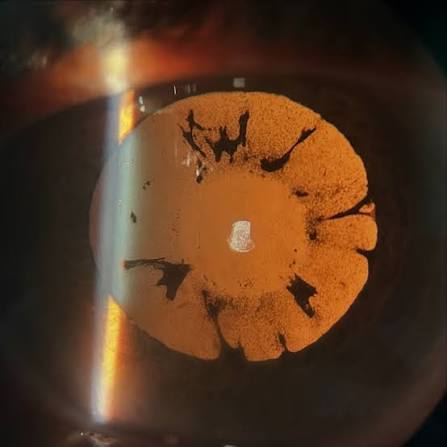
A Vossius ring is a small, circular imprint of iris pigment left on the anterior lens capsule at the precise moment of blunt ocular trauma, and finding this subtle ring during examination is essentially a fingerprint of the injury itself, confirming that the iris and lens made direct, forceful contact at the instant of impact and prompting a specifically thorough search for the other, potentially more visually significant injuries that so often travel alongside it.
How the Ring Actually Forms
At the moment of blunt trauma, the sudden anteroposterior compression of the globe can force the iris posteriorly against the anterior lens capsule with enough force to transfer pigment directly from the posterior iris pigment epithelium onto the capsule surface, leaving behind a ring or partial ring corresponding exactly to the pupillary margin’s position at the instant of contact.
Clinical Appearance
- A faint, circular or partial-circular ring of brown to gray pigment deposited on the anterior lens capsule, generally corresponding in size and position to the pupillary margin
- Typically found centrally or paracentrally on the lens, directly reflecting where the pupil margin contacted the capsule during the traumatic compression
- Usually does not affect vision itself, given its typically faint, thin, and often incomplete nature, remaining more of a diagnostic marker than a visually significant lens change
- Can fade gradually over subsequent weeks to months as the pigment is slowly cleared or dispersed
All-fit Slit-Lamp Adapter
Record and share exactly what you see at the slit lamp. One adapter fits any slit lamp or surgical microscope — and any smartphone.
From Choroida — the team behind this siteWhy Its Presence Matters Beyond Itself
A Vossius ring, in isolation, is visually insignificant and requires no treatment, but its real clinical value lies in what it confirms: that a genuine, forceful blunt impact occurred with enough energy to compress the globe and force direct iris-lens contact, which should prompt a specifically thorough search for the range of other injuries that commonly accompany this same mechanism and degree of force.
Associated Injuries to Actively Search For
- Traumatic mydriasis or iris sphincter tears, from the same compressive force acting on the iris directly (see iris sphincter tear)
- Angle recession, from the same blunt compressive mechanism affecting the anterior chamber angle and ciliary body, carrying a delayed glaucoma risk that can manifest years later (see angle recession glaucoma)
- Lens subluxation, if the same traumatic force was sufficient to also disrupt zonular support (see lens subluxation clinical signs)
- Traumatic cataract, which can develop acutely or with delayed onset following the same injury
- Commotio retinae or other posterior segment traumatic findings, given that the same compressive force transmitted through the globe can also affect the retina
- Hyphema, from disruption of iris or angle blood vessels at the time of impact
Clinical Evaluation
- A complete anterior segment examination, including careful assessment of the lens capsule for a Vossius ring, the iris for sphincter tears or transillumination defects, and gonioscopy to assess for angle recession
- Assessment of lens stability (looking for phacodonesis) and clarity, given the associated risks of subluxation and traumatic cataract
- A thorough dilated fundus examination to assess for any posterior segment traumatic findings, once anterior segment examination is complete and permits adequate dilation
- Intraocular pressure measurement, both at the time of initial injury and with a clear plan for long-term monitoring given the delayed glaucoma risk associated with angle recession
Management
The Vossius Ring Itself
No treatment is directed at the ring itself, since it is a benign, typically fading pigment deposit without independent visual significance.
Associated Injuries
Management is directed entirely at whatever associated injuries are identified on the complete examination that a Vossius ring should prompt, following the standard, specific management approach appropriate to each: glaucoma surveillance for angle recession, surgical planning adjustments for lens subluxation, and standard traumatic cataract management when a visually significant cataract develops.
Long-Term Follow-Up
Given the association with angle recession and its delayed glaucoma risk, any patient found to have a Vossius ring, confirming significant blunt trauma, warrants counseling about the importance of long-term, sustained follow-up for glaucoma surveillance, even once the acute injury has fully settled and the eye appears otherwise entirely quiet.
Prognosis
The Vossius ring itself carries an excellent prognosis and fades over time without consequence.
The overall visual prognosis following the traumatic event depends entirely on the presence, severity, and management of the associated injuries the ring should prompt a clinician to specifically search for, which is precisely why this small, easily overlooked pigment ring deserves more clinical attention than its own minimal visual significance would otherwise suggest.
Document what you see
Two smartphone imaging tools built for everyday clinic use — one for the slit lamp, one for the fundus.
From Choroida — the team behind this siteReferences
- Vossius A. Ein Pigmentring an der vorderen Linsenkapsel. Klin Monatsbl Augenheilkd. 1906;44:661.
- Sihota R, Sood NN, Agarwal HC. Traumatic glaucoma. Acta Ophthalmol Scand. 1995;73:252-254.
- Kanski JJ, Bowling B. Clinical Ophthalmology: A Systematic Approach. 7th ed. Edinburgh: Elsevier; 2011.
- Canavan YM, Archer DB. Anterior segment consequences of blunt ocular injury. Br J Ophthalmol. 1982;66:549-555.
