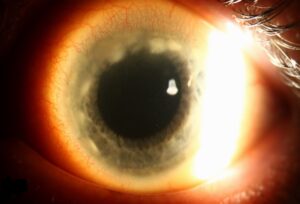
Cataract symptoms develop slowly, so many patients adapt without noticing.
Blur, glare and faded colors are common complaints.
Recognizing them early helps patients seek care in time.
What Causes Cataract Symptoms
The lens becomes cloudy with age, injury, steroids or disease.
Light scatters instead of focusing on the retina.
This lowers contrast and sharpness.
Therefore, symptoms depend on the type of cataract (see cortical cataract).
Blurred Vision
Vision becomes hazy, as if looking through a dirty window.
Glasses help less than before.
The blur is often worse in low light.
So frequent prescription changes are a clue.
All-fit Slit-Lamp Adapter
Record and share exactly what you see at the slit lamp. One adapter fits any slit lamp or surgical microscope — and any smartphone.
From Choroida — the team behind this siteGlare and Halos
Bright lights cause streaks and rings.
Night driving becomes harder.
Posterior subcapsular cataracts cause marked glare (see posterior subcapsular cataract).
Also ask about sensitivity to sunlight.
Faded Colors
Colors look dull and yellowed.
The change is slow, so patients may not notice.
After surgery, many are surprised by bright colors.
Therefore, ask about color comparisons between the eyes.
Second Sight
Some nuclear cataracts increase near vision temporarily.
Patients can read without glasses for a while.
Distance vision worsens at the same time.
So this change should not reassure the patient.
Double Vision in One Eye
Monocular diplopia can arise from lens changes.
The image doubles when the other eye is covered.
This points to an optical cause.
Also rule out cornea and retina problems.
Poor Night Vision
Contrast loss makes dim conditions hard.
Patients struggle with stairs and curbs.
They may stop driving after dark.
Therefore, ask about falls and accidents.
Cataract Symptoms in Children
Children rarely complain.
A white pupil, squint or poor tracking may be the clue (see congenital cataract).
Early treatment prevents amblyopia.
So refer infants quickly.
Other Causes of Similar Symptoms
Dry eye, macular disease and glaucoma cause blur and glare.
A dilated exam separates them.
Do not label every complaint as cataract.
Therefore, examine the whole eye.
Symptoms From Medication
Steroids cause posterior subcapsular cataracts (see steroid induced cataract).
Other drugs may add to opacity.
Ask about steroid use in every patient.
Also review inhaled and topical steroids.
When to See a Doctor
See an eye doctor if vision interferes with daily tasks.
Seek urgent help for sudden loss, pain or a red eye.
Annual checks suit older adults.
So do not wait for severe symptoms.

What the Examination Shows
The doctor examines the lens at a slit lamp.
Cataract type and density are recorded.
Retinal health is assessed after dilation.
Therefore, the exam guides the plan.
Managing Cataract Symptoms Before Surgery
Updated glasses can help for a time.
Anti-glare coatings and good lighting also help.
Stop smoking and protect eyes from sunlight.
Also control diabetes.
Cataract Symptoms: Practical Summary
Ask about glare, night driving and color changes.
If symptoms limit function, discuss surgery.
Because other diseases mimic cataract, examine thoroughly.
Finally, reassure patients that surgery is safe.
Pitfalls to Avoid
- Do not assume blur is always cataract
- Never overlook sudden changes
- Avoid ignoring steroid exposure
- Do not forget to examine children
Cataract Symptoms and Daily Tasks
Reading menus, recognizing faces and judging steps can all become hard.
These tasks reveal the true effect on life.
Because acuity may look fine, ask about activities.
Therefore, base decisions on function.
Cataract Symptoms in Diabetes
Diabetes causes earlier and faster lens opacity.
Fluctuating glucose changes focus.
If vision varies day to day, check blood sugar.
Because retinopathy matters too, dilate and examine.
Cataract Symptoms and Sunlight
Strong light makes cataract symptoms worse.
Sunglasses and hats help outdoors.
Because ultraviolet light contributes to cataract, advise protection.
However, glasses do not reverse the opacity.
Cataract Symptoms and Eye Strain
Patients squint and strain to see.
Headaches and fatigue follow.
Because strain has other causes, check refraction and the surface.
So rule out dry eye and uncorrected error.
Cataract Symptoms: What to Expect From Surgery
Surgery removes the cloudy lens and places a clear one.
Most patients regain sharp, bright vision.
Because the eye may have other disease, outcomes vary.
Therefore, check the macula first.
Cataract Symptoms: Patient Questions
Patients ask whether eye drops can dissolve a cataract.
No drop has proved effective, and surgery is the only cure.
They also ask whether the cataract can come back.
The lens cannot regrow, but the capsule can cloud later.
Cataract Symptoms: When Surgery Helps Most
Surgery helps most when symptoms limit reading, driving or safety.
If the retina is healthy, the results are excellent.
Because the operation is short, recovery is quick.
Therefore, discuss it once symptoms affect daily life.
For the latest studies, see the PubMed results for cataract symptoms.


Document what you see
Two smartphone imaging tools built for everyday clinic use — one for the slit lamp, one for the fundus.
From Choroida — the team behind this siteReferences
- Liu YC, Wilkins M, Kim T, Malyugin B, Mehta JS. Cataracts. Lancet. 2017;390:600-612.
- Miller KM, Oetting TA, Tweeten JP, et al. Cataract in the adult eye preferred practice pattern. Ophthalmology. 2022;129:P1-P126.
- Congdon N, Vingerling JR, Klein BE, et al. Prevalence of cataract and pseudophakia/aphakia among adults in the United States. Arch Ophthalmol. 2004;122:487-494.
- Asbell PA, Dualan I, Mindel J, Brocks D, Ahmad M, Epstein S. Age-related cataract. Lancet. 2005;365:599-609.

Writes and reviews the clinical articles on Educate. Every post is checked against peer-reviewed sources before it goes live.