Glaucoma risk factors help decide who needs screening and who needs treatment.
Some factors cannot change, such as age and genes.
Others, like pressure, can be treated.
Why Glaucoma Risk Factors Matter
Glaucoma damages the optic nerve slowly and silently.
Risk factors identify patients who deserve closer care.
They also help set the pace of follow-up.
Therefore, record them in every glaucoma chart.
Age
The risk rises sharply after the age of 60.
Prevalence doubles with each decade in some groups.
Older nerves also tolerate pressure less well.
So screen older adults regularly.
All-fit Slit-Lamp Adapter
Record and share exactly what you see at the slit lamp. One adapter fits any slit lamp or surgical microscope — and any smartphone.
From Choroida — the team behind this siteIntraocular Pressure
Higher pressure is the strongest modifiable risk factor.
The OHTS and EMGT trials showed that lowering it reduces progression.
However, many patients with glaucoma have normal readings (see normal-tension glaucoma).
Therefore, pressure is only one part of the picture.
Family History
Close relatives of patients have a higher risk of glaucoma.
The Baltimore Eye Survey found a several-fold increase in siblings.
Multiple genes contribute to this risk.
So ask every patient about affected relatives.
Race and Ethnicity
People of African ancestry have more open-angle disease and earlier onset.
Asian populations have more angle-closure disease.
Hispanic populations also show higher rates in some studies.
Also remember that risk differs by subtype.
Thin Central Cornea
Thin corneas predict conversion from ocular hypertension to glaucoma.
This may reflect biology as well as measurement.
Measure thickness at the first visit.
Therefore, interpret pressure with the thickness in mind.
Myopia
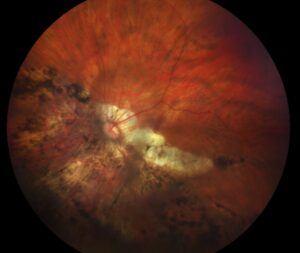
High myopia increases the risk of open-angle glaucoma.
The optic discs are often tilted, which makes diagnosis harder.
OCT and fields are useful in these eyes.
So watch myopic patients carefully.
Optic Disc Features
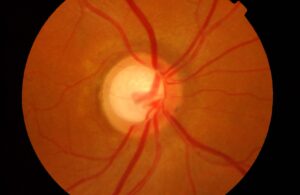
A large cup, asymmetry and disc hemorrhage are risk markers.
Disc hemorrhages often precede field loss.
Document them with photographs.
Also act when you see one.
Systemic Factors
Diabetes, hypertension and low blood pressure all interact with glaucoma risk.
Sleep apnea has been linked to glaucoma in several studies.
Evidence for each factor varies.
Therefore, treat these conditions for their own sake and watch the nerve.
Medications
Long-term steroids raise pressure in susceptible people (see steroid-induced glaucoma).
Anticholinergic drugs can trigger angle closure in narrow angles.
Review the drug list at each visit.
So adjust therapy when risk rises.
Pseudoexfoliation and Pigment Dispersion
Pseudoexfoliation increases pressure and the speed of progression.
Pigment dispersion affects young myopic men.
Examine the lens surface and iris for deposits.
Therefore, look for secondary causes (see pseudoexfoliation syndrome).
Using Glaucoma Risk Factors in Practice
Combine factors to estimate risk.
Patients with many factors need closer follow-up.
Risk calculators exist but are not used everywhere.
Also remember that absence of risk factors does not exclude disease.
Counseling Patients
Explain which factors apply to them.
Encourage relatives to be examined.
Discuss the factors that can be controlled.
So patients feel involved in their care.
Glaucoma Risk Factors: Practical Summary
Record age, pressure, thickness, family history and race.
If several apply, shorten the follow-up interval.
Because risk changes over time, update the assessment.
Finally, never forget the angle.
Pitfalls to Avoid
- Do not rely on pressure alone
- Never skip the family history
- Avoid missing a thin cornea
- Do not forget to check medications
Glaucoma Risk Factors in Young Adults
Young adults seldom have glaucoma, but secondary forms occur.
Steroid use, trauma and pigment dispersion are examples.
Because the disease can be severe at this age, examine carefully.
Therefore, ask about injury and drug history.
Glaucoma Risk Factors and Sleep Apnea
Sleep apnea has been linked to open-angle glaucoma and normal-tension disease.
The mechanism may involve low oxygen and blood pressure swings.
If a patient snores and has glaucoma, ask about sleep.
Then refer for testing when suspicion is high.
Glaucoma Risk Factors That Can Be Changed
Pressure is the main target for treatment.
Controlling blood pressure and avoiding steroid overuse also help.
Because lifestyle can matter, encourage exercise and sleep.
However, drops remain the proven therapy.
Glaucoma Risk Factors and Screening Intervals
High-risk patients need closer follow-up.
If three or more factors apply, shorten the interval.
Because disease can progress silently, rely on the schedule.
Then reassess risk each year.
Glaucoma Risk Factors and Family Counseling
Relatives of patients often delay their own examinations.
Provide a leaflet for patients to share.
Because early detection saves vision, make the message simple.
Therefore, ask patients to bring relatives to the clinic.
Glaucoma Risk Factors: Research Gaps
Genetic testing is not yet part of routine practice.
Risk scores need validation in every population.
However, research continues to improve prediction.
So clinical judgment still guides care.
For the latest studies, see the PubMed results for glaucoma risk factors.


Document what you see
Two smartphone imaging tools built for everyday clinic use — one for the slit lamp, one for the fundus.
From Choroida — the team behind this siteReferences
- Tielsch JM, Katz J, Sommer A, Quigley HA, Javitt JC. Family history and risk of primary open angle glaucoma: the Baltimore Eye Survey. Arch Ophthalmol. 1994;112:69-73.
- Kass MA, Heuer DK, Higginbotham EJ, et al. The Ocular Hypertension Treatment Study: a randomized trial determines that topical ocular hypotensive medication delays or prevents the onset of primary open-angle glaucoma. Arch Ophthalmol. 2002;120:701-713.
- Leske MC, Heijl A, Hussein M, et al. Factors for glaucoma progression and the effect of treatment: the Early Manifest Glaucoma Trial. Arch Ophthalmol. 2003;121:48-56.
- Wiggs JL, Pasquale LR. Genetics of glaucoma. Hum Mol Genet. 2017;26:R21-R27.

Writes and reviews the clinical articles on Educate. Every post is checked against peer-reviewed sources before it goes live.