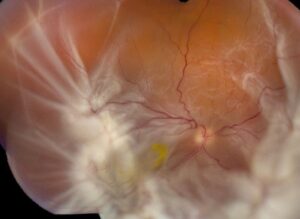
Hyperbaric oxygen for retinal artery occlusion supplies oxygen to the inner retina through a different route.
It raises the dissolved oxygen in plasma so that the choroid can feed the ischemic retina.
Therefore, it may bridge the time until the artery reopens.
Why Hyperbaric Oxygen for Retinal Artery Occlusion Is Considered
Central retinal artery occlusion cuts off the blood supply to the inner retina.
The outer retina still receives oxygen from the choroid, which is a separate circulation.
Also, at high pressure the dissolved oxygen can reach the inner layers by diffusion.
As a result, the treatment attempts to keep tissue alive during the ischemia.
How the Treatment Works
Patients breathe 100 percent oxygen at 2.0 to 2.4 atmospheres absolute.
Plasma oxygen rises many times above normal, and the oxygen tension in the choroid increases.
Also, the diffusion distance in the retina is short.
Therefore, the inner retina may receive a small supply until the clot moves.
Fundus Explorer Pro
Photograph the retinal findings described here with the phone already in your pocket — 22 D optics and built-in illumination in one handheld unit.
From Choroida — the team behind this siteTime Is the Limit
Experimental work shows irreversible damage after a few hours of complete ischemia.
Hyperbaric sessions are logistically complex and take time to arrange.
Also, a delay of many hours reduces the benefit.
Because of this, treatment should start within hours of onset.
Typical Protocol
Most centers give sessions of about 90 minutes, once or twice a day, for a few days.
The first session is the most important and should start as early as possible.
Also, some centers use a first session at 2.4 atmospheres followed by lower pressures.
In addition, treatment is repeated until vision stabilizes.
Evidence for Hyperbaric Oxygen for Retinal Artery Occlusion
Menzel-Severing and colleagues reported early hyperbaric treatment in nonarteritic central retinal artery occlusion.
Visual gains were more common in patients treated within about 12 hours.
Also, retrospective series report better outcomes than natural history in selected patients.
Therefore, the data are encouraging but come from uncontrolled work.
Cilioretinal Artery Sparing
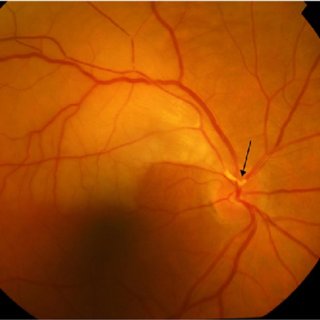
Eyes with a cilioretinal artery often show the best response.
The macula already has some perfusion, and oxygen may sustain it.
Also, such eyes keep better baseline vision than eyes without sparing.
As a result, selection bias can inflate the apparent benefit.
Guidelines on Hyperbaric Oxygen for Retinal Artery Occlusion
The Undersea and Hyperbaric Medical Society lists central retinal artery occlusion as an approved indication.
The American Heart Association statement discusses hyperbaric oxygen as an option in selected cases (see central retinal artery occlusion).
Also, access to a chamber is the main practical limit.
Therefore, check local availability.
Comparison with Thrombolysis
Thrombolysis aims to reopen the artery, and hyperbaric oxygen supports tissue in the meantime.
They are not exclusive, and some protocols combine them.
Also, thrombolysis follows a stroke pathway with a strict window (see thrombolysis for central retinal artery occlusion).
Therefore, do not delay thrombolysis to arrange a chamber.
Risks of Hyperbaric Oxygen for Retinal Artery Occlusion
Barotrauma of the ear and sinuses is the most common problem.
Myopic shift and cataract progression can occur with repeated courses.
Also, oxygen toxicity seizures are rare at these pressures.
In addition, claustrophobia limits some patients.
Selecting Patients for Hyperbaric Oxygen for Retinal Artery Occlusion
Consider the treatment in patients seen within a few hours with a clear onset.
Patients with a cilioretinal artery and severe vision loss from branch involvement are also candidates.
Also, exclude untreated pneumothorax and other contraindications.
Therefore, coordinate with a hyperbaric physician.
Systemic Care Still Comes First
Every patient needs a stroke workup and cardiovascular prevention.
Giant cell arteritis needs steroids at once in older patients.
Also, neither chamber access nor any local treatment replaces these steps.
As a result, hyperbaric oxygen should join, not replace, the standard pathway.
Pitfalls to Avoid
- Do not delay systemic workup to start hyperbaric oxygen
- Never promise recovery of vision
- Do not offer the treatment when the onset was more than a day ago without clear rationale
- Never forget the barotrauma risk
Practical Access
Few centers have a hyperbaric chamber near an eye clinic.
Transfer time can exceed the useful window.
Also, staff need training for emergency starts.
Therefore, build a pathway before you need it.
Counseling Patients
Explain that the treatment is supportive and not proven by randomized trials.
Describe the sessions and the possible ear discomfort.
Also, stress that vision may not return.
In addition, keep expectations realistic.
For the latest studies, see the PubMed results for hyperbaric oxygen for retinal artery occlusion.


Document what you see
Two smartphone imaging tools built for everyday clinic use — one for the slit lamp, one for the fundus.
From Choroida — the team behind this siteReferences
- Menzel-Severing J, Siekmann U, Weinberger A, Roessler G, Walter P, Mazinani B. Early hyperbaric oxygen treatment for nonarteritic central retinal artery obstruction. Am J Ophthalmol. 2012;153:454-459.
- Hayreh SS, Zimmerman MB. Central retinal artery occlusion: visual outcome. Am J Ophthalmol. 2005;140:376-391.
- Mac Grory B, Schrag M, Biousse V, et al. Management of central retinal artery occlusion: a scientific statement from the American Heart Association. Stroke. 2021;52:e282-e294.
- Moon RE, ed. Hyperbaric Oxygen Therapy Indications. 14th ed. Undersea and Hyperbaric Medical Society; 2019.

Writes and reviews the clinical articles on Educate. Every post is checked against peer-reviewed sources before it goes live.