Intravitreal methotrexate for PVR is an adjunct meant to stop scar formation after retinal detachment surgery.
Proliferative vitreoretinopathy causes most failures of primary repair.
Therefore, a drug that limits cell growth in the vitreous cavity has clear appeal.
What Proliferative Vitreoretinopathy Is
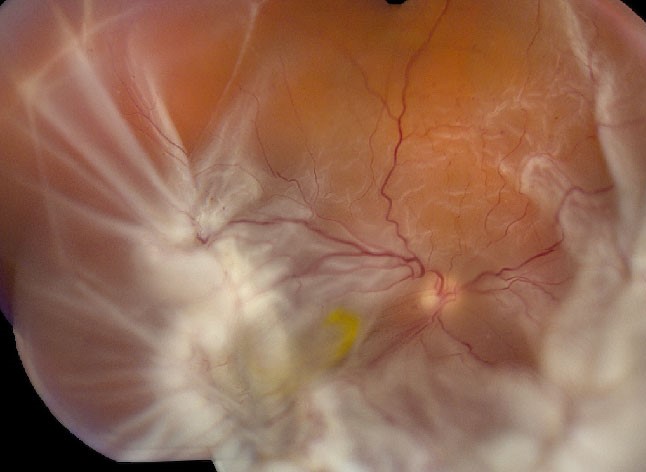
Retinal pigment epithelial cells, glial cells and fibroblasts grow as membranes on both retinal surfaces.
The membranes contract and pull the retina into folds.
Also, this process follows about 5 to 10 percent of repairs of rhegmatogenous detachment (see rhegmatogenous retinal detachment).
As a result, the detachment recurs despite a technically sound operation.
Risk Factors
Large or multiple breaks, vitreous hemorrhage and preoperative choroidal detachment raise the risk.
Giant tears, uveitis and prior surgery also add to it.
Also, cryotherapy and extensive laser can release cells into the vitreous.
Therefore, mark high-risk eyes before surgery.
Fundus Explorer Pro
Photograph the retinal findings described here with the phone already in your pocket — 22 D optics and built-in illumination in one handheld unit.
From Choroida — the team behind this siteWhy Intravitreal Methotrexate Is Used
Methotrexate blocks dihydrofolate reductase and slows DNA synthesis in dividing cells.
Cells in PVR proliferate quickly, so they are a natural target.
Also, the drug is stable and cheap, and clinicians know its systemic safety.
As a result, it became a leading candidate for intravitreal use.
Dose of Intravitreal Methotrexate in Published Series
Series used about 400 micrograms in 0.1 mL placed into the vitreous cavity.
Some gave the dose at the end of surgery and repeated it in the weeks after.
Also, regimens differ in the number and timing of injections.
In addition, some surgeons add the drug to the infusion or the tamponade.
Intravitreal Methotrexate for PVR in Silicone-Filled Eyes
Silicone oil does not stop PVR but may act as a barrier.
Hardwig and colleagues reported that methotrexate in silicone-filled eyes was well tolerated in a small series.
Also, the drug stays in the aqueous phase of the vitreous.
Therefore, the dose may act on the posterior hyaloid and the retinal surface.
Cohort Evidence for Intravitreal Methotrexate
Retrospective cohorts report lower rates of redetachment with methotrexate than with historical controls.
However, selection and surgeon effects limit these findings.
Also, outcome definitions vary between series.
As a result, such data suggest benefit but cannot prove it.
Randomized Evidence on Intravitreal Methotrexate
Randomized trials of intravitreal methotrexate for PVR are limited and the results are mixed.
A large phase 3 program tested repeated injections after surgery.
Also, earlier trials of other adjuncts gave conflicting results.
Because of this, routine use has not entered guidelines in most centers.
Other Adjuncts for Comparison
Trials of 5-fluorouracil with low-molecular-weight heparin showed a benefit in high-risk eyes but none in unselected eyes.
Triamcinolone helps visualize the vitreous and may reduce inflammation.
Also, oral or intravitreal retinoids and daunorubicin have been tried.
In addition, none has become standard care.

Toxicity of Intravitreal Methotrexate
Corneal epitheliopathy is the most frequent problem after repeated injections.
It usually settles with lubrication and a pause in the dose.
Also, retinal toxicity has not been a feature at the doses studied.
Therefore, monitor the corneal surface at each visit.
Selecting Eyes for Treatment
Consider the adjunct in eyes with grade C proliferative disease or a high-risk profile.
Repeat vitrectomy after failed surgery is a typical setting.
Also, patients should understand that the evidence is limited.
As a result, consent should state that use is off label in many regions.
Surgical Principles Still Matter
Careful removal of all membranes remains the foundation of PVR surgery.
Relaxing retinotomy and silicone oil are common choices in severe cases.
Also, complete vitreous removal lowers the cell load.
Therefore, no drug replaces meticulous technique.
Classification Guides the Plan
The 1991 Retina Society classification divides PVR into grades A, B and C.
Grade C involves full-thickness folds, with posterior and anterior types.
Also, the grade predicts the chance of reattachment.
In addition, document the grade in every operative note.
Postoperative Follow-Up
Check the eye weekly for the first month, then monthly.
Look for new membranes, folds at the vitreous base and macular puckering.
Also, assess the cornea if methotrexate was repeated.
Therefore, plan visits around the highest risk window of the first three months.
Counseling Patients
Explain that the detachment can return even after a good first operation.
Say that the adjunct may lower this risk but does not remove it.
Also, outline the chance of silicone oil and a second surgery.
In addition, document the discussion.
Pitfalls to Avoid
- Do not treat the adjunct as proof of success in every eye
- Never skip the corneal examination after repeated injections
- Do not forget to remove all membranes before relying on any drug
- Never use unverified dosing outside a protocol
For the latest studies, see the PubMed results for intravitreal methotrexate.


Document what you see
Two smartphone imaging tools built for everyday clinic use — one for the slit lamp, one for the fundus.
From Choroida — the team behind this siteReferences
- Machemer R, Aaberg TM, Freeman HM, Irvine AR, Lean JS, Michels RM. An updated classification of retinal detachment with proliferative vitreoretinopathy. Am J Ophthalmol. 1991;112:159-165.
- Asaria RH, Kon CH, Bunce C, et al. Adjuvant 5-fluorouracil and heparin prevents proliferative vitreoretinopathy: results from a randomized, double-blind, controlled clinical trial. Ophthalmology. 2001;108:1179-1183.
- Sadaka A, Giuliari GP. Proliferative vitreoretinopathy: current and emerging treatments. Clin Ophthalmol. 2012;6:1325-1333.
- Hardwig PW, Pulido JS, Bakri SJ. The safety of intraocular methotrexate in silicone-filled eyes. Retina. 2008;28:1082-1086.

Writes and reviews the clinical articles on Educate. Every post is checked against peer-reviewed sources before it goes live.