
Latent nystagmus, now more precisely termed fusion maldevelopment nystagmus, is a jerk nystagmus that appears or significantly worsens specifically when one eye is occluded, distinguishing it clearly from the acquired and infantile nystagmus types discussed in their own dedicated articles on this site.
It is strongly and specifically associated with early-onset strabismus, most classically infantile esotropia, and it reflects a disruption of normal binocular visual development rather than a primary oculomotor or sensory problem in either eye alone.
Understanding this association matters practically, since latent nystagmus can complicate monocular visual acuity testing in exactly the population, young children with early strabismus, where accurate acuity measurement is already most difficult and most important.
The finding is common enough among children with infantile esotropia that its absence is arguably more notable than its presence in that specific population.
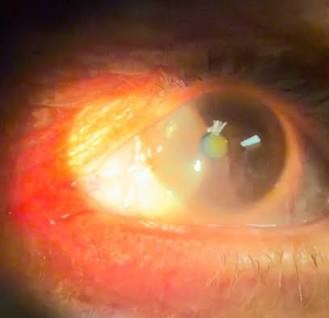
Mechanism
Fusion maldevelopment nystagmus is thought to arise from a disruption of normal binocular cortical development during infancy, in the same general developmental window disrupted by early-onset strabismus itself.
Covering one eye removes binocular input entirely, and in a visual system that never developed normal binocular fusion mechanisms, this triggers a jerk nystagmus in the viewing eye, with the fast phase characteristically beating toward the side of the viewing eye.
This is why the finding is termed fusion maldevelopment nystagmus in current terminology, reflecting the underlying developmental mechanism more precisely than the older, purely descriptive term latent nystagmus.
Both terms remain in common clinical use, and recognizing them as referring to the same entity avoids unnecessary confusion when reading older versus more recent literature on the subject.
Clinical Features
- Jerk nystagmus that appears or significantly worsens specifically with monocular occlusion, and improves or resolves with both eyes open
- Fast phase beating toward the uncovered, viewing eye, a consistent and useful clinical feature for recognizing the pattern
- Strong association with infantile esotropia and other forms of early-onset strabismus, rarely occurring as an isolated finding without an accompanying strabismus history
- A “manifest latent” component in some patients, where a similar, milder nystagmus is present even with both eyes open, particularly when one eye is already suppressed due to amblyopia
All-fit Slit-Lamp Adapter
Record and share exactly what you see at the slit lamp. One adapter fits any slit lamp or surgical microscope — and any smartphone.
From Choroida — the team behind this siteWhy It Complicates Visual Acuity Testing
Standard monocular visual acuity testing requires occluding one eye, which is precisely the maneuver that triggers or worsens the nystagmus in an affected child, and the resulting eye movement can genuinely degrade the accuracy of the acuity measurement obtained.
This creates a practical dilemma in exactly the population most likely to have this finding, since children with early strabismus already need accurate monocular acuity assessment to track for amblyopia, and the testing method itself may be interfering with the result.
Techniques to minimize this effect include using a translucent occluder or a blur/fogging lens rather than a fully opaque occluder for the fellow eye, which can reduce the induced nystagmus while still adequately isolating the eye being tested for acuity purposes.
Differential Diagnosis
Infantile nystagmus syndrome, discussed in its own dedicated article on this site, is present with both eyes open and does not depend on monocular occlusion to appear or worsen, distinguishing it clearly from fusion maldevelopment nystagmus.
Acquired nystagmus from a central neurological cause has a different, typically later age of onset and is not specifically tied to a strabismus history or to monocular occlusion in the same characteristic way.
The clear temporal relationship to occlusion, the consistent direction of the fast phase, and the near-universal association with early strabismus together make fusion maldevelopment nystagmus a recognizable, distinct clinical pattern once specifically looked for.
Management
There is no direct treatment for the nystagmus itself, and management is centered on treating the associated strabismus and any resulting amblyopia through standard strabismus and amblyopia management, both discussed in their own dedicated articles on this site.
Adjusting visual acuity testing technique, using minimally occlusive methods as described above, is a practical accommodation that improves the reliability of vision assessment in affected children without requiring any treatment directed at the nystagmus itself.
Families benefit from understanding that the nystagmus they may notice during an eye exam or patching is a recognized, expected accompaniment of their child’s strabismus, not a separate or additional problem requiring its own workup.
This reassurance matters clinically, since a parent who notices new eye movement during patching therapy might otherwise reasonably worry that patching itself is causing a new problem, when in fact it is simply revealing a preexisting, expected finding.
Document what you see
Two smartphone imaging tools built for everyday clinic use — one for the slit lamp, one for the fundus.
From Choroida — the team behind this siteReferences
- American Academy of Ophthalmology. Basic and Clinical Science Course, Section 6: Pediatric Ophthalmology and Strabismus.
- Good WV, Hoyt CS. Optotype acuity and the development of vision-impairment. American Journal of Ophthalmology.
- von Noorden GK, Campos EC. Binocular Vision and Ocular Motility: Theory and Management of Strabismus.
