
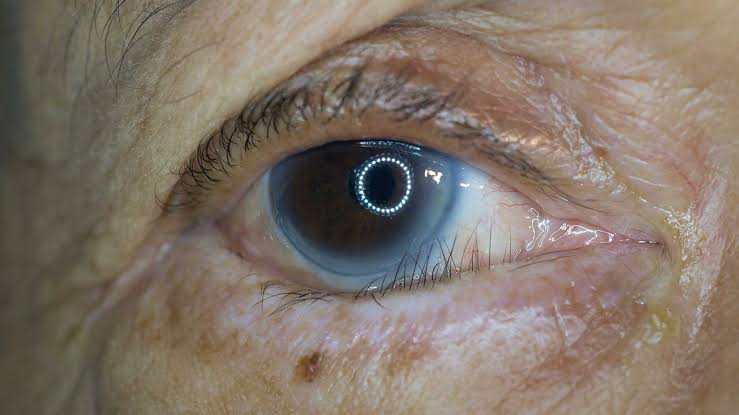
Entropion is inward turning of the eyelid margin, bringing the lashes and sometimes keratinized lid skin into direct contact with the cornea and conjunctiva.
Unlike ectropion, which is mostly a cosmetic and exposure problem, entropion is a mechanical one: the constant rubbing of misdirected lashes against the ocular surface (trichiasis from entropion) can produce corneal abrasion, ulceration, and scarring if left uncorrected.
It most commonly affects the lower lid, though upper lid entropion does occur, particularly in cicatricial disease where scarring can pull either lid margin inward depending on where the underlying conjunctival contracture is centered.
Classification by Cause
- Involutional (age-related) — the most common form in older adults, from a combination of horizontal lid laxity, weakening of the lower lid retractors, and overriding of the preseptal orbicularis muscle above the pretarsal orbicularis
- Cicatricial — scarring and contracture of the posterior lamella (tarsoconjunctival surface) pulls the lid margin inward; causes include trachoma, ocular cicatricial pemphigoid, Stevens-Johnson syndrome, chemical burns, and prior eyelid surgery
- Spastic — orbicularis spasm, often triggered by ocular surface irritation or following intraocular surgery, causing a temporary inward rotation superimposed on an otherwise normal lid
- Congenital — rare, present from birth, related to abnormal development of the lower lid retractors or tarsal plate
Distinguishing involutional from cicatricial entropion matters directly for management, because a purely involutional case usually responds well to lid-tightening procedures alone, while cicatricial entropion requires addressing the posterior lamellar scarring itself, and simple lid tightening without that step tends to fail.
Worldwide, cicatricial entropion from trachoma remains one of the leading preventable causes of corneal blindness, which is a useful reminder that the same clinical entity carries very different public health weight depending on the population and underlying cause being considered.
Clinical Presentation
Patients report foreign-body sensation, tearing, redness, and photophobia, symptoms that overlap substantially with simple dry eye or blepharitis.
This is why entropion is sometimes missed on a quick exam, especially the involutional form, which can be intermittent early on — present only with forceful eyelid closure or blinking before becoming constant.
Asking the patient to squeeze their eyes shut and then open them during the exam can reveal an intermittent entropion that is not obvious with the lids in a relaxed, resting position.
Longstanding cases, particularly in patients who have adapted to chronic irritation over months or years, sometimes present less with active complaints and more with the downstream signs of chronic mechanical damage — reduced vision from corneal scarring, for example — making an active search for entropion worthwhile in any older patient with unexplained ocular surface findings, not only those with prominent current symptoms.
All-fit Slit-Lamp Adapter
Record and share exactly what you see at the slit lamp. One adapter fits any slit lamp or surgical microscope — and any smartphone.
From Choroida — the team behind this siteExam Findings
- Inward rotation of the lid margin, with lashes contacting the globe
- Corneal punctate staining with fluorescein, sometimes in a linear pattern corresponding to the path of the offending lashes
- Conjunctival injection
- Signs of chronic mechanical irritation in longstanding cases — superficial pannus, corneal scarring
- Evidence of the underlying cause on careful exam — symblepharon and forniceal shortening in cicatricial disease, lid laxity on distraction and snap-back testing in involutional disease
Differential Diagnosis
- Trichiasis without entropion — misdirected lashes from a normally positioned lid margin, a distinct mechanism requiring different treatment (lash removal or ablation rather than lid repositioning)
- Epiblepharon — a fold of skin and muscle pushing lashes into a vertical position against the globe, more common in children and typically resolving with facial growth
- Distichiasis — an accessory row of lashes emerging from meibomian gland orifices
Diagnostic Evaluation
The diagnosis is made clinically, based on direct observation of the inward-rotated lid margin, ideally captured both at rest and during forced lid closure to catch an intermittent, early involutional case that is not apparent with the lid relaxed.
Careful eversion and inspection of the tarsoconjunctival surface helps distinguish involutional from cicatricial disease, looking specifically for the symblepharon, forniceal foreshortening, and conjunctival scarring characteristic of the cicatricial form.
Lid laxity testing — the distraction test (pulling the lid away from the globe) and the snap-back test (releasing the lid and observing how quickly it returns to normal position) — quantifies the degree of horizontal laxity contributing to involutional entropion and helps guide surgical planning.
Fluorescein staining documents the extent of corneal involvement and provides a baseline against which improvement after treatment can be measured.
Management
Temporary measures — lubrication, taping the lower lid down, or botulinum toxin injection for spastic entropion — provide short-term relief while more definitive treatment is arranged, and are sometimes sufficient on their own for mild, intermittent, or resolving cases (spastic entropion following cataract surgery, for example, often resolves as postoperative inflammation settles).
Definitive surgical correction depends on the underlying mechanism: horizontal lid-tightening procedures (with or without lower lid retractor reinsertion) for involutional entropion, and more complex reconstruction — often including a posterior lamellar graft — to address the scarring and contracture driving cicatricial entropion.
Because the two forms require genuinely different surgical approaches, correctly identifying the underlying mechanism before planning surgery is essential; a purely lid-tightening procedure performed on a cicatricial entropion, without addressing the posterior lamellar scarring, is likely to fail and require repeat surgery.
Complications of Untreated Disease
Chronic mechanical trauma from entropion-associated trichiasis can progress from superficial punctate staining to frank corneal abrasion, recurrent epithelial breakdown, secondary microbial keratitis, and, in longstanding severe cases, corneal scarring dense enough to threaten vision.
Because the mechanical insult is continuous and the eye’s own protective blink reflex cannot compensate for lashes rubbing against the surface with every closure, entropion causing any corneal staining warrants active treatment rather than observation.
Document what you see
Two smartphone imaging tools built for everyday clinic use — one for the slit lamp, one for the fundus.
From Choroida — the team behind this siteReferences
- Damasceno RW, Osaki MH, Dantas PE, Belfort R Jr. Involutional entropion and ectropion of the lower eyelid: prevalence and associated risk factors. Ophthalmic Plastic and Reconstructive Surgery.
- American Academy of Ophthalmology. Basic and Clinical Science Course, Section 7: Orbit, Eyelids, and Lacrimal System.
- Bagheri N, Wajda B, eds. The Wills Eye Manual.
Test yourself
A few questions straight from this article.
-
Why is entropion considered a mechanical rather than a cosmetic problem?
Unlike ectropion, which is largely a cosmetic and exposure problem, entropion drives lashes and keratinised lid skin against the ocular surface, producing abrasion, ulceration and scarring if uncorrected. -
Which combination of changes produces involutional entropion?
The commonest form in older adults combines horizontal lid laxity, weakened lower lid retractors, and the preseptal orbicularis riding up over the pretarsal orbicularis. -
Which layer is scarred in cicatricial entropion?
Scarring and contracture of the posterior lamella pull the lid margin inward; causes include trachoma, ocular cicatricial pemphigoid, Stevens-Johnson syndrome, chemical burns and prior eyelid surgery. -
What produces spastic entropion?
Spasm rotates an otherwise normal lid inward temporarily, and spastic entropion after cataract surgery often resolves as postoperative inflammation settles. -
Which cause of cicatricial entropion is a leading preventable cause of corneal blindness worldwide?
Cicatricial entropion from trachoma remains one of the leading preventable causes of corneal blindness worldwide, giving the same clinical entity very different public health weight across populations. -
Which bedside manoeuvre reveals an early intermittent involutional entropion?
Early involutional entropion may appear only with forceful closure or blinking, so forced lid closure during the exam exposes a malposition invisible at rest. -
Which tests quantify the horizontal lid laxity contributing to involutional entropion?
Pulling the lid away from the globe and observing how quickly it returns measures the degree of horizontal laxity and helps guide surgical planning. -
How does trichiasis without entropion differ from entropion itself?
Lashes are misdirected from a normally positioned margin, so treatment is lash removal or ablation rather than repositioning the lid; lashes from meibomian orifices instead define distichiasis. -
Which operation corrects a purely involutional entropion?
Involutional cases respond well to lid tightening, whereas cicatricial entropion needs the posterior lamellar scarring addressed; tightening alone in a cicatricial lid tends to fail and need repeat surgery. -
What degree of corneal involvement in entropion warrants active treatment rather than observation?
The mechanical insult is continuous and the blink reflex cannot compensate for lashes rubbing with every closure, so staining can progress to abrasion, keratitis and vision-threatening scarring.
