The latest treatments for dry eye go well beyond artificial tears.
New drugs, devices, and procedures target inflammation, the lipid layer, the glands of the lids, and the nerves that drive tear production.
Also, matching the treatment to the mechanism gives the best chance of relief (see dry eye disease).
Why the Latest Treatments for Dry Eye Matter
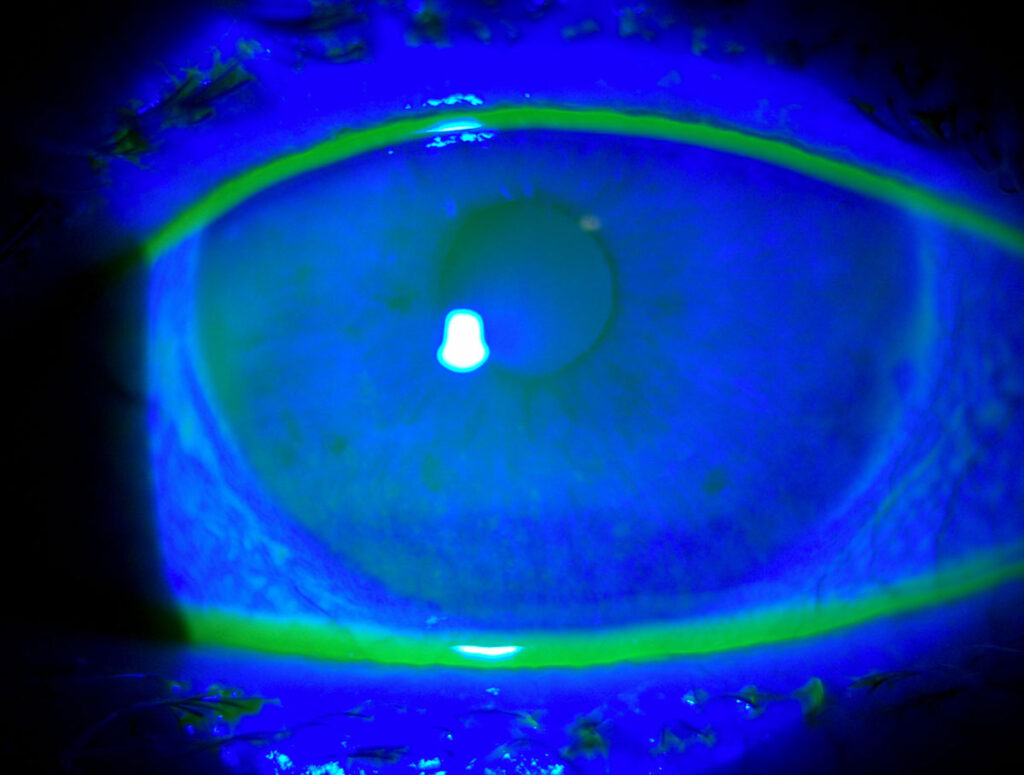
Dry eye is common, chronic, and often mixed, with aqueous deficiency and evaporative loss at the same time.
Lubricants give short relief, and many patients stay symptomatic, so research has focused on the causes (see aqueous-deficient dry eye and evaporative dry eye).
Latest Treatments for Dry Eye: Treating Inflammation
- Cyclosporine drops raise tear production over weeks and lower surface inflammation, in several concentrations and formulations (see topical cyclosporine)
- Lifitegrast 5 percent blocks the binding of LFA-1 to ICAM-1, a step in T-cell activation, and improved symptoms and corneal staining in phase 3 trials (see the references)
- Short courses of low-dose steroid calm flares, if the pressure is monitored
All-fit Slit-Lamp Adapter
Record and share exactly what you see at the slit lamp. One adapter fits any slit lamp or surgical microscope — and any smartphone.
From Choroida — the team behind this siteRestoring the Lipid Layer
Perfluorohexyloctane is a waterless drop that forms a layer on the tear surface, and so slows evaporation.
In the GOBI and MOJAVE trials, it reduced corneal staining and dryness scores in patients with meibomian gland disease (see the references).
It is also approved in several regions, and suits evaporative dry eye (see meibomian gland dysfunction).
Latest Treatments for Dry Eye: Stimulating the Nerves
- Varenicline nasal spray activates nasal nerve endings, which stimulates the reflex that produces natural tears, and improved tear production in trials (see the references)
- Intranasal neurostimulation devices also act in a similar way
These options bypass the surface, so they suit patients with aqueous deficiency.
Treating the Glands
- Thermal pulsation warms and massages the lids to express blocked glands, and improved gland function in studies (see the references)
- Intense pulsed light applied to the skin around the eyes reduced signs and symptoms in trials of gland disease (see the references)
- Warm compresses and lid hygiene still remain the base of daily care
- Probing and microblepharoexfoliation are also used in some centers
Latest Treatments for Dry Eye: Biologic and Procedural Options
- Autologous serum drops supply growth factors and nutrients (see autologous serum eye drops)
- Punctal plugs keep tears on the surface (see punctal plugs)
- Scleral lenses bathe the cornea in fluid
- Amniotic membrane rings treat severe surface damage
What Did Not Work
The DREAM trial found that oral omega-3 supplements did not perform better than placebo for dry eye (see the references).
This result tempered enthusiasm for supplements, though some patients report benefit.
Latest Treatments for Dry Eye: Putting It Together
- Step 1: educate, treat lid disease, improve the environment, and use lubricants
- Step 2: add anti-inflammatory drops, a lipid-layer drop, or a nasal spray, according to the mechanism
- Next, step 3: use procedures, serum, plugs, or scleral lenses
- Step 4: consider surgical or advanced options for severe cases
Review at six to twelve weeks and change the plan if there is no response.
Counselling
Explain that dry eye is a chronic condition, that treatments take weeks to work, although combining measures often works best.
Set realistic goals, and then encourage regular follow-up.
An Example Plan
A 48-year-old office worker has burning and fluctuating vision, a short tear break-up time, and blocked meibomian glands.
She starts lid hygiene and warm compresses, with perfluorohexyloctane drops four times a day, and a short course of anti-inflammatory therapy for surface staining.
At twelve weeks, symptoms have halved, and a thermal pulsation session is also added for the glands, which shows how mechanism-based choices fit together.
Safety and Cost
- Most new drops cause mild stinging or blurred vision after instillation
- Nasal spray can also cause sneezing and cough
- Devices carry costs that are often paid by the patient
- Preservative-free options suit frequent users
Clinicians should set expectations, since benefits often appear after weeks.
Choosing by Phenotype
Aqueous-deficient patients tend to respond to anti-inflammatory and neural approaches, while evaporative patients do better with lipid-layer and gland treatments.
In addition, testing tear osmolarity, MMP-9, and meibography helps to classify patients (see tear osmolarity testing and meibography).
Practical Tips for Patients
- Use lubricants as often as needed, but choose preservative-free formulas when using them more than four times a day
- Take breaks from screens, and blink fully
- Keep indoor air from blowing on the face, and drink enough water
- Treat allergies and lid disease, since they add to symptoms
Many patients improve more from a combination of small changes than from one new drug.
For the latest studies, see the PubMed results for latest treatments for dry eye.


Document what you see
Two smartphone imaging tools built for everyday clinic use — one for the slit lamp, one for the fundus.
From Choroida — the team behind this siteReferences
- Holland EJ, Luchs J, Karpecki PM, et al. Lifitegrast for the treatment of dry eye disease: results of a phase III, randomized, double-masked, placebo-controlled trial (OPUS-3). Ophthalmology. 2017;124:53-60.
- Tauber J, Berdy GJ, Wirta DL, et al. NOV03 for dry eye disease associated with meibomian gland dysfunction: results of the randomized phase 3 GOBI study. Ophthalmology. 2023;130:516-524.
- Wirta D, Torkildsen GL, Boehmer B, et al. ONSET-2: randomized controlled trial to evaluate the efficacy and safety of OC-01 (varenicline solution) nasal spray on signs and symptoms of dry eye disease. Cornea. 2022;41:1207-1216.
- Asbell PA, Maguire MG, Pistilli M, et al. n-3 fatty acid supplementation for the treatment of dry eye disease. N Engl J Med. 2018;378:1681-1690.

Writes and reviews the clinical articles on Educate. Every post is checked against peer-reviewed sources before it goes live.