Anti-VEGF for nonproliferative diabetic retinopathy is a way of treating severe disease before it causes complications.
It raises a real question about whether to treat early or to wait.
Two large trials showed that injections improve the retinopathy severity score and reduce complications, but the effect on vision was not clearly better than waiting and treating when needed.
The decision therefore depends on the patient and the setting.
Rationale for Anti-VEGF for Nonproliferative Diabetic Retinopathy
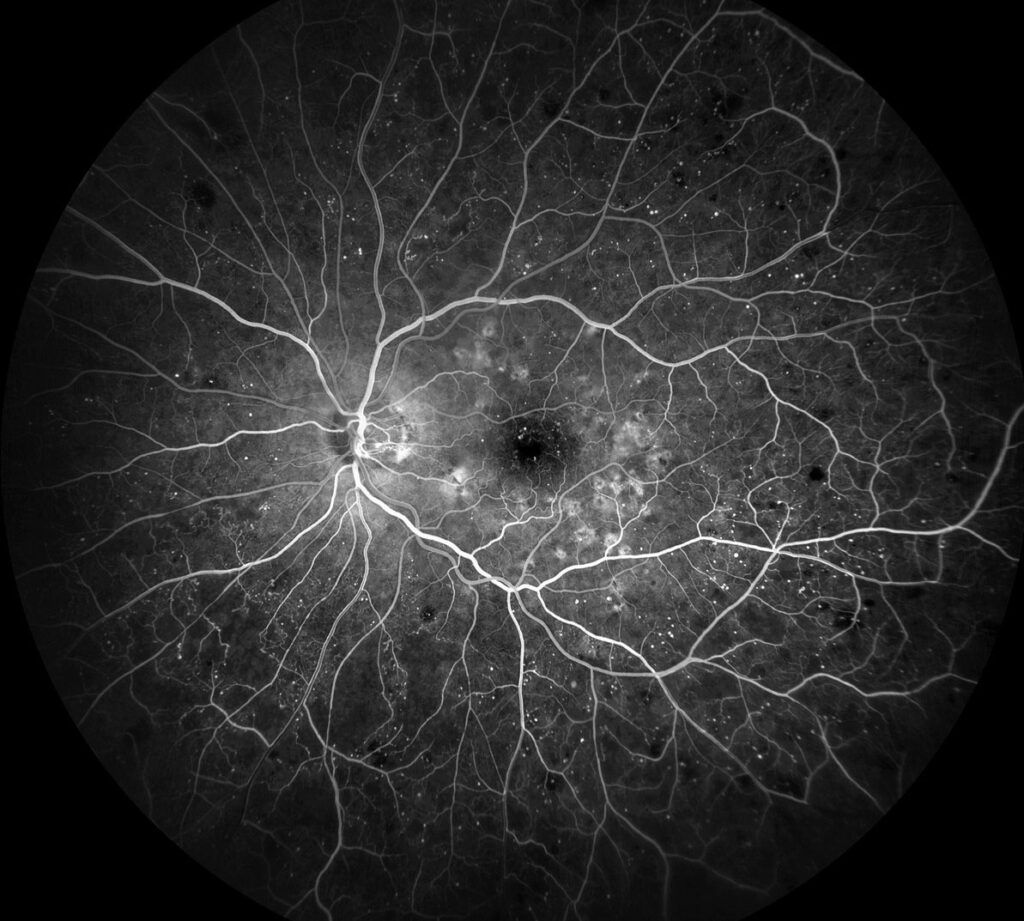
Severe nonproliferative diabetic retinopathy has a high risk of progressing to proliferative disease or macular edema within a year (see diabetic retinopathy classification).
Anti-VEGF drugs can cause regression of retinal vascular changes, such as neovascularization, and trials in macular edema showed an improvement in the severity score as a secondary finding.
It was logical to test whether early treatment of severe nonproliferative disease would prevent complications and protect vision.
Anti-VEGF for Nonproliferative Diabetic Retinopathy: PANORAMA
PANORAMA randomized patients with moderately severe to severe nonproliferative retinopathy, without center-involved edema, to aflibercept at two dosing regimens or to sham injection.
At 24 weeks, a much larger proportion of treated eyes had an improvement of two or more steps on the severity scale.
The rates held in the second year with continued treatment.
Treated eyes also had fewer vision-threatening complications, such as proliferative disease and center-involved edema, at one year (see the references).
Fundus Explorer Pro
Photograph the retinal findings described here with the phone already in your pocket — 22 D optics and built-in illumination in one handheld unit.
From Choroida — the team behind this siteProtocol W
Protocol W randomized eyes with moderate to severe nonproliferative retinopathy to aflibercept or sham, with the option to treat when complications appeared.
Over two years, aflibercept reduced the development of proliferative disease or center-involved edema with vision loss, compared with sham, as the primary endpoint.
At four years, however, the vision outcomes were not different between the early treatment group and the sham group, in which investigators gave treatment when needed.
This result has shaped the discussion about whether early treatment is needed (see the references).
Anti-VEGF for Nonproliferative Diabetic Retinopathy: What the Two Trials Together Suggest
- Anti-VEGF therapy reduces the progression of retinopathy and the development of complications while it is given
- Vision at four years was no better in eyes that doctors treated early, with treatment in the sham group when complications arose
- Treatment requires frequent visits and injections, with costs and risks
- The benefit of early treatment may be greatest in patients who are unlikely to attend follow-up
When patients are lost to follow-up, early treatment may protect against complications that would otherwise go undetected.
Who Might Be Treated
- Patients with severe nonproliferative disease who are unlikely to attend regular visits
- Patients in whom panretinal photocoagulation is not possible or desirable
- Those about to undergo cataract surgery or pregnancy with high risk of progression
- Patients with severe disease in one eye and proliferative disease in the other, as a case-by-case choice
Doctors can observe many patients with severe nonproliferative disease with close monitoring, and treat them at the first sign of complications.
Comparison With Laser
Panretinal photocoagulation can also lower the risk of progression, with a long-lasting effect and fewer visits, but it destroys peripheral retina and may reduce the visual field and night vision (see panretinal photocoagulation).
Anti-VEGF therapy avoids these problems but needs repetition, and the effect fades when it stops.
The choice depends on reliability, preferences, and resources.
Anti-VEGF for Nonproliferative Diabetic Retinopathy: Risks and Practical Issues
- Injection risks, including endophthalmitis (see post-injection endophthalmitis)
- Systemic safety concerns, still being studied (see anti-VEGF systemic safety)
- Cost and burden of repeated visits
- A rebound of retinopathy if treatment is stopped without follow-up
- Unmasking of tractional changes when neovascularization regresses in eyes with fibrous tissue
Counselling
Explain that treatment can slow the disease, but that systemic control remains the main factor.
Make sure that the patient understands the schedule and the risk of stopping treatment.
Document the severity at each visit and discuss the choice of strategy openly.
Counting the Cost of Early Treatment
A patient treated early with aflibercept in the trials received many injections over the first year, then fewer in the second.
Some needed continued treatment for years.
The burden includes travel, time, and the small risk of each injection, which adds up over time.
Patients should help to weigh these factors against the benefit of a lower chance of complications.
Documentation
Record the severity level at baseline, the plan, and the agreed follow-up interval.
If the patient chooses observation, schedule frequent visits and a clear threshold for treatment.
For the latest studies, see the PubMed results for anti-VEGF for nonproliferative diabetic retinopathy.


Document what you see
Two smartphone imaging tools built for everyday clinic use — one for the slit lamp, one for the fundus.
From Choroida — the team behind this siteReferences
- Brown DM, Wykoff CC, Boyer D, et al. Evaluation of intravitreal aflibercept for the treatment of severe nonproliferative diabetic retinopathy: results from the PANORAMA randomized clinical trial. JAMA Ophthalmol. 2021;139:946-955.
- Maturi RK, Glassman AR, Josic K, et al. Four-year visual outcomes in the Protocol W randomized trial of intravitreous aflibercept for prevention of vision-threatening complications of diabetic retinopathy. JAMA. 2023;329:376-385.
- Ryan SJ, Schachat AP, Wilkinson CP, et al, eds. Retina. 6th ed. Elsevier; 2018.
- American Academy of Ophthalmology. Basic and Clinical Science Course, Section 12: Retina and Vitreous. AAO; current edition.

Writes and reviews the clinical articles on Educate. Every post is checked against peer-reviewed sources before it goes live.