Treatment advances in retinitis pigmentosa are real, but they are uneven, and most patients still rely on supportive care.
For decades, doctors could only monitor the disease and treat complications.
Today, regulators have also approved one gene therapy, several trials are under way, and good care of related problems can protect function (see retinitis pigmentosa).
Why Treatment Advances in Retinitis Pigmentosa Matter
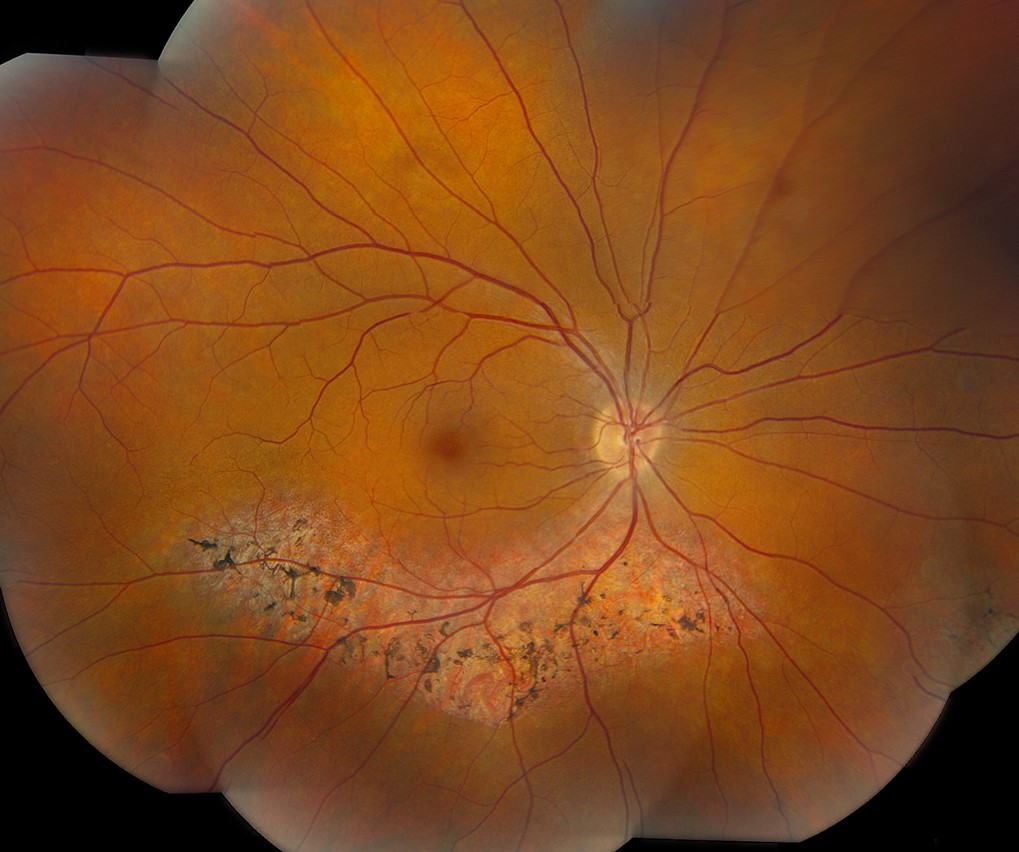
Retinitis pigmentosa is a group of inherited diseases in which rods, and later cones, degenerate, causing night blindness, loss of side vision, and in advanced cases central loss.
Also, more than 80 genes are involved, and the course varies from mild to severe.
Accurate diagnosis, with genetic testing, is the first step to any specific treatment.
Treatment Advances in Retinitis Pigmentosa: Gene Therapy
Voretigene neparvovec was the first approved gene therapy for an inherited retinal disease.
Doctors use it in patients with biallelic RPE65 mutations.
A phase 3 trial showed improvement in a mobility test under dim light, and in light sensitivity, which persisted for years (see the references and gene therapy for inherited retinal disease).
It applies to a small fraction of patients, since RPE65 is a rare cause, and trials target other genes.
Fundus Explorer Pro
Photograph the retinal findings described here with the phone already in your pocket — 22 D optics and built-in illumination in one handheld unit.
From Choroida — the team behind this siteSupplements and Drugs
- Vitamin A palmitate: in a trial of vitamin A, 15,000 IU daily slowed the decline of the electroretinogram in some patients, with benefit that is modest, and use is individualized because of liver and bone effects and pregnancy risk (see the references)
- Omega-3 fatty acids: mixed results
- N-acetylcysteine: an antioxidant tested in a large trial of oral treatment to protect cones, with results awaited
- Carbonic anhydrase inhibitors: treat cystoid macular edema, which affects many patients (see cystoid macular edema in retinitis pigmentosa)
Treatment Advances in Retinitis Pigmentosa: Optogenetics, Prostheses, and Cell Therapy
- Optogenetic therapy gives light sensitivity to remaining cells in advanced disease (see optogenetic therapy for retinal degeneration)
- Retinal implants provide coarse vision in some patients (see retinal implants)
- Stem cell and gene editing approaches are in early trials
Managing Complications
- Cataract surgery, often needed at a young age, since posterior subcapsular cataract is common
- Cystoid macular edema, treated with drops or tablets
- Light sensitivity, helped by tinted lenses
- Epiretinal membrane and other macular problems
Treating these can give meaningful improvement in function.
Treatment Advances in Retinitis Pigmentosa: Low Vision and Rehabilitation
Orientation and mobility training, devices that enlarge or enhance images, and support from social services help patients keep independence.
Early referral is better than late, since patients adapt more easily when they still have some vision.
Genetic Counselling
Testing finds the gene, the pattern of inheritance, and trial eligibility.
Family members may also be at risk, and counselling helps with reproductive decisions.
Treatment Advances in Retinitis Pigmentosa: What to Tell Patients
Explain that research has made progress, that more treatments are coming, and that the best step now is to have a genetic diagnosis and to stay in touch with a specialist.
Warn against unproven injections or clinics.
An Example Plan
A 24-year-old man has retinitis pigmentosa with night blindness and a constricted field.
Genetic testing finds a mutation in USH2A, so he has Usher syndrome type 2, and he is referred for hearing and counselling services.
He receives glasses with tints, treatment for early cataract, orientation training, and information on trials for USH2A, such as antisense and gene therapy approaches.
Safe Use of Vitamin A
Patients should not start high-dose vitamin A on their own, since the dose in studies was supervised, with liver tests.
Doctors avoid it in pregnancy.
Eye doctors should discuss the benefit and risks with the patient, and with the physician.
Special Types
- X-linked disease: often more severe, and a target for gene therapy (see X-linked retinitis pigmentosa)
- Syndromic forms, such as Usher syndrome, need multi-specialty care
- Sector and sine pigmento forms have slower courses (see retinitis pigmentosa sine pigmento)
Where to Find Trials
Patient registries, national retinal societies, and public trial registries list ongoing studies.
A specialist can also check eligibility and avoid unproven offers.
Questions Families Ask
Families often ask whether the child will go blind, whether diet can help, and whether they should wait for a cure.
The honest answers are that many patients keep useful vision for decades, that a healthy diet is good but no diet cures the disease, and that waiting is not a plan, since care of complications and genetic diagnosis help now.
Also, provide contact details of patient organizations and genetic services.
For the latest studies, see the PubMed results for treatment advances in retinitis pigmentosa.


Document what you see
Two smartphone imaging tools built for everyday clinic use — one for the slit lamp, one for the fundus.
From Choroida — the team behind this siteReferences
- Russell S, Bennett J, Wellman JA, et al. Efficacy and safety of voretigene neparvovec (AAV2-hRPE65v2) in patients with RPE65-mediated inherited retinal dystrophy: a randomised, controlled, open-label, phase 3 trial. Lancet. 2017;390:849-860.
- Berson EL, Rosner B, Sandberg MA, et al. A randomized trial of vitamin A and vitamin E supplementation for retinitis pigmentosa. Arch Ophthalmol. 1993;111:761-772.
- Hartong DT, Berson EL, Dryja TP. Retinitis pigmentosa. Lancet. 2006;368:1795-1809.
- American Academy of Ophthalmology. Basic and Clinical Science Course, Section 12: Retina and Vitreous. AAO; current edition.

Writes and reviews the clinical articles on Educate. Every post is checked against peer-reviewed sources before it goes live.