The eye was always going to be where gene therapy proved itself first. It is small, enclosed, partly immune-privileged, and every part of it can be watched directly through an ophthalmoscope.
In 2017, that promise became a licensed product: a single subretinal injection, for a single gene, in a single inherited retinal disease.
Gene therapy for inherited retinal disease is no longer experimental for at least one condition, and dozens more are now in active clinical trials.
What it offers is fundamentally different from every other treatment on this site – a one-time intervention aimed at the genetic cause, not lifelong management of its downstream effects.
What it cannot yet offer, for most patients, is treatment at all – eligibility remains tightly restricted to specific mutations with viable remaining retinal tissue.
What Is Gene Therapy for Retinal Disease?
Gene therapy delivers genetic material into retinal cells to correct or compensate for a disease-causing mutation, most commonly using an adeno-associated virus (AAV) vector injected into the subretinal space.
Current and investigational approaches fall into distinct strategies:
- Gene augmentation – delivering a functional copy of a gene to compensate for a loss-of-function mutation, the approach behind the only currently licensed retinal gene therapy
- Gene editing – using CRISPR-based tools to correct the mutation directly within the patient’s own genome, still investigational for retinal disease
- Optogenetic therapy – introducing light-sensitive proteins into surviving retinal cells to restore some light perception in advanced, photoreceptor-depleted disease
- RNA-based approaches, including antisense oligonucleotides, targeting specific mutations at the RNA level rather than the DNA level
Gene augmentation is the only strategy with a licensed product so far, and it is the one this article focuses on.
Voretigene Neparvovec: The First Approved Retinal Gene Therapy
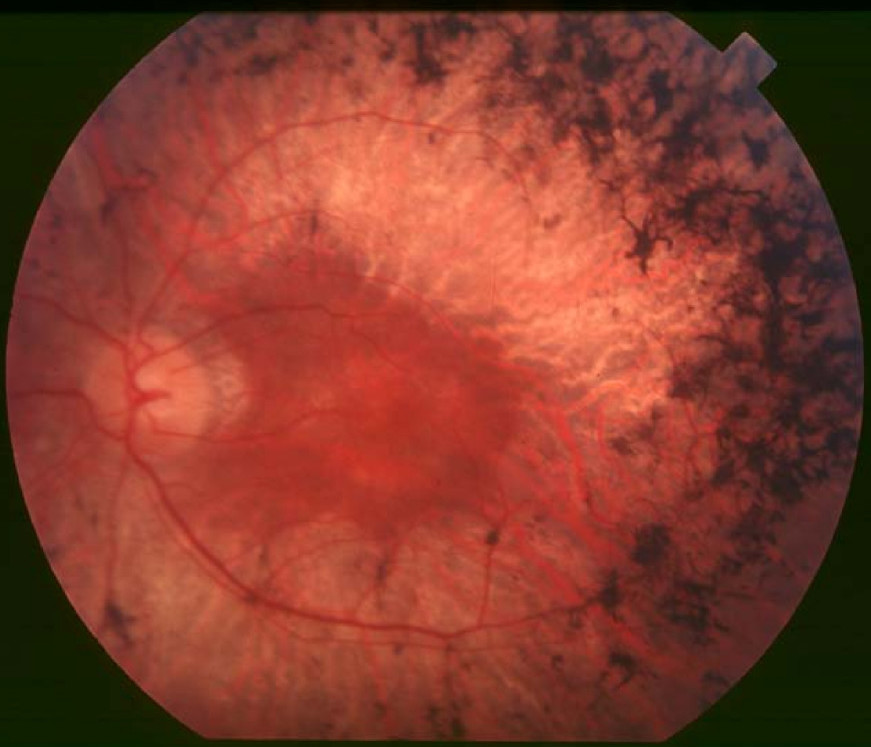
- Voretigene neparvovec is an AAV2 vector delivering a functional copy of the RPE65 gene, for biallelic RPE65 mutation-associated retinal dystrophy – a spectrum including Leber congenital amaurosis and some forms of retinitis pigmentosa
- RPE65 encodes an enzyme essential to the visual cycle in the retinal pigment epithelium; without it, photoreceptors cannot regenerate the visual pigment needed to respond to light
- The pivotal trial demonstrated meaningful improvement in functional vision, measured using a multi-luminance mobility test navigating an obstacle course under varying light levels, alongside improvements in visual field and light sensitivity
- Treatment is a single subretinal injection per eye, typically performed as two separate procedures, and is approved for patients with sufficient viable retinal cells at the time of treatment
The mobility test outcome measure is worth understanding specifically, because it captures something visual acuity charts do not – functional vision in the low-light conditions that mattered most to these patients’ daily lives.
Fundus Explorer Pro
Photograph the retinal findings described here with the phone already in your pocket — 22 D optics and built-in illumination in one handheld unit.
From Choroida — the team behind this sitePatient Selection
- Confirmed biallelic RPE65 mutations on genetic testing – this is a molecularly defined indication, not a clinical diagnosis alone
- Sufficient viable retinal cells, generally assessed by residual retinal thickness on OCT and functional visual field, since the therapy rescues surviving cells rather than regenerating lost ones
- Treatment is generally more effective the earlier it is given in the disease course, before extensive photoreceptor loss has occurred
- Genetic counselling is an essential part of the pathway, both for diagnosis confirmation and for family implications
This is the central limitation of the entire field so far: gene therapy can rescue retina that is still alive, but it cannot restore retina that has already degenerated.
Surgical Delivery
Procedure
- Delivery requires pars plana vitrectomy to access the subretinal space
- A fine cannula creates a localised retinal detachment (a “bleb”) to deliver the vector precisely beneath the retina at the treatment site
- Careful surgical technique is required to avoid foveal trauma while still achieving adequate posterior pole coverage
Perioperative Considerations
- Perioperative corticosteroids are typically used to reduce the immune response to the viral vector
- Careful patient positioning postoperatively supports even distribution of the therapeutic bleb and reabsorption of subretinal fluid
The delivery procedure is, in effect, borrowed directly from vitreoretinal surgery – the therapeutic innovation is entirely in the vector and the gene, not in a new surgical technique.
Gene Therapy in Clinical Development
- X-linked retinitis pigmentosa, targeting RPGR mutations, is in advanced clinical trials
- Choroideremia, targeting CHM mutations, has shown encouraging early trial results
- Achromatopsia and other cone-specific disorders are being investigated with gene augmentation approaches
- Optogenetic therapy has shown proof-of-concept partial visual restoration in advanced retinitis pigmentosa with essentially no surviving photoreceptors, a fundamentally different and more ambitious target than gene augmentation
- Gene editing approaches for dominant conditions, where simply adding a normal gene copy is insufficient because the mutant copy remains active, are in earlier-stage development
The field is moving from “replace a missing gene” toward “edit the gene in place,” which is the harder problem but the one that will eventually be needed for dominant inherited retinal disease.
Safety Considerations
- Surgical risks common to any vitrectomy and subretinal injection – retinal tear, detachment, endophthalmitis and cataract
- Intraocular inflammation related to the viral vector, generally managed with perioperative corticosteroids
- Transient intraocular pressure elevation
- Chorioretinal atrophy has been reported at or near the injection site in some cases, a specific complication under active study
- Long-term durability of effect is still being characterised as real-world follow-up data accumulate beyond the original trial period
Durability is the open question hanging over the entire field – a treatment framed as one-time only holds up if its effect does not fade, and that evidence is still maturing.
Prognosis
Gene therapy has proven the concept for inherited retinal disease, but its reach remains narrow.
- Patients treated with voretigene neparvovec have shown sustained functional visual improvement over the published follow-up period to date
- Only a small minority of inherited retinal disease is currently treatable, since eligibility depends on a specific, molecularly confirmed mutation with a licensed or trial-available therapy
- The pipeline of gene-specific trials is expanding steadily, and genetic testing for inherited retinal disease is increasingly relevant even where no treatment yet exists, since it determines trial eligibility
- The single biggest practical barrier for most patients remains access to genetic testing and diagnosis in the first place, not the therapy itself
The most useful thing this technology has changed, for now, is the value of an accurate genetic diagnosis – even in inherited retinal disease without a licensed treatment, knowing the gene is what keeps a patient’s options open as the field expands.

Document what you see
Two smartphone imaging tools built for everyday clinic use — one for the slit lamp, one for the fundus.
From Choroida — the team behind this siteReferences
- Russell S, Bennett J, Wellman JA, et al. Efficacy and safety of voretigene neparvovec for RPE65-mediated inherited retinal dystrophy. The Lancet. 2017.
- Maguire AM, Russell S, Wellman JA, et al. Efficacy, safety, and durability of voretigene neparvovec: results up to 4 years. Ophthalmology. 2019.
- Sahel JA, Boulanger-Scemama E, Pagot C, et al. Partial recovery of visual function in a blind patient after optogenetic therapy. Nature Medicine. 2021.
- Gene Therapy for Inherited Retinal Disease. EyeWiki, American Academy of Ophthalmology.
- Retinitis Pigmentosa and Gene Therapy. StatPearls, NCBI Bookshelf.
Test yourself
A few questions straight from this article.
-
Voretigene neparvovec treats retinal dystrophy caused by mutations in which gene?
Voretigene neparvovec is an AAV2 vector delivering a functional copy of RPE65, licensed for biallelic RPE65 mutation-associated retinal dystrophy. -
What is the consequence of losing RPE65 enzyme function in the retinal pigment epithelium?
RPE65 encodes an enzyme essential to the visual cycle; without it, photoreceptors cannot regenerate the visual pigment needed to respond to light. -
Which outcome measure demonstrated benefit in the voretigene neparvovec pivotal trial?
The trial used a multi-luminance mobility test, navigating an obstacle course under varying light levels, capturing functional vision that acuity charts do not. -
What must be confirmed before a patient is eligible for voretigene neparvovec?
This is a molecularly defined indication, not a clinical diagnosis alone: biallelic RPE65 mutations must be confirmed on genetic testing. -
Why must sufficient viable retinal cells remain before retinal gene therapy is given?
Gene therapy can rescue retina that is still alive but cannot restore retina that has already degenerated, so residual thickness and field are assessed first. -
How is the vector positioned beneath the retina during subretinal gene therapy delivery?
A fine cannula creates a localised retinal detachment, a bleb, to deliver the vector precisely beneath the retina at the treatment site. -
Why are perioperative corticosteroids typically given with retinal gene therapy?
Perioperative corticosteroids are used to reduce the immune response to the viral vector, and vector-related intraocular inflammation is managed the same way. -
Which complication specific to retinal gene therapy has been reported near the injection site?
Chorioretinal atrophy has been reported at or near the injection site in some cases and is a specific complication under active study. -
Why is gene augmentation insufficient for dominantly inherited retinal disease?
In dominant conditions simply adding a normal gene copy is insufficient because the mutant copy remains active, which is why gene editing approaches are being developed. -
What is the single biggest practical barrier to retinal gene therapy for most patients?
For most patients the barrier is not the therapy itself but access to genetic testing and diagnosis, which determines both licensed treatment and trial eligibility.

Writes and reviews the clinical articles on Educate. Every post is checked against peer-reviewed sources before it goes live.