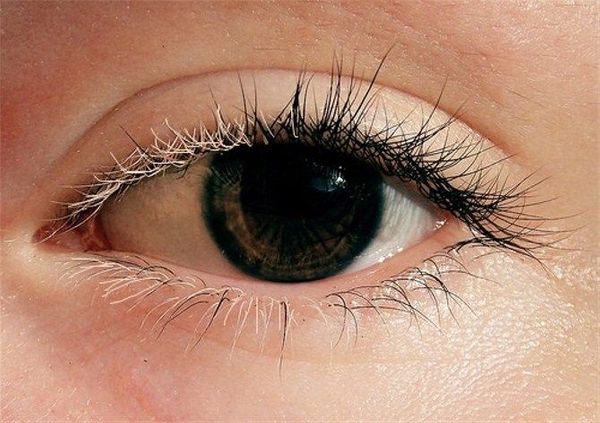
Poliosis is a localized patch of white or gray hair, and on the eye it appears as white eyelashes or eyebrows.
It results from loss or absence of melanin in the hair follicle.
Therefore, a few white lashes can point to a systemic or ocular disease, so look beyond the lid.
What Poliosis Means
Melanocytes in the hair bulb give the shaft its color.
When these cells are absent or destroyed, the new hair grows white.
Poliosis may be congenital or acquired, and it may involve one lash, a patch or the whole lid.
Because it is easy to see, patients often notice it before they mention other symptoms.
Causes of Poliosis
Congenital causes include piebaldism, Waardenburg syndrome and tuberous sclerosis.
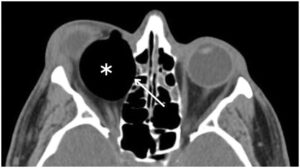
Acquired causes include vitiligo, alopecia areata, Vogt-Koyanagi-Harada disease and sympathetic ophthalmia.
Local disease can also cause it, such as chronic blepharitis, trauma, burns or past herpes zoster.
Also, some eyelid tumors and their treatments leave white lashes behind.
All-fit Slit-Lamp Adapter
Record and share exactly what you see at the slit lamp. One adapter fits any slit lamp or surgical microscope — and any smartphone.
From Choroida — the team behind this sitePoliosis in Vogt-Koyanagi-Harada Disease
Poliosis, vitiligo and alopecia appear in the convalescent phase of the disease.
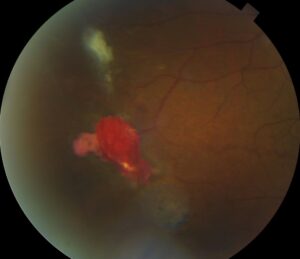
They reflect an immune attack on melanocytes, and they accompany the sunset glow fundus (see Vogt-Koyanagi-Harada disease).
Also, the revised diagnostic criteria list these skin and hair changes among the integumentary findings.
Therefore, ask any patient with a granulomatous uveitis about white hair.
Poliosis After Eye Injury and Sympathetic Ophthalmia
Sympathetic ophthalmia follows penetrating injury or surgery and can show poliosis, vitiligo and alopecia in the same way (see sympathetic ophthalmia).
Therefore, ask about previous eye trauma or surgery on either side.
Poliosis in Waardenburg Syndrome
Waardenburg syndrome combines a white forelock, different colored irides and sensorineural hearing loss (see Waardenburg syndrome).
Many patients also have wide-set inner canthi.
Also, white eyelashes can be the first sign in a child.
Because the syndrome is genetic, family members may show the same features.
History and Examination in Poliosis
Ask when the white hair began, whether it spread, and whether there was trauma, surgery or inflammation.
Also, ask about hearing loss, skin patches, floaters, pain and a family history.
Examine the lashes, eyebrows and scalp, and look for skin depigmentation.
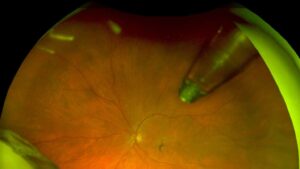
Then do a slit-lamp examination for uveitis, and examine the fundus.
Investigations
Targeted tests work better than a long panel.
If uveitis is present, request optical coherence tomography and angiography to assess choroidal disease.
When the syndrome is suspected, arrange audiology and genetic counselling.
Also, a Wood lamp highlights subtle depigmentation of the skin.
Management and Counselling
Poliosis itself does not threaten vision, so treat the cause.
Explain that hair color rarely returns without treating the underlying disease.
Also, warn patients about eyelash dyes, since the FDA has not approved color additives for use near the eye.
Telling True Poliosis From Other Causes of Pale Lashes
Gray hair of aging usually involves many hairs and scalp hair, and it spreads gradually.
Lashes that look pale because of crusting or debris regain their color after cleaning.
Also, hair bleached by chemicals or dyes matches the history.
Therefore, examine the lash under magnification before you label the finding.
Associated Eyelid and Skin Findings
Look for madarosis, trichiasis and depigmented patches on the lids (see madarosis).
Also, vitiligo around the eyes and on the hands supports an autoimmune cause.
Because patients often hide skin patches, ask about them directly.
Systemic Associations to Ask About
Ask about thyroid disease, pernicious anemia and diabetes, because they occur more often with vitiligo.
Also, ask about hearing loss, headache, neck stiffness and tinnitus when VKH is possible.
Therefore, a short systemic review can reveal the cause before investigations.
Poliosis in Children
Congenital poliosis suggests a genetic syndrome such as Waardenburg syndrome or piebaldism.
Acquired poliosis in a child should prompt a search for uveitis, especially after trauma.
Also, a child with a white forelock deserves a hearing test.
Documentation and Follow-Up
Photograph the lashes and the brows at baseline.
Repeat the photographs at each visit, since spread of white hair can signal active disease.
Also, record the iris color and any heterochromia.
When to Refer
Refer promptly when white lashes come with uveitis, hearing loss or neurological symptoms.
Also refer when the cause stays unclear after history and examination.
Dermatology, audiology and genetics are the usual partners.
Why Poliosis Deserves a Photograph
White lashes can look subtle in clinic and obvious in a photograph.
A dated image lets you compare the pattern at later visits.
Also, patients can bring old photographs to show when the change began.


Document what you see
Two smartphone imaging tools built for everyday clinic use — one for the slit lamp, one for the fundus.
From Choroida — the team behind this siteReferences
- Read RW, Holland GN, Rao NA, et al. Revised diagnostic criteria for Vogt-Koyanagi-Harada disease: report of an international committee on nomenclature. Am J Ophthalmol. 2001;131:647-652.
- Read AP, Newton VE. Waardenburg syndrome. J Med Genet. 1997;34:656-665.
- Ezzedine K, Eleftheriadou V, Whitton M, van Geel N. Vitiligo. Lancet. 2015;386:74-84.
- Chu XK, Chan CC. Sympathetic ophthalmia: to the twenty-first century and beyond. J Ophthalmic Inflamm Infect. 2013;3:49.

Writes and reviews the clinical articles on Educate. Every post is checked against peer-reviewed sources before it goes live.