The port delivery system is a refillable eye implant that releases ranibizumab continuously through a porous titanium valve.
It aims to replace frequent monthly injections with a surgical implant and a refill every six months or so.
Because the procedure is surgical, patient selection and safety monitoring matter more than with injections.
How the Port Delivery System Works
First, the device is a small reservoir that surgeons place through the pars plana, with a flange resting on the sclera.
The reservoir holds a concentrated ranibizumab solution, and the drug diffuses slowly through the valve into the vitreous.
During a refill, the clinician exchanges the contents through the self-sealing septum in the office.
Dose rate depends on the formulation, and because the device is passive, it does not need a pump or a battery.
Evidence for the Port Delivery System
The Archway trial compared the port delivery system with refills every 24 weeks against monthly ranibizumab injections in neovascular AMD.
Vision outcomes at 40 weeks and later were noninferior to monthly injections.
Most patients in the implant arm did not need supplemental injections for six months (see age-related macular degeneration management).
Later trials tested the implant in diabetic macular edema and diabetic retinopathy, with positive vision results.
Fundus Explorer Pro
Photograph the retinal findings described here with the phone already in your pocket — 22 D optics and built-in illumination in one handheld unit.
From Choroida — the team behind this siteSurgical Technique
Surgery takes place in an operating room under sterile conditions.
The surgeon opens the conjunctiva and Tenon capsule, makes a scleral incision, and inserts the implant into the vitreous cavity.
Then the conjunctiva closes over the flange, and the surgeon checks the position of the device.
Careful conjunctival closure is the most important step for lowering the risk of exposure and infection.
Complications of the Port Delivery System
- Endophthalmitis occurs more often than after intravitreal injections
- Vitreous hemorrhage is common in the first weeks after surgery
- Conjunctival erosion or retraction can expose the implant
- Septum dislodgement led to a voluntary recall in 2022 for a time
These risks explain why many specialists reserve the device for patients who respond well to anti-VEGF drugs.
Regulators allowed the product back on the market after design and manufacturing changes (see intravitreal injection therapy).
Who May Benefit
Patients who respond well to ranibizumab and struggle to attend monthly visits may benefit most.
Patients with poor adherence due to travel, work, or health problems are good candidates.
Eyes with active infection, uncontrolled glaucoma, or prior conjunctival surgery need extra caution.
Follow-Up
Examine the eye in the first weeks for hemorrhage, wound leaks, and infection.
Then refill every six months, and use OCT to check for fluid between refills.
Give a supplemental injection through the standard route when fluid persists.
Teach patients to report pain, redness, or sudden drops in vision at once.
An Example Case
A 70-year-old man with neovascular AMD has needed monthly ranibizumab for three years to keep his macula dry.
He lives four hours from the clinic and misses visits during winter.
After a discussion of risks, he receives an implant under the retina service.
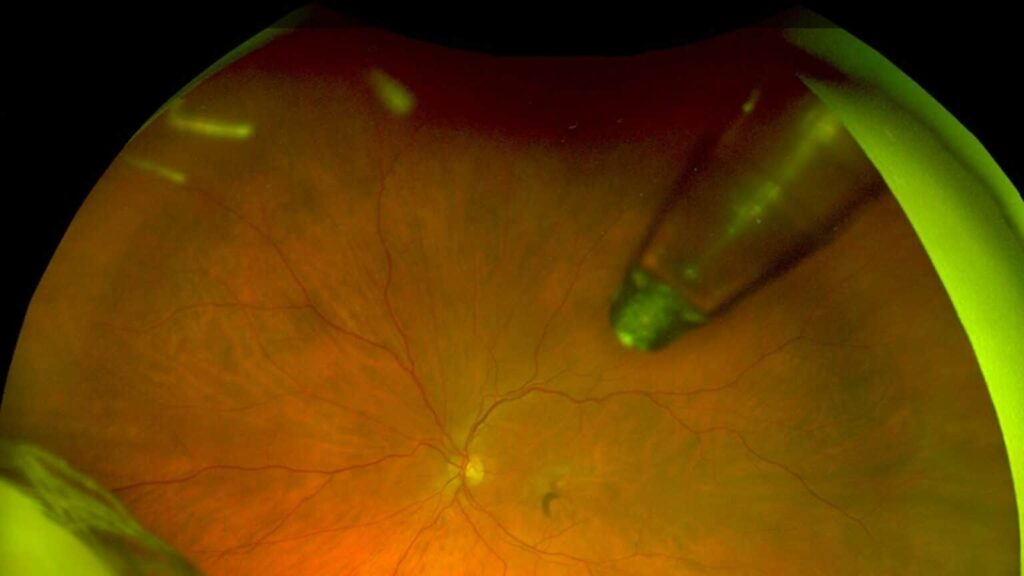
He has a small vitreous hemorrhage in the first week, and it clears without treatment.
At the first refill, the macula is dry, and he keeps his vision at 20/40.
Port Delivery System Versus Injections
The implant lowers the number of visits for patients who respond to ranibizumab.
Injections carry lower surgical risk and allow switching to other drugs.
Therefore, the choice depends on the patient’s response, travel limits, and tolerance for surgical risk.
Pitfalls to Avoid
- Offer the implant only to patients who responded to anti-VEGF drugs
- Watch for early conjunctival thinning over the device
- Schedule a review in the first weeks after surgery
- Keep using OCT, since the implant does not remove the need for imaging
Questions Patients Ask
Patients ask whether the device can be seen or felt, and the answer is usually that it sits under the conjunctiva near the sclera.
They also ask what happens if they miss a refill, and the answer is that the macula may leak and vision may fall.
Explain the risk of infection clearly before surgery.
Key Points
The implant releases ranibizumab slowly, and refills occur about twice a year.
It matched monthly injections in Archway but carries a higher risk of endophthalmitis.
Choose patients carefully and follow them closely.


Document what you see
Two smartphone imaging tools built for everyday clinic use — one for the slit lamp, one for the fundus.
From Choroida — the team behind this siteReferences
- Holekamp NM, Campochiaro PA, Chang MA, et al. Archway randomized phase 3 trial of the port delivery system with ranibizumab for neovascular age-related macular degeneration. Ophthalmology. 2022;129:295-307.
- Campochiaro PA, Marcus DM, Awh CC, et al. The port delivery system with ranibizumab for neovascular age-related macular degeneration: results from the randomized phase 2 Ladder clinical trial. Ophthalmology. 2019;126:1141-1154.
- Flaxel CJ, Adelman RA, Bailey ST, et al. Age-related macular degeneration preferred practice pattern. Ophthalmology. 2020;127:P1-P65.
- American Academy of Ophthalmology. Basic and Clinical Science Course, Section 12: Retina and Vitreous. AAO; current edition.

Writes and reviews the clinical articles on Educate. Every post is checked against peer-reviewed sources before it goes live.