Bacterial conjunctivitis is an infection of the conjunctiva with purulent or mucopurulent discharge.
Most cases are mild and self-limited, so antibiotics change the course only modestly.
Therefore, the main task is to separate it from viral, allergic and sight-threatening causes.
Organisms Behind Bacterial Conjunctivitis
In children, Haemophilus influenzae, Streptococcus pneumoniae and Moraxella catarrhalis are common.
In adults, Staphylococcus aureus is the most frequent cause.
Hyperacute disease suggests Neisseria gonorrhoeae and needs urgent care (see gonococcal conjunctivitis).
Also, chlamydial infection causes a chronic follicular picture (see adult inclusion conjunctivitis).
Clinical Features of Bacterial Conjunctivitis
Patients wake with the lids stuck together, and they have thick yellow or green discharge.
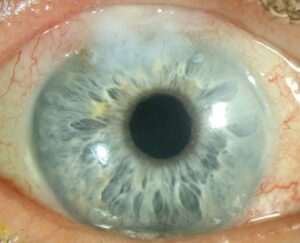
The conjunctiva is red with a papillary reaction, and the cornea is usually clear.
Because vision stays normal and pain is mild, severe pain or blur points elsewhere.
All-fit Slit-Lamp Adapter
Record and share exactly what you see at the slit lamp. One adapter fits any slit lamp or surgical microscope — and any smartphone.
From Choroida — the team behind this siteBacterial Conjunctivitis Versus Viral Disease
Viral disease usually gives watery discharge, follicles and a tender preauricular node.
In one cohort, glued lids on waking, no itching and a previous episode predicted bacterial disease.
Also, no single sign separates the two, so the history and examination work together (see epidemic keratoconjunctivitis).
When to Swab or Culture
Take a swab in hyperacute purulence, in neonates and in contact lens wearers.
Also, culture when the patient is immunocompromised, when symptoms recur or when treatment fails.
Most routine cases do not need culture.
Do Antibiotics Help Bacterial Conjunctivitis
A Cochrane review found that antibiotics raise clinical remission modestly.
Most untreated cases resolve within one to two weeks.
Therefore, delayed prescribing and watchful waiting are acceptable in mild cases.
Choosing Treatment for Bacterial Conjunctivitis
A broad-spectrum topical agent is enough for most patients.
Options include erythromycin ointment, azithromycin, fluoroquinolones and polymyxin-trimethoprim.
Contact lens wearers need cover for Pseudomonas and must stop lens wear, so use a fluoroquinolone (see contact lens-related keratitis).
Infection Control
Advise hand washing, separate towels and no eye makeup sharing.
Also, discard makeup used during the infection.
School exclusion rules vary, so follow local policy.
Red Flags
Refer promptly for pain, photophobia, reduced vision or a corneal infiltrate.
Also refer neonates, because ophthalmia neonatorum can threaten vision (see ophthalmia neonatorum).
Because steroids can worsen infection, avoid them until the diagnosis is clear.
Hyperacute Disease
Hyperacute purulent conjunctivitis develops within 12 to 24 hours with copious discharge, lid swelling and pain.
Gonococcus is the main cause, and it can penetrate an intact cornea.
Therefore, send a swab, start systemic therapy and refer at once.
Also, look for genital infection and treat partners.
Chronic and Recurrent Cases
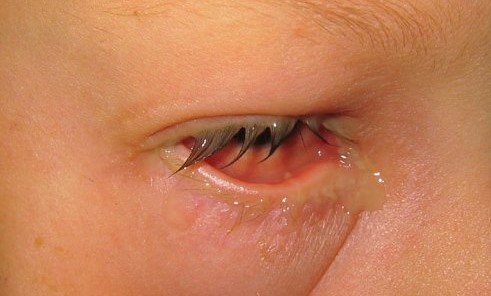
Chronic bacterial conjunctivitis often points to blepharitis, dacryocystitis or Moraxella infection.
Also, a persistent unilateral discharge in a child suggests nasolacrimal duct obstruction (see congenital nasolacrimal duct obstruction).
Therefore, look at the lids and the lacrimal system before you change antibiotics.
Contact Lens Wearers
Stop lens wear until the eye is white and comfortable.
Also, send the lens and the case for culture when there is a corneal infiltrate.
Because Pseudomonas is the main concern, use a fluoroquinolone.
Pediatric Considerations
Children often have bilateral disease with thick discharge.
Also, schools may ask for a doctor’s note.
Because Haemophilus influenzae is common in younger children, check for associated otitis media.
Adverse Effects and Resistance
Topical antibiotics can cause allergy and toxicity of the ocular surface.
Also, overuse promotes resistance.
Therefore, prescribe sparingly and for a short course.
Follow-Up and Counselling
Review the patient if there is no improvement after three to five days.
Also, consider swabs for treatment failure.
Explain that most cases settle, that hands spread infection, and that lenses must stay out.
Clinical Course of Bacterial Conjunctivitis
Symptoms usually appear in one eye and spread to the other within a few days.
Also, discharge and redness peak around the third day and then fade.
Because the course is short, reassure the patient and give clear safety advice.
Diagnostic Pitfalls
Allergic and dry eye disease can produce mucous discharge and redness without infection.
Also, blepharitis and canaliculitis mimic bacterial disease and need different treatment (see canaliculitis).
Therefore, look at the lids, the punctum and the cornea before you prescribe.
Bacterial Conjunctivitis in Adults Versus Children
Children more often have bilateral disease with thick discharge and associated otitis media.
Adults more often have Staphylococcus aureus infection linked to blepharitis.
Also, adults with hyperacute disease need a sexual history and urgent referral.
Because the organisms differ by age, the choice of empirical drops and the follow-up differ too.
Safety Netting for Bacterial Conjunctivitis
Give the patient clear written advice about warning signs.
Pain, light sensitivity and a drop in vision mean that the cornea may be involved.
Also, ask patients to return if symptoms last beyond one week.
Therefore, even a simple case ends with a plan for review.
For the latest studies, see the PubMed results for bacterial conjunctivitis.


Document what you see
Two smartphone imaging tools built for everyday clinic use — one for the slit lamp, one for the fundus.
From Choroida — the team behind this siteReferences
- Azari AA, Barney NP. Conjunctivitis: a systematic review of diagnosis and treatment. JAMA. 2013;310:1721-1729.
- Sheikh A, Hurwitz B, van Schayck CP, McLean S, Nurmatov U. Antibiotics versus placebo for acute bacterial conjunctivitis. Cochrane Database Syst Rev. 2012;(9):CD001211.
- Rietveld RP, ter Riet G, Bindels PJE, Sloos JH, van Weert HCPM. Predicting bacterial cause in infectious conjunctivitis: cohort study on informativeness of combinations of signs and symptoms. BMJ. 2004;329:206-210.
- Varu DM, Rhee MK, Akpek EK, et al. Conjunctivitis Preferred Practice Pattern. Ophthalmology. 2019;126:P94-P169.

Writes and reviews the clinical articles on Educate. Every post is checked against peer-reviewed sources before it goes live.