A newborn with a sticky eye is usually a blocked tear duct. Occasionally it is an organism that can perforate a cornea within two days.
Ophthalmia neonatorum is conjunctivitis occurring in the first month of life, and it is defined by age rather than by cause.
That definition matters, because the causes range from a self-limiting chemical irritation to gonococcal infection that constitutes an ophthalmic emergency.
The neonatal cornea offers little resistance to Neisseria gonorrhoeae, which is one of the few organisms able to penetrate intact corneal epithelium.
The single most useful clinical discriminator is the day of onset, and the second is the character of the discharge.
Recognising the hyperacute presentation, and treating it systemically rather than topically, is what preserves sight in these infants.
What Is Ophthalmia Neonatorum?
Ophthalmia neonatorum, also called neonatal conjunctivitis, is any conjunctival inflammation presenting within the first 28 days of life.
The main causes, and their characteristic timing, are:
- Chemical conjunctivitis – within the first 24 hours, from topical prophylaxis, and self-limiting
- Gonococcal – classically day 2 to 5, hyperacute, with profuse purulent discharge and a genuine risk of corneal perforation
- Chlamydial – typically day 5 to 14, the commonest infectious cause in many settings, with associated risk of pneumonitis
- Other bacterial – staphylococcal, streptococcal and Gram-negative organisms, with variable timing
- Herpes simplex – usually day 6 to 14, often with vesicles, and a marker of potentially disseminated neonatal HSV
Timing narrows the differential quickly, but it is a guide rather than a rule, and cultures still decide the diagnosis.
Epidemiology
The pattern of disease is closely tied to maternal health services and prophylaxis policy.
- Chlamydia is the most frequently identified infectious cause in most high-income settings
- Gonococcal disease is far less common where antenatal screening and neonatal prophylaxis are established, but remains a significant cause elsewhere
- Incidence correlates directly with the prevalence of untreated maternal genital infection
- Transmission is usually during passage through an infected birth canal, though chlamydial infection can occur after caesarean section with ruptured membranes
- Ophthalmia neonatorum remains a preventable cause of childhood blindness in settings without prophylaxis
This is a condition where public health measures – antenatal screening and universal prophylaxis – have done more to reduce blindness than any treatment given after the fact.
All-fit Slit-Lamp Adapter
Record and share exactly what you see at the slit lamp. One adapter fits any slit lamp or surgical microscope — and any smartphone.
From Choroida — the team behind this sitePathophysiology
The neonatal ocular surface is unusually vulnerable, which explains the speed of the disease.
- The newborn conjunctiva lacks mature lymphoid tissue and the infant has limited local immunity
- Tear production and the mechanical clearance it provides are reduced in the first weeks
- Neisseria gonorrhoeae is able to penetrate intact corneal epithelium, unlike most bacteria, which is why it can cause ulceration and perforation so rapidly
- Intense neutrophilic infiltration produces the characteristic profuse purulent discharge and marked lid oedema
- Chlamydia trachomatis is an obligate intracellular organism producing a more indolent papillary conjunctivitis, and true follicles do not form in neonates because lymphoid tissue is immature
The absence of follicles in a neonate is a useful point – chlamydial ophthalmia neonatorum looks different from the follicular chlamydial conjunctivitis seen in older children and adults.
Risk Factors
Maternal
- Untreated maternal gonococcal or chlamydial genital infection
- Absent or inadequate antenatal care and screening
- Active maternal genital herpes at the time of delivery
- Prolonged rupture of membranes
Neonatal
- Vaginal delivery through an infected birth canal
- Prematurity
- Omitted or ineffective neonatal ocular prophylaxis
- Nasolacrimal duct obstruction, which predisposes to secondary bacterial infection
The maternal history is a central part of this diagnosis, and needs to be asked about explicitly rather than assumed from the notes.
Clinical Presentation
Symptoms and Timing
- Eyelid swelling and discharge, with the day of onset guiding the likely organism
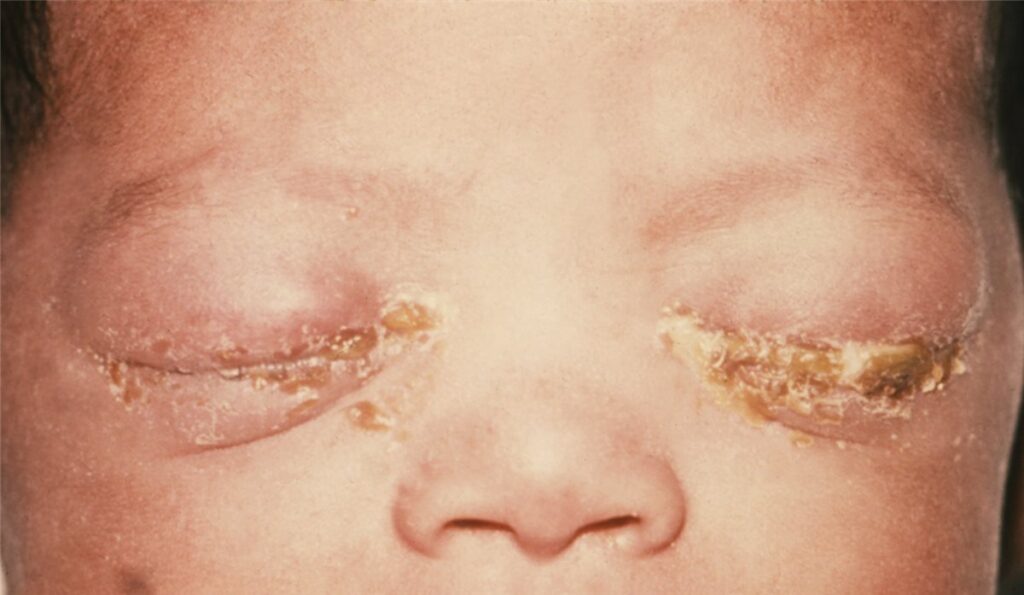
- Hyperacute, copious, thick purulent discharge that reaccumulates within minutes of being cleaned – highly suggestive of gonococcal infection
- More watery or mucopurulent discharge with milder lid swelling in chlamydial disease
- Vesicles on the lids or periocular skin, or a keratitis, suggesting herpes simplex
- Systemic features – respiratory symptoms with chlamydia, or lethargy and poor feeding suggesting disseminated infection
Examination Findings
- Marked, sometimes tense eyelid oedema, which can make examination difficult
- Copious purulent discharge, characteristically under pressure in gonococcal disease
- Intense conjunctival injection and chemosis
- Papillary reaction of the palpebral conjunctiva; follicles are absent in neonates
- Careful corneal assessment for haze, ulceration or perforation – the finding that determines urgency
- A pseudomembrane may be present in severe cases
The cornea must be examined in every case, however difficult the lids make it, because corneal involvement changes this from an outpatient problem to an emergency admission.
Diagnostic Evaluation
Microbiology
- Conjunctival swabs for Gram stain, which can show Gram-negative intracellular diplococci in gonococcal infection and allow immediate treatment
- Culture on appropriate media, including chocolate agar for Neisseria
- Nucleic acid amplification testing for Chlamydia trachomatis, which is more sensitive than culture
- Viral PCR and culture where herpes simplex is suspected
Systemic Assessment
- Evaluation for disseminated gonococcal infection, including arthritis, sepsis and meningitis
- Assessment for chlamydial pneumonitis, which can develop weeks after the conjunctivitis
- Full septic screen and paediatric involvement where systemic infection is suspected
Parental Investigation
- Both parents require sexual health assessment and treatment
- Untreated parental infection is a route to reinfection and to further affected children
Treating the baby without treating the parents leaves the problem in place, so referral to sexual health services is part of the management, not an optional extra.
Differential Diagnosis
Conditions to distinguish from infectious ophthalmia neonatorum include:
- Chemical conjunctivitis – within 24 hours of prophylaxis, mild, and resolving spontaneously
- Congenital nasolacrimal duct obstruction – persistent watering and mild mucoid discharge without significant lid swelling or injection
- Congenital glaucoma – watering and photophobia with corneal haze and an enlarged cornea, not discharge
- Dacryocystitis – swelling centred over the lacrimal sac at the medial canthus
- Preseptal or orbital cellulitis – diffuse lid erythema rather than conjunctival discharge as the dominant feature
Congenital glaucoma is the important non-infectious mimic, because a watering, photophobic infant with a hazy cornea has a completely different and equally urgent pathway.
Management
Gonococcal Disease – An Emergency
- Systemic antibiotic therapy, typically a single dose of a third-generation cephalosporin such as ceftriaxone or cefotaxime – topical treatment alone is inadequate
- Frequent saline irrigation of the conjunctival sac to clear the purulent discharge
- Hospital admission, paediatric involvement and assessment for disseminated infection
- Urgent ophthalmology review with close monitoring of the cornea
Chlamydial Disease
- Systemic oral macrolide therapy, since topical treatment does not eradicate nasopharyngeal carriage and does not prevent pneumonitis
- Awareness of the association between oral erythromycin in young infants and infantile hypertrophic pyloric stenosis
- Follow-up for respiratory symptoms in the weeks after treatment
Other Causes and Prevention
- Herpes simplex requires systemic aciclovir and paediatric assessment for disseminated or CNS disease, alongside topical antiviral therapy
- Other bacterial causes are treated with topical antibiotics guided by culture
- Neonatal ocular prophylaxis at birth, where policy provides for it, together with antenatal screening and treatment of maternal infection
The recurring theme across the two most serious causes is the same: both need systemic treatment, and topical therapy alone is a treatment failure waiting to happen.
Prognosis
Outcome depends almost entirely on cause and on how quickly systemic treatment starts.
- Chemical conjunctivitis resolves within a day or two with no sequelae
- Chlamydial conjunctivitis has a good ocular prognosis when treated, though untreated infants risk pneumonitis
- Gonococcal infection treated promptly usually resolves without visual loss
- Delayed gonococcal treatment can cause corneal ulceration, perforation, endophthalmitis and permanent blindness
- Neonatal herpes carries a prognosis dominated by the systemic disease rather than the eye
Ophthalmia neonatorum is one of the clearest examples in ophthalmology of a condition where the difference between a normal eye and a blind one is measured in hours of delay.

Document what you see
Two smartphone imaging tools built for everyday clinic use — one for the slit lamp, one for the fundus.
From Choroida — the team behind this siteReferences
- World Health Organization. WHO guidelines for the treatment of Neisseria gonorrhoeae.
- Centers for Disease Control and Prevention. Sexually Transmitted Infections Treatment Guidelines: Ophthalmia Neonatorum.
- Matejcek A, Goldman RD. Treatment and prevention of ophthalmia neonatorum. Canadian Family Physician. 2013.
- Ophthalmia Neonatorum. StatPearls, NCBI Bookshelf.
- Ophthalmia Neonatorum. EyeWiki, American Academy of Ophthalmology.
Test yourself
A few questions straight from this article.
-
How is ophthalmia neonatorum defined?
Ophthalmia neonatorum is defined by age rather than by cause: any conjunctival inflammation presenting within the first 28 days of life. -
Which cause of neonatal conjunctivitis appears within the first 24 hours and is self-limiting?
Chemical conjunctivitis follows topical prophylaxis within the first 24 hours, is mild and resolves spontaneously within a day or two without sequelae. -
Which discharge pattern in a newborn most strongly suggests gonococcal ophthalmia neonatorum?
Hyperacute, copious purulent discharge under pressure that reaccumulates within minutes of being cleaned is highly suggestive of gonococcal infection, classically on days 2 to 5. -
Why can Neisseria gonorrhoeae perforate a neonatal cornea so rapidly?
Neisseria gonorrhoeae is one of the few organisms able to penetrate intact corneal epithelium, which is why ulceration and perforation can follow so quickly. -
Why does chlamydial conjunctivitis in a neonate produce papillae rather than follicles?
True follicles do not form in neonates because conjunctival lymphoid tissue is immature, so neonatal chlamydial disease looks different from the follicular conjunctivitis of older patients. -
Which Gram stain finding on a neonatal conjunctival swab permits immediate treatment for gonococcal disease?
Gram-negative intracellular diplococci on the conjunctival smear indicate gonococcal infection and allow treatment to be started immediately, before culture results. -
Which non-infectious condition is the important mimic of ophthalmia neonatorum?
Congenital glaucoma causes watering and photophobia with corneal haze and an enlarged cornea rather than discharge, and needs an entirely different but equally urgent pathway. -
What is the correct treatment for confirmed gonococcal ophthalmia neonatorum?
Gonococcal disease requires systemic therapy such as ceftriaxone or cefotaxime plus frequent saline irrigation and admission; topical treatment alone is inadequate. -
Why is chlamydial ophthalmia neonatorum treated with a systemic oral macrolide?
Topical treatment does not eradicate nasopharyngeal carriage and does not prevent pneumonitis, so a systemic macrolide is used, with awareness of the erythromycin association with infantile hypertrophic pyloric stenosis. -
What is the consequence of delayed systemic treatment in gonococcal ophthalmia neonatorum?
Promptly treated gonococcal infection usually resolves without visual loss, whereas delay can lead to corneal ulceration, perforation, endophthalmitis and permanent blindness.

Writes and reviews the clinical articles on Educate. Every post is checked against peer-reviewed sources before it goes live.