Natamycin versus voriconazole was a question that clinicians could not answer for many years, because doctors used both drugs and no head-to-head trial existed.
The Mycotic Ulcer Treatment Trials gave clear data, and they changed the first-line choice for filamentous fungal keratitis.
Knowing what they showed, and what they did not, helps in daily practice.
Why Natamycin Versus Voriconazole Mattered
Fungal keratitis is hard to treat, because few antifungal drugs penetrate the cornea.
Many ulcers end in scarring or perforation.
Natamycin 5 percent was the only commercial topical antifungal for decades, and voriconazole 1 percent, a drug with a broad spectrum and good penetration, was seen as a modern alternative.
Reports from case series pointed in both directions, so a randomized trial was needed (see fungal versus bacterial keratitis).
Natamycin Versus Voriconazole: Design of MUTT I
The trial enrolled patients with smear-positive filamentous fungal ulcers and visual acuity of 20/40 to 20/400 in southern India.
Investigators randomized patients to topical natamycin 5 percent or topical voriconazole 1 percent, given every hour while awake for the first week and then tapered according to response.
The primary outcome was best spectacle-corrected acuity at three months, and secondary outcomes included scar size, perforation, and need for keratoplasty (see the references).
All-fit Slit-Lamp Adapter
Record and share exactly what you see at the slit lamp. One adapter fits any slit lamp or surgical microscope — and any smartphone.
From Choroida — the team behind this siteResults of Natamycin Versus Voriconazole
- Natamycin gave a better three-month acuity, by about one and a half lines on the chart
- Perforation or the need for therapeutic keratoplasty was less common in the natamycin group
- The difference was greatest in Fusarium ulcers, where natamycin performed much better (see Fusarium keratitis)
- In Aspergillus ulcers the difference was smaller and not clearly significant
- Scar size and infiltrate size were smaller with natamycin
The conclusion was that natamycin is the better first drug for filamentous keratitis, at least for the organisms common in the study.
MUTT II and the Question of Oral Voriconazole
Also, the second trial tested the addition of oral voriconazole to topical therapy in severe ulcers.
The oral drug did not reduce the rate of perforation or the need for keratoplasty.
Experts did not recommend it as routine treatment (see the references).
This result discouraged the routine use of systemic therapy, except in deep infection, endophthalmitis, or scleral spread.
Practical Dosing
- Natamycin 5 percent: one drop every hour while awake at first, then every two hours after improvement, with a taper over weeks
- Voriconazole 1 percent: the same schedule, used as an add-on or when natamycin is not available
- Continue treatment for several weeks, and stop only when the infiltrate has healed and the epithelium has closed
- Take repeat scrapings if there is no response in a week
Natamycin is a suspension, so shake the bottle well before use, and warn the patient about the white residue on the lids.
Natamycin Versus Voriconazole: Limitations of the Evidence
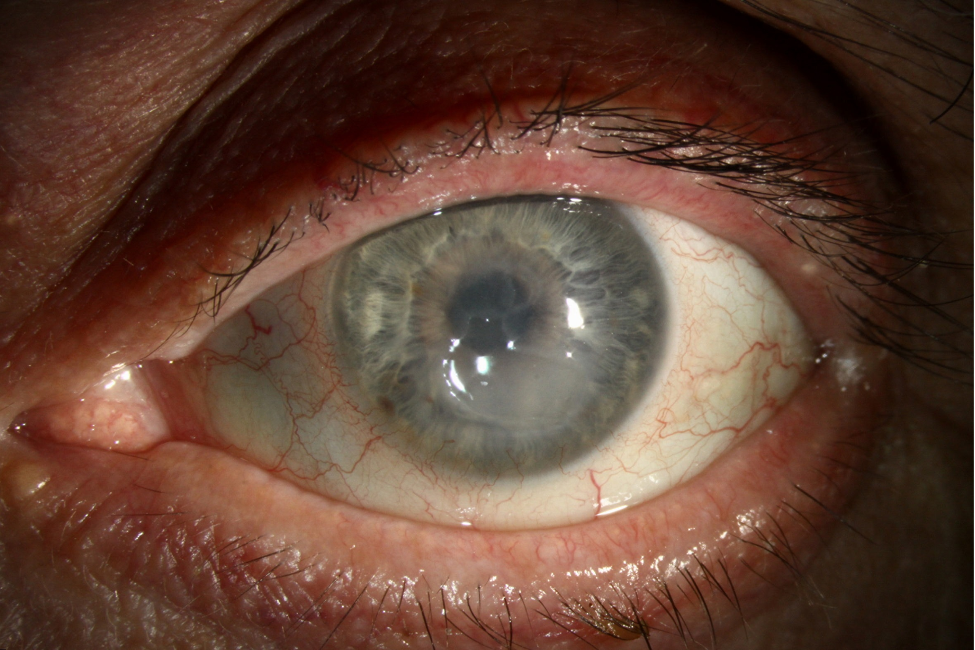
Investigators ran the trial in one region, with mostly Fusarium and Aspergillus species.
The findings may also differ for Candida or for yeast ulcers.
Natamycin is not available in every country, and access shapes the choice in practice.
Delayed presentation and prior treatment with steroids affect outcomes, and you cannot apply the trial data to every case.
Where Do We Go From Here?
Researchers are studying newer agents and combinations, such as intrastromal injections, and cross-linking adjuncts have so far shown mixed results.
Early scraping and rapid species identification remain the practical steps that improve the odds.
Dosing Notes for Special Situations
In deep ulcers that extend more than halfway into the stroma, many specialists add an intrastromal injection of voriconazole, with the dose and timing chosen by the surgeon.
Some use intracameral injection when there is a hypopyon with endothelial plaque.
In patients who cannot attend frequent visits, clinicians may simplify the schedule to four times daily after the first days, though a lower frequency may reduce the effect.
Choosing When Natamycin Is Not Available
Where natamycin is unavailable, clinicians also use topical voriconazole, amphotericin B, or compounded preparations.
The choice depends on local supply and on the organism.
Clinicians often use topical amphotericin B 0.15 percent for yeast ulcers and for resistant molds, with local irritation as the main side effect.
Monitoring Response
Follow the size of the infiltrate and the epithelial defect at each visit, and watch for new satellite lesions and a rising hypopyon.
Improvement is slow, and do not change treatment too early unless the ulcer clearly worsens, in which case repeat scraping, culture, and consideration of a second agent or surgery are advised.
For the latest studies, see the PubMed results for natamycin versus voriconazole.


Document what you see
Two smartphone imaging tools built for everyday clinic use — one for the slit lamp, one for the fundus.
From Choroida — the team behind this siteReferences
- Prajna NV, Krishnan T, Mascarenhas J, et al. The Mycotic Ulcer Treatment Trial: a randomized trial comparing natamycin vs voriconazole. JAMA Ophthalmol. 2013;131:422-429.
- Prajna NV, Krishnan T, Rajaraman R, et al. Effect of oral voriconazole on fungal keratitis in the Mycotic Ulcer Treatment Trial II (MUTT II): a randomized clinical trial. JAMA Ophthalmol. 2016;134:1365-1372.
- Thomas PA, Kaliamurthy J. Mycotic keratitis: epidemiology, diagnosis and management. Clin Microbiol Infect. 2013;19:210-220.
- American Academy of Ophthalmology. Basic and Clinical Science Course, Section 8: External Disease and Cornea. AAO; current edition.

Writes and reviews the clinical articles on Educate. Every post is checked against peer-reviewed sources before it goes live.