Monovision cataract surgery aims for one eye to be focused for distance and the other for near, so the patient can function at both distances without glasses.
It is also a simple strategy that uses standard monofocal lenses, and it works well for many patients.
Not everyone adapts, and a short trial before surgery helps to identify those who will not.
What Is Monovision Cataract Surgery?
Surgeons also set the dominant eye for distance vision and make the nondominant eye mildly myopic for near.
The brain learns to suppress the blur from the eye that is also out of focus, and most patients adapt in days to weeks.
Also, the amount of anisometropia that surgeons accept varies, but a difference of about 1.25 to 2.0 diopters is typical.
Surgeons call a smaller difference of 0.75 to 1.25 diopters mini-monovision.
Monovision is a long-standing technique in contact lens practice for presbyopia (see presbyopia).
Surgeons have adapted it to refractive surgery and to cataract surgery.
Monovision Cataract Surgery: Advantages
- Reduced dependence on glasses for reading and distance
- Use of monofocal lenses, which give the best image quality and contrast
- Lower cost and fewer halos and glare than with multifocal lenses
- A reversible option if the patient does not adapt, with a lens exchange or glasses
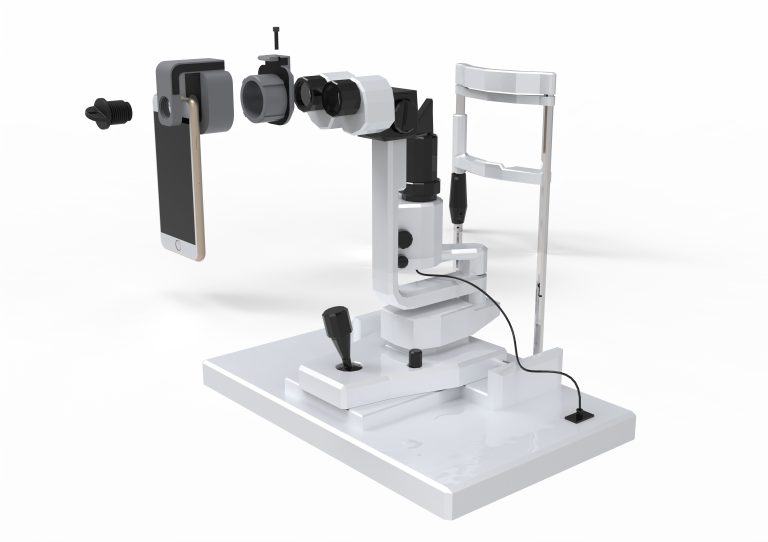
All-fit Slit-Lamp Adapter
Record and share exactly what you see at the slit lamp. One adapter fits any slit lamp or surgical microscope — and any smartphone.
From Choroida — the team behind this siteDisadvantages
- A loss of stereopsis and depth perception, which can be a problem for some tasks
- Reduced intermediate vision in some patients
- Difficulty with night driving, due to blur in the near eye and imbalance
- Possible symptoms of headache, asthenopia, or unwanted blur
- A need for glasses for demanding tasks, such as prolonged reading or driving at night
Patients with a tendency toward strabismus, large heterophorias, or poor fusion may decompensate.
Monovision Cataract Surgery: Selecting Patients
Monovision suits patients who have previously tolerated it in contact lenses or after refractive surgery.
Surgeons can offer it to those who want to reduce glasses but do not want the halos of multifocal lenses.
Consider the occupation: pilots, professional drivers, and those who need fine depth perception may not be good candidates.
A patient with an unhealthy eye or a very different refractive error in the two eyes needs individual planning.
Contact Lens Trial
A trial of monovision with contact lenses, or with trial frames, before surgery predicts the success of the plan.
Put a lens that gives about 1.5 diopters of myopia in the nondominant eye, and have the patient wear it for several days in the usual activities.
Those who tolerate the trial are likely to do well, and those who do not are better served by another plan.
Test eye dominance with the hole-in-card test or a similar method, and note that the dominant eye is not always the right eye.
Monovision Cataract Surgery: Planning the Lenses
Plan the operation as for any phacoemulsification (see phacoemulsification), use accurate biometry and a good formula, and aim for emmetropia in the distance eye and a mild myopic target in the near eye (see IOL power calculation formulas).
Perform the second eye soon after the first when possible, so the patient does not stay long with a large imbalance.
If the surgeon operates on the first eye with a myopic target and the patient dislikes it, a contact lens can test the other option.
Satisfaction and Follow-Up
Studies report satisfaction rates of about 80 to 90 percent in patients who chose monovision after a trial.
The common reasons for dissatisfaction include poor night vision and loss of stereopsis.
Follow patients for the first weeks, and offer a refractive touch-up or lens adjustment if the result is not tolerated.
Explain that glasses may still be needed for some tasks, and that the choice is not irreversible.
Special Groups
Patients with early macular disease, glaucoma, or other conditions that reduce contrast may find monovision more difficult.
A smaller anisometropia may be wiser.
In patients with a history of amblyopia or a preexisting strabismus, the benefits and risks need careful discussion.
Patients with a history of monovision in contact lenses, who are comfortable, are good candidates.
Counsel against it in those who never tolerated it.
Driving and Safety
Explain that night driving may be less comfortable, and that patients can use a pair of distance glasses that corrects the near eye for long trips or at night.
Check the legal driving requirements, since some countries have requirements related to monocular acuity.
Patients should know that depth perception may be slightly reduced for the first weeks.
Combining Monovision With Other Lenses
Some surgeons combine a monofocal distance lens in one eye with an extended depth of focus lens in the other, to give intermediate vision without large halos.
The choice depends on the patient’s goals and the available lens platforms, and the surgeon should be familiar with the lens used.
For the latest studies, see the PubMed results for monovision cataract surgery.
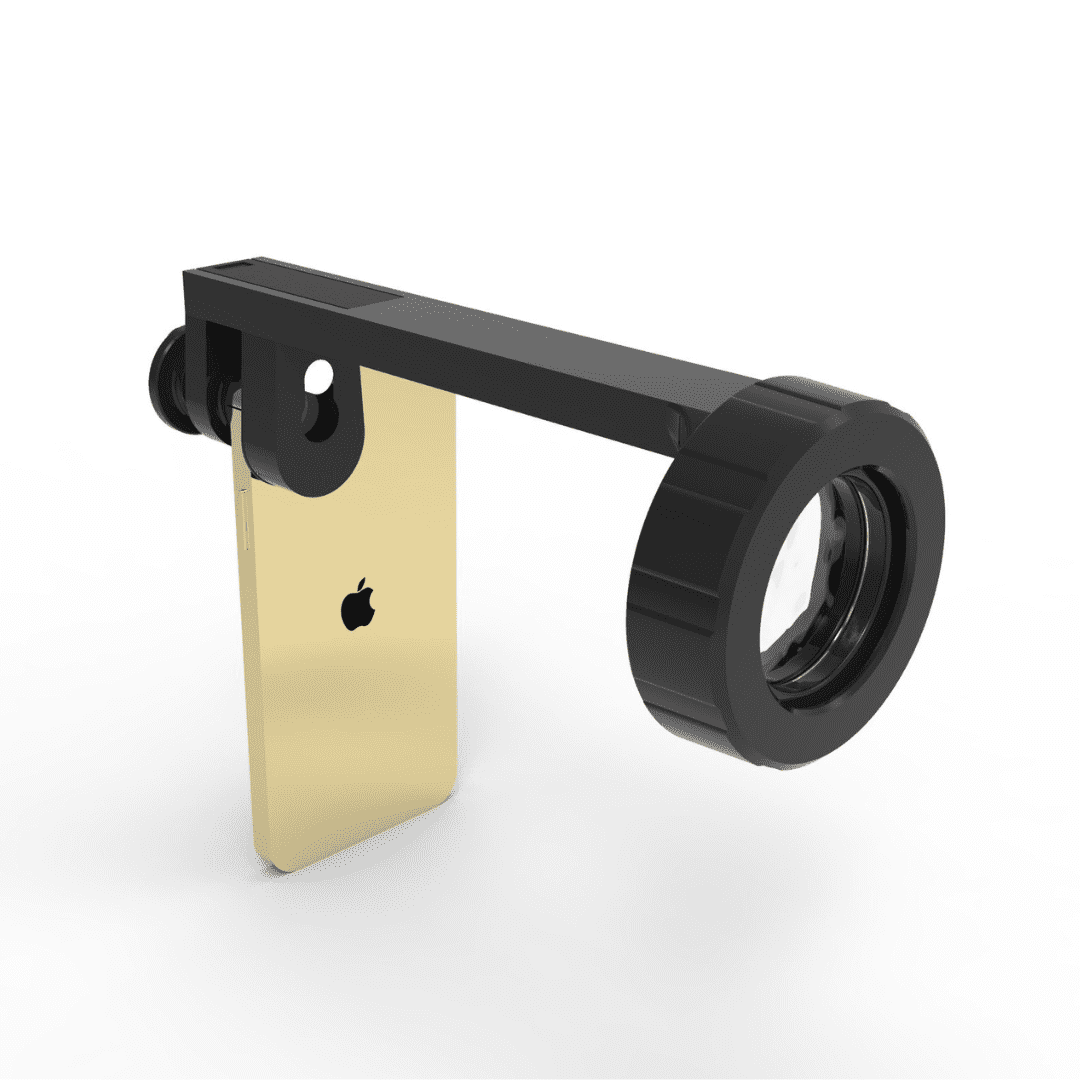
Document what you see
Two smartphone imaging tools built for everyday clinic use — one for the slit lamp, one for the fundus.
From Choroida — the team behind this siteReferences
- Finkelman YM, Ng JQ, Barrett GD. Patient satisfaction and visual function after pseudophakic monovision. J Cataract Refract Surg. 2009;35:998-1002.
- Jain S, Arora I, Azar DT. Success of monovision in presbyopes: review of the literature and potential applications to refractive surgery. Surv Ophthalmol. 1996;40:491-499.
- Salmon JF. Kanski’s Clinical Ophthalmology: A Systematic Approach. 9th ed. Elsevier; 2020.
- American Academy of Ophthalmology. Basic and Clinical Science Course, Section 11: Lens and Cataract. AAO; current edition.

Writes and reviews the clinical articles on Educate. Every post is checked against peer-reviewed sources before it goes live.