Povidone-iodine before intravitreal injection is the single most useful step to prevent endophthalmitis.
Each injection passes a needle through a surface that carries bacteria.
Therefore, the antisepsis routine matters as much as the drug.
Why Antisepsis Matters
Endophthalmitis after intravitreal injection is rare but can destroy vision.
The incidence is roughly one case per few thousand injections.
Also, patients in anti-VEGF programs receive many injections over the years.
As a result, small differences in technique add up to real cases.
How Povidone-Iodine Works
Free iodine kills a wide range of bacteria, fungi and viruses within seconds.
It acts on the conjunctival flora that would otherwise enter the eye.
Also, resistance is not a concern with this agent.
Therefore, it is a better choice than a topical antibiotic.
Fundus Explorer Pro
Photograph the retinal findings described here with the phone already in your pocket — 22 D optics and built-in illumination in one handheld unit.
From Choroida — the team behind this siteThe Evidence Behind Povidone-Iodine Before Intravitreal Injection
Speaker and Menikoff showed that a 5 percent solution lowered conjunctival bacterial counts and endophthalmitis in surgery.
Later guidelines applied the same principle to injections.
Also, the Euretina and US panel statements both place it first.
In addition, no antibiotic has matched its effect.
Povidone-Iodine Concentration
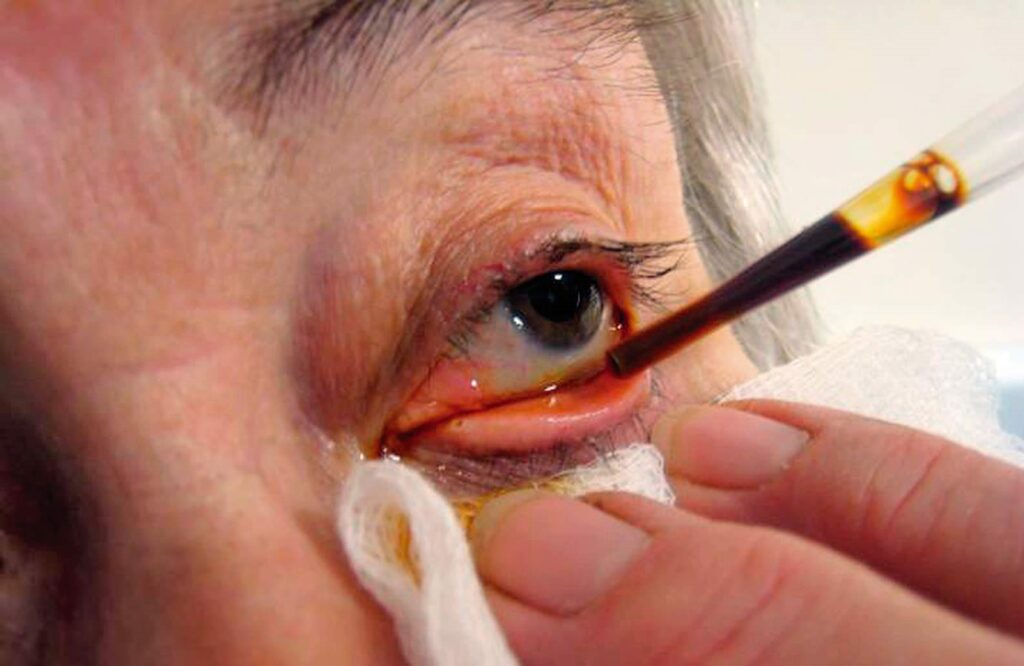
Use a 5 percent solution on the conjunctiva and eyelid margin.
A 10 percent preparation suits the skin but irritates the cornea.
Also, weak dilutions such as 0.25 percent lack proof of equal effect.
As a result, stay with the 5 percent product.
Povidone-Iodine Contact Time
Apply the solution to the injection site and the surrounding conjunctiva.
Allow at least 30 seconds before the needle passes.
Also, a longer wait lowers the bacterial load further.
Therefore, do not wipe the solution away early.
Eyelids, Lashes and Speculum
Clean the lid skin and lashes, then place a sterile speculum to keep the lashes away.
The needle should never touch the lid margin.
Also, a drape is optional but helps in anxious patients.
In addition, use sterile gloves for each patient.
Masks and Talking
Oral flora, especially streptococci, can reach the eye in droplets during speech.
Studies showed that dispersal of bacteria is lower when the clinician wears a mask or stays quiet.
Also, the patient should avoid talking during the injection.
Therefore, make masks routine for every injector in the room.
Topical Antibiotics
Topical antibiotics after the injection did not lower endophthalmitis rates in large series.
They may select resistant organisms in the conjunctiva.
Also, patients dislike the extra drops and may stop treatment.
As a result, expert panels no longer recommend them as routine.
Allergy to Povidone-Iodine
True iodine allergy is rare, and shellfish allergy does not predict it.
Most reports describe contact dermatitis of the lid skin.
Also, a patient with a documented reaction needs an alternative.
Therefore, ask about the actual reaction before choosing.
Chlorhexidine as an Alternative
Dilute aqueous chlorhexidine at 0.05 to 0.1 percent is an accepted alternative.
It has strong activity against common skin organisms.
Also, it can irritate the cornea at higher concentrations.
In addition, use only preparations made for ocular use.
Ocular Reactions to Povidone-Iodine
Povidone-iodine can cause mild epithelial keratopathy and conjunctival injection.
Patients may notice brief stinging.
Also, severe toxicity is unusual with the 5 percent solution.
Therefore, reassure patients and rinse only if a reaction occurs.
Practical Checklist
Confirm the eye, the drug and the consent.
Apply anesthesia, clean the lids, instill povidone-iodine and wait.
Also, inject with a clean technique in the quadrant planned.
In addition, check vision and pressure afterward.
Recognizing Early Endophthalmitis
Patients present with pain, redness and falling vision within days of injection.
Hypopyon and vitritis are late signs.
Also, treat suspected cases at once with a tap and injection of antibiotics (see endophthalmitis).
As a result, give patients clear instructions to call the same day.
Pitfalls to Avoid
- Do not shorten the contact time to speed up the clinic
- Never use the 10 percent solution on the cornea
- Do not rely on antibiotic drops as a substitute
- Never ignore a call about pain after injection
Anesthesia Before the Injection
Topical anesthetic drops or gel should work fully before the antiseptic goes on.
A subconjunctival anesthetic bleb is an alternative in anxious patients.
Also, wait for the lid to relax.
Therefore, comfort and sterility go together.
Injection Site and Needle
Mark the site 3.5 to 4 millimeters behind the limbus.
Use a 30-gauge needle and a steady, perpendicular entry.
Also, avoid the horizontal meridian.
As a result, the risk of lens injury falls.
Documentation and Audit
Record the batch of the antiseptic and the drug.
Track each case of endophthalmitis in the clinic.
Also, review the technique after any case.
In addition, share the results with the whole team.
For the latest studies, see the PubMed results for povidone-iodine.


Document what you see
Two smartphone imaging tools built for everyday clinic use — one for the slit lamp, one for the fundus.
From Choroida — the team behind this siteReferences
- Speaker MG, Menikoff JA. Prophylaxis of endophthalmitis with topical povidone-iodine. Ophthalmology. 1991;98:1769-1775.
- Avery RL, Bakri SJ, Blumenkranz MS, et al. Intravitreal injection technique and monitoring: updated guidelines of an expert panel. Retina. 2014;34(Suppl 12):S1-S18.
- Grzybowski A, Told R, Sacu S, et al. 2018 update on intravitreal injections: Euretina expert consensus recommendations. Ophthalmologica. 2018;239:181-193.
- Storey P, Dollin M, Pitcher J, et al. The role of topical antibiotic prophylaxis to prevent endophthalmitis after intravitreal injection. Ophthalmology. 2014;121:283-289.

Writes and reviews the clinical articles on Educate. Every post is checked against peer-reviewed sources before it goes live.