Hydroxychloroquine screening aims to find retinal toxicity before it causes visible damage to central vision.
The American Academy of Ophthalmology published revised recommendations in 2016, based on dose, duration, and risk factors.
Therefore, the clinician can tailor the schedule to each patient.
Risk of Toxicity and Hydroxychloroquine Screening
Melles and Marmor studied more than 2000 long-term users.
At a dose of 5 mg per kilogram or less, the risk was under 1 percent in the first five years.
It stayed under 2 percent up to ten years, and it approached 20 percent after twenty years.
Therefore, risk rises sharply with duration, and screening should intensify after five years.
Dose Limit in Hydroxychloroquine Screening
Use a maximum of 5.0 mg per kilogram of real body weight per day.
Also, base the dose on real weight, not ideal weight.
Marmor and colleagues set this limit in the 2016 revision, which lowered the earlier ceiling.
Because the dose depends on body weight, recalculate it after large weight changes.
Fundus Explorer Pro
Photograph the retinal findings described here with the phone already in your pocket — 22 D optics and built-in illumination in one handheld unit.
From Choroida — the team behind this siteMajor Risk Factors in Hydroxychloroquine Screening
- Daily dose above 5 mg per kilogram
- Duration of therapy above five years
- Reduced kidney function
- Concurrent tamoxifen use (see tamoxifen retinopathy)
- Preexisting macular disease
Patients with these factors need earlier and more frequent screening.
Tests Used in Hydroxychloroquine Screening
Perform automated visual fields with a 10-2 white stimulus and spectral-domain OCT.
Add fundus autofluorescence or multifocal ERG when results are equivocal (see fundus autofluorescence).
Also, Asian patients often show a pericentral pattern, so add wider fields such as 24-2 or 30-2.
Melles and Marmor described this racial difference in 2015.
Schedule of Hydroxychloroquine Screening
First, perform a baseline examination within the first year of therapy.
Then start annual screening after five years in patients without major risk factors.
Also, screen yearly from the start when major risk factors exist.
Document the dose and the weight at each visit.
Recognizing Toxicity in Hydroxychloroquine Screening
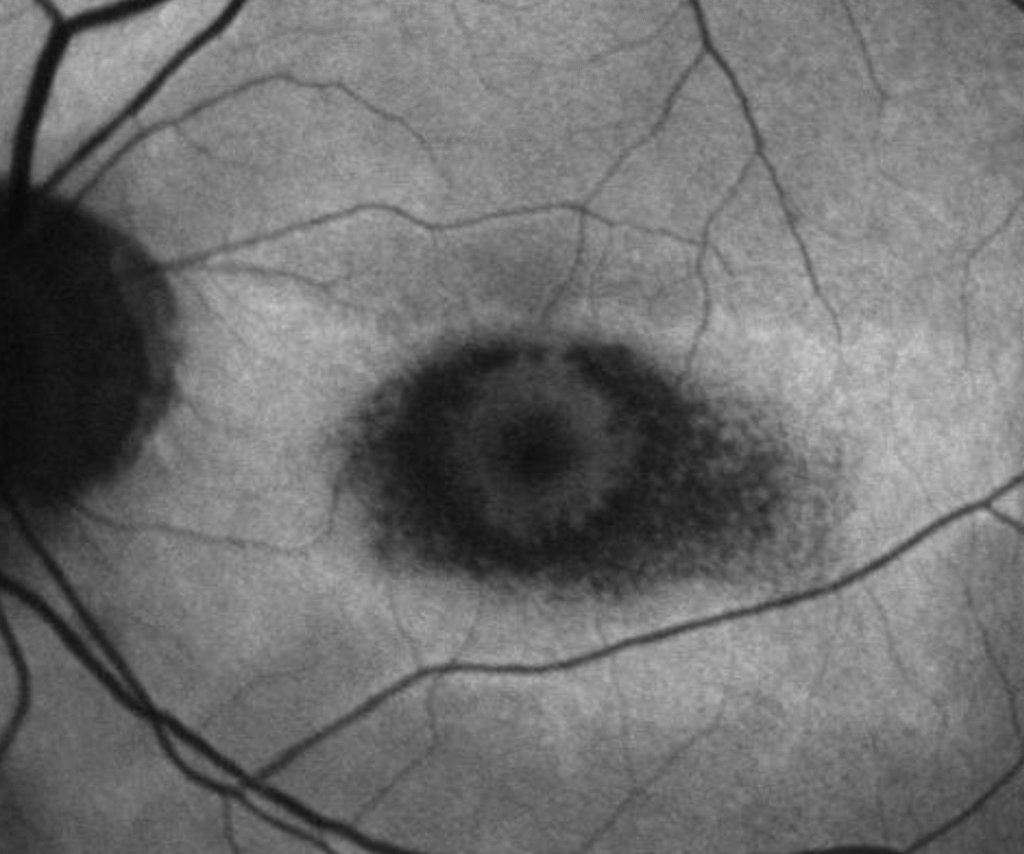
Early damage appears as parafoveal loss of the ellipsoid zone on OCT and ring scotomas on fields.
Advanced disease produces a bull’s-eye pattern (see bull’s-eye maculopathy).
Therefore, act on early signs, because damage can progress after stopping.
What to Do When Toxicity Appears
Discuss stopping the drug with the prescribing physician and weigh the benefits for the underlying disease.
Also repeat testing to confirm the finding.
For the full clinical picture, see hydroxychloroquine toxicity.
Patient Counselling
Explain why the tests matter, even when vision is normal.
Also tell patients to report new blurred vision, and to keep the appointments.
Because toxicity can appear without symptoms, the tests protect the patient.
Take-Home Message
Screening works best when the dose is correct and the tests are on schedule.
Also, early recognition limits the damage.
Therefore, build a recall system for every patient on the drug.
Why a Baseline Matters
A baseline examination shows preexisting macular disease that affects later interpretation.
Also, it gives a reference for future OCT and field results.
Because toxicity is rare in the first years, the baseline mainly establishes a comparison.
Then record the dose per kilogram in the chart.
OCT Signs to Know
Early damage shows loss of the parafoveal ellipsoid zone.
In more advanced cases, the outer retina thins and looks like a flying saucer in cross section.
Also, the pattern differs in Asian patients, who often show pericentral change.
Therefore, scan beyond the fovea when you suspect toxicity.
Pitfalls With Visual Fields
Automated fields produce false positives, especially in older patients.
Also, learning effects and fatigue distort results.
Therefore, repeat abnormal tests and correlate with OCT before you act.
Avoid red stimuli, since they are less reliable in this setting.
Communication With the Prescriber
Send a short report after each screening visit.
Also state the dose limit, so that the prescriber can adjust the dose.
Because the drug protects patients with lupus and rheumatoid arthritis, avoid stopping it without evidence of toxicity.
Then agree on the next review date.
Chloroquine Needs a Lower Dose
Chloroquine carries a higher risk than hydroxychloroquine.
The daily dose should stay at or below 2.3 mg per kilogram of real weight.
Also, the same tests apply, and the schedule is the same.
Therefore, adapt the dose calculation to the drug.
Key Points for the Clinician
Use a dose of 5.0 mg per kilogram or less.
Also, screen with fields and OCT after five years, or earlier with risk factors.
Because early detection prevents loss, keep to the schedule.


Document what you see
Two smartphone imaging tools built for everyday clinic use — one for the slit lamp, one for the fundus.
From Choroida — the team behind this siteReferences
- Marmor MF, Kellner U, Lai TY, Melles RB, Mieler WF. Recommendations on screening for chloroquine and hydroxychloroquine retinopathy (2016 revision). Ophthalmology. 2016;123:1386-1394.
- Melles RB, Marmor MF. The risk of toxic retinopathy in patients on long-term hydroxychloroquine therapy. JAMA Ophthalmol. 2014;132:1453-1460.
- Melles RB, Marmor MF. Pericentral retinopathy and racial differences in hydroxychloroquine toxicity. Ophthalmology. 2015;122:110-116.
- Marmor MF, Kellner U, Lai TY, et al. Revised recommendations on screening for chloroquine and hydroxychloroquine retinopathy. Ophthalmology. 2011;118:415-422.

Writes and reviews the clinical articles on Educate. Every post is checked against peer-reviewed sources before it goes live.