The Tube Versus Trabeculectomy Study (TVT) compared a Baerveldt glaucoma implant with trabeculectomy using mitomycin C in eyes that had failed earlier treatment.
It is also the main randomized trial. It guides the choice between a tube and a filter in eyes with a poorer outlook (see glaucoma drainage device and trabeculectomy).
Design of the Tube Versus Trabeculectomy Study
The trial enrolled 212 eyes of patients aged 18 to 85 with uncontrolled glaucoma who had previous cataract surgery, previous failed filtering surgery, or both.
Also, eyes were randomized to a 350 square millimeter Baerveldt implant or to trabeculectomy with mitomycin C, and followed for five years (see the references).
Investigators defined treatment failure as a pressure over 21 mmHg or not reduced by at least 20 percent. They also counted a pressure of 5 mmHg or less, additional glaucoma surgery, or loss of light perception.
Tube Versus Trabeculectomy Study: Five-Year Results
The cumulative probability of treatment failure was about 30 percent with the tube and 47 percent with trabeculectomy (see the references).
The most frequent cause of failure after trabeculectomy was a pressure that was too high. After the tube, it was the need for a reoperation or a pressure out of range.
Also, the difference favored the tube mainly in the first years and narrowed later.
All-fit Slit-Lamp Adapter
Record and share exactly what you see at the slit lamp. One adapter fits any slit lamp or surgical microscope — and any smartphone.
From Choroida — the team behind this sitePressure and Medications
The mean pressure at five years was a little higher in the tube group, about 14 mmHg against 13 mmHg.
The tube group used more medications, about 1.4 drugs against 0.5, since the trabeculectomy group often stopped treatment.
Visual acuity, however, was similar in both groups.
Tube Versus Trabeculectomy Study: Complications
- Early: hypotony, choroidal effusion, and a shallow chamber, more often after trabeculectomy
- Late with trabeculectomy: bleb leaks, blebitis, and endophthalmitis (see bleb-associated endophthalmitis)
- Late with the tube: tube erosion, corneal decompensation, and diplopia
Reoperation for complications was more frequent in the trabeculectomy group, and rates of serious complications were similar over five years (see the references).
Tube Versus Trabeculectomy Study: Which Eyes Do Better With Which Procedure?
Eyes with conjunctival scarring, prior failed trabeculectomy, uveitis, or neovascular glaucoma may also do better with a tube.
In addition, eyes with a low target pressure, a healthy conjunctiva, and good compliance may do well with trabeculectomy, which reaches lower pressures with fewer drops.
Limits of the Study
The study used a Baerveldt implant, and its findings may not apply to valved devices such as the Ahmed, which behave differently (see the references).
It included only eyes with previous surgery, so results in primary surgery cannot be assumed.
Tube Versus Trabeculectomy Study: Practical Use
Discuss both options with the patient, explain the different complication profiles, and then choose by the eye and the surgeon’s experience.
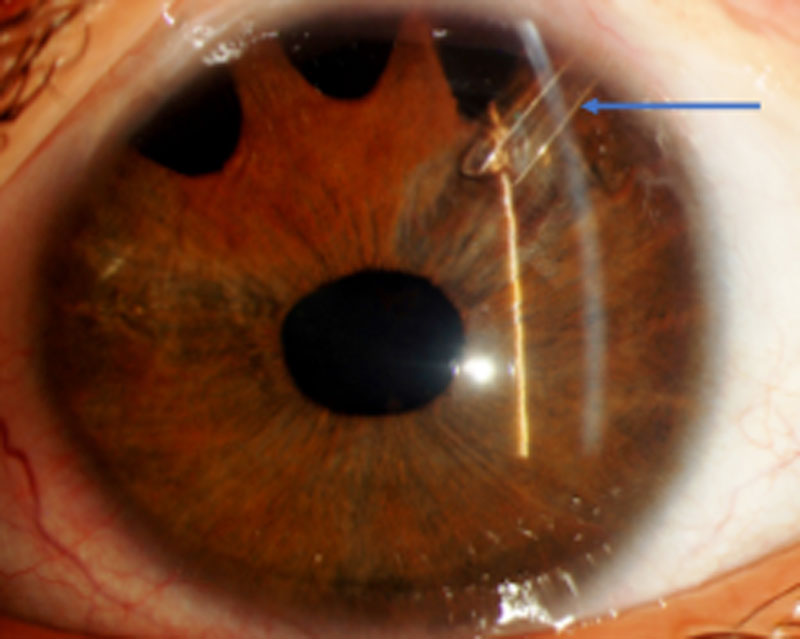
An Example Case
A 63-year-old man has glaucoma that is uncontrolled at 26 mmHg after a failed trabeculectomy and cataract surgery, with scarring of the superior conjunctiva.
Guided by the TVT results, the surgeon implants a Baerveldt tube in the inferonasal quadrant, with the tube placed in the sulcus.
The pressure falls to 13 mmHg on one medication.
At two years the pressure is stable, and the cornea is clear, with regular checks of the tube position.
How to Explain the Study
Explain that the study compared two operations in eyes that were harder to treat. More tube eyes were still successful at five years, though they needed more drops.
Also, tell patients that both operations carry risks, and that the choice depends on the eye.
Questions Patients Ask
- Will the tube be visible? It sits under the conjunctiva and is covered by a patch graft.
- What are the risks? Low pressure, double vision, and corneal problems can occur with tubes.
- How long will it last? Many last for years, and some need revision.
What Came After
The Primary Tube Versus Trabeculectomy study tested the same comparison in eyes without previous surgery, and found similar pressure control with fewer complications from tubes.
Newer devices and minimally invasive procedures are also competing with both approaches in earlier stages of disease.
Key Points to Remember
- The tube had a lower failure rate at five years in eyes with prior surgery
- Trabeculectomy reached a slightly lower pressure with fewer drugs
- Complications differed, and reoperation was more common after trabeculectomy
- The Baerveldt result may not apply to other devices
Use in Clinical Practice
Examine the conjunctiva for scarring, check the endothelium, and review the patient’s other eye conditions before choosing a procedure. Then tell the patient what follow-up to expect.
Both procedures need long-term surveillance for late complications.


Document what you see
Two smartphone imaging tools built for everyday clinic use — one for the slit lamp, one for the fundus.
From Choroida — the team behind this siteReferences
- Gedde SJ, Schiffman JC, Feuer WJ, et al. Treatment outcomes in the Tube Versus Trabeculectomy (TVT) study after five years of follow-up. Am J Ophthalmol. 2012;153:789-803.
- Gedde SJ, Schiffman JC, Feuer WJ, et al. Three-year follow-up of the tube versus trabeculectomy study. Am J Ophthalmol. 2009;148:670-684.
- Gedde SJ, Herndon LW, Brandt JD, et al. Postoperative complications in the Ahmed Baerveldt Comparison Study during five years of follow-up. Am J Ophthalmol. 2012;153:804-814.
- American Academy of Ophthalmology. Basic and Clinical Science Course, Section 10: Glaucoma. AAO; current edition.

Writes and reviews the clinical articles on Educate. Every post is checked against peer-reviewed sources before it goes live.