
Amblyopia is reduced vision in one eye, or occasionally both, caused by abnormal visual development during childhood, rather than by any structural abnormality of the eye itself that persists once identified and corrected.
That distinction, a problem of visual development rather than of the eye’s optics or anatomy, is central to understanding why amblyopia is treatable only within a specific window of childhood and why early detection matters so much more here than in most other pediatric eye conditions.
Amblyopia is the leading cause of monocular vision loss in children, and because it is genuinely reversible with timely treatment, missing the window to intervene is one of the more consequential preventable outcomes in pediatric ophthalmology.
It affects a meaningful percentage of children overall, making it one of the more common conditions encountered in general pediatric eye care rather than a rare diagnosis reserved for a specialty clinic.
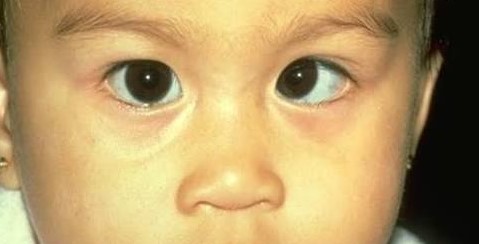
Mechanism
During a critical period of visual development, roughly the first seven to nine years of life, the visual cortex requires clear, well-matched input from both eyes to develop normal binocular processing.
When one eye provides a persistently blurred, misaligned, or otherwise degraded image relative to the other during this window, the brain preferentially suppresses input from the weaker eye, and the cortical pathways serving that eye fail to develop normally.
This cortical, rather than ocular, basis for the vision loss is why an amblyopic eye can have a perfectly normal-appearing retina and optic nerve on exam despite significantly reduced acuity, and why correcting the eye’s optics alone, without addressing the underlying suppression, is not sufficient treatment on its own.
Types of Amblyopia
- Strabismic amblyopia, from misalignment causing the brain to suppress the deviating eye’s image to avoid diplopia and confusion
- Refractive amblyopia, from a significant, uncorrected refractive error in one eye (anisometropic) or both eyes (isoametropic), providing a chronically blurred image during the critical period
- Deprivation amblyopia, from any physical obstruction to a clear retinal image, including congenital cataract, ptosis severe enough to occlude the visual axis, or corneal opacity, generally the most severe and treatment-resistant form
- Combined mechanisms, since strabismus and significant refractive error frequently coexist in the same child and both contribute to the resulting amblyopia
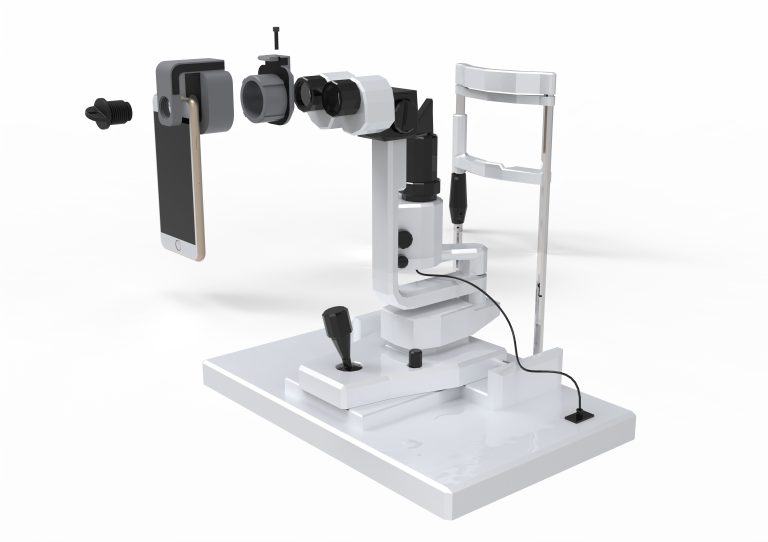
All-fit Slit-Lamp Adapter
Record and share exactly what you see at the slit lamp. One adapter fits any slit lamp or surgical microscope — and any smartphone.
From Choroida — the team behind this siteScreening and Detection
Because amblyopia is usually asymptomatic to the child, who has no basis for comparison and no way to recognize that one eye sees less clearly than the other, routine vision screening rather than waiting for a complaint is essential for early detection.
Red reflex testing in infancy, and formal visual acuity or photoscreening testing beginning around the time a child can cooperate with subjective acuity testing, are standard components of pediatric screening precisely because of this silent presentation.
A family history of amblyopia, strabismus, or significant refractive error in a parent or sibling raises a child’s individual risk and is worth specifically asking about at any pediatric or primary eye exam.
Instrument-based photoscreening has become increasingly common in pediatric and primary care settings, offering an accessible way to flag children who need a full ophthalmic exam without requiring subjective cooperation from a very young child.
Evaluation
A complete cycloplegic refraction identifies any significant refractive error or anisometropia contributing to the amblyopia, and is a standard part of the workup in any child with reduced vision in one or both eyes.
A careful exam for strabismus, media opacity such as cataract, and any structural abnormality distinguishes the underlying mechanism, or combination of mechanisms, driving the amblyopia in that particular child.
Visual acuity testing appropriate to the child’s age and developmental stage, whether preferential looking, picture optotypes, or standard letter charts, is needed to establish a baseline and track treatment response over time.
Treatment
Correcting the underlying cause comes first: glasses for significant refractive error, surgery for a visually significant cataract, or ptosis repair when the lid is occluding the visual axis.
Occlusion therapy, patching the stronger eye to force use of and visual development in the weaker eye, remains the mainstay of active treatment once any underlying structural cause has been addressed, and is discussed in more detail, including specific patching regimens, in its own dedicated article on this site.
Atropine penalization, blurring the stronger eye’s near vision pharmacologically rather than physically occluding it, is an effective alternative for some children, particularly when compliance with patching is difficult to achieve.
Treatment works best when started as early as possible within the critical period, and while some plasticity persists into later childhood and even adolescence, outcomes are generally better the earlier treatment begins relative to the child’s age.
Family engagement matters enormously for successful treatment, since consistent daily patching or atropine use over months requires real, sustained effort from parents and caregivers well beyond what happens during office visits themselves.
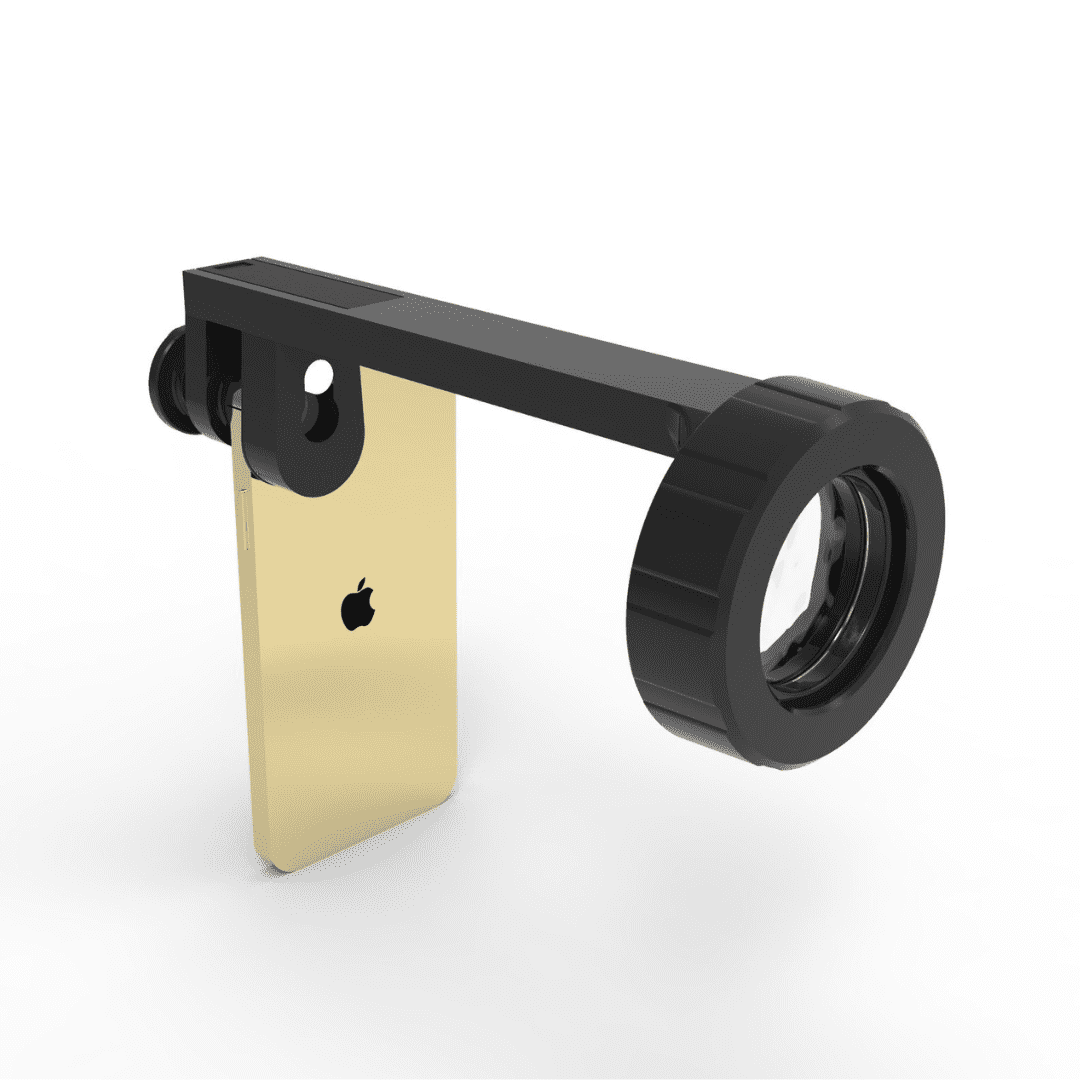
Document what you see
Two smartphone imaging tools built for everyday clinic use — one for the slit lamp, one for the fundus.
From Choroida — the team behind this siteReferences
- Pediatric Eye Disease Investigator Group. A randomized trial of patching regimens for treatment of moderate amblyopia in children. Archives of Ophthalmology.
- American Academy of Ophthalmology. Basic and Clinical Science Course, Section 6: Pediatric Ophthalmology and Strabismus.
- Holmes JM, Clarke MP. Amblyopia. The Lancet.
