
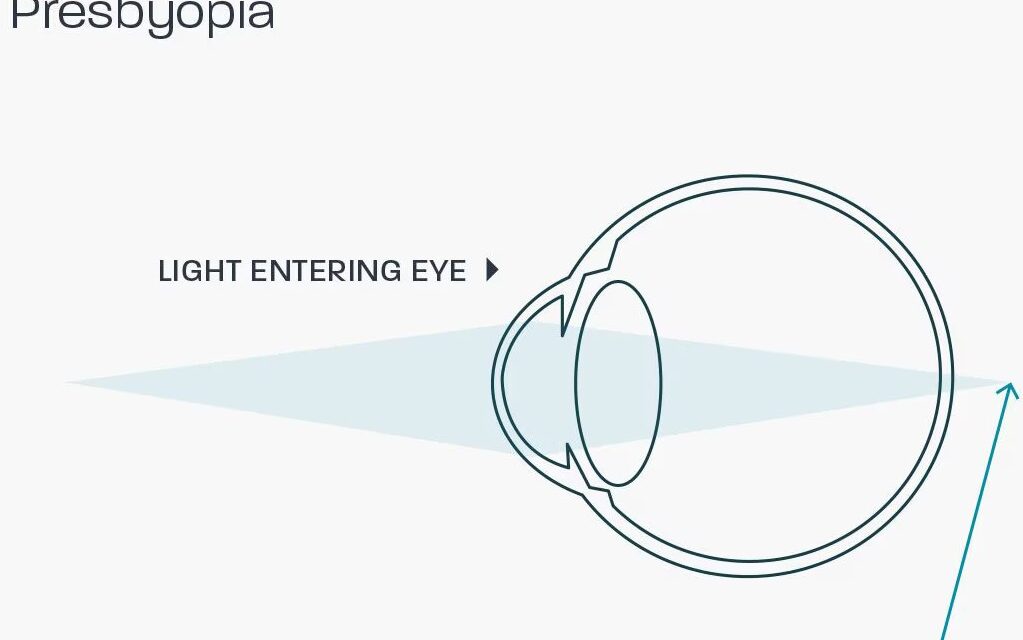
Presbyopia is the universal, age-related decline in the eye’s ability to accommodate, or actively shift focus from distance to near objects, and it eventually affects essentially everyone who lives long enough.
Unlike a refractive error such as hyperopia, presbyopia is not a problem with how light focuses at distance but a loss of the dynamic focusing mechanism itself, which is a distinction patients often find confusing and worth explaining clearly.
That mechanism, not the eye’s overall refractive power, is what actually fails first, and understanding this is the key to counseling patients accurately about what correction can and cannot do.
Presbyopia is not itself a disease process, and framing it that way to patients, rather than as an expected part of normal aging, tends to generate unnecessary anxiety about their eye health.
Mechanism
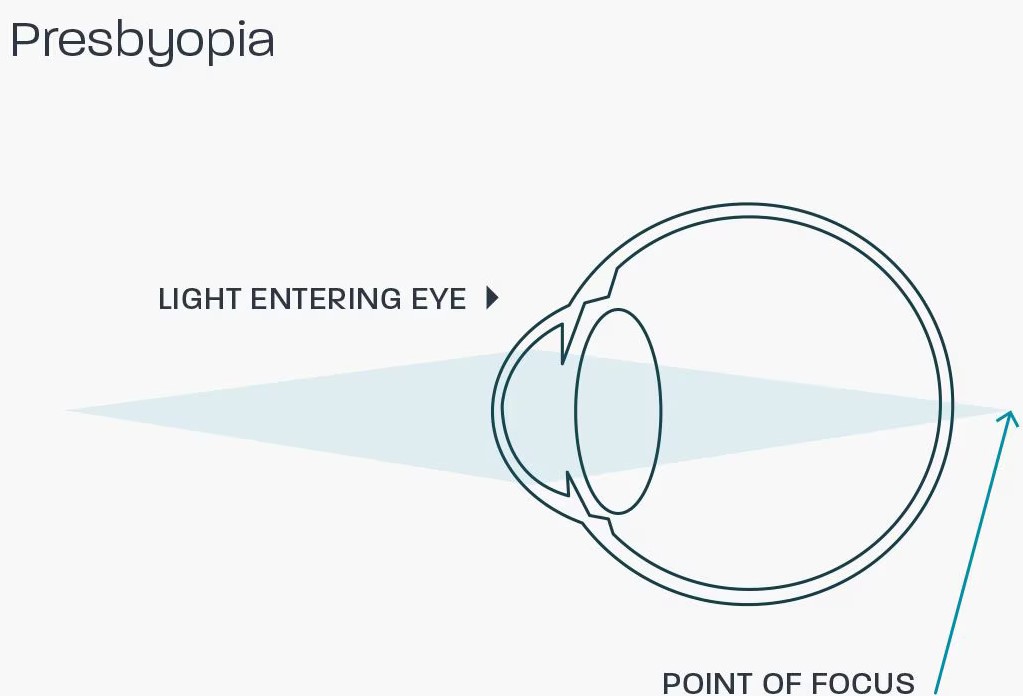
Accommodation depends on the crystalline lens changing shape in response to ciliary muscle contraction, becoming more convex to increase focusing power for near objects.
With age, the lens progressively stiffens and loses elasticity, so that even when the ciliary muscle contracts normally, the lens can no longer change shape enough to meaningfully increase its focusing power.
Some ciliary muscle function decline may also contribute, but the dominant mechanism is this loss of lens elasticity rather than a primary problem with the muscle itself.
Clinical Course
Symptoms typically become noticeable in the early-to-mid forties, though the underlying loss of accommodative amplitude is actually a lifelong, gradual process that becomes symptomatic only once the reserve of accommodation drops below what daily near tasks require.
Patients describe difficulty reading small print, needing to hold reading material farther away, and eye strain or headaches with prolonged near work, particularly in dim lighting where the pupil dilates and depth of focus decreases.
Progression continues until roughly the mid-to-late sixties, when accommodative amplitude effectively plateaus near zero, meaning the near correction needed tends to stabilize rather than keep increasing indefinitely after that point.
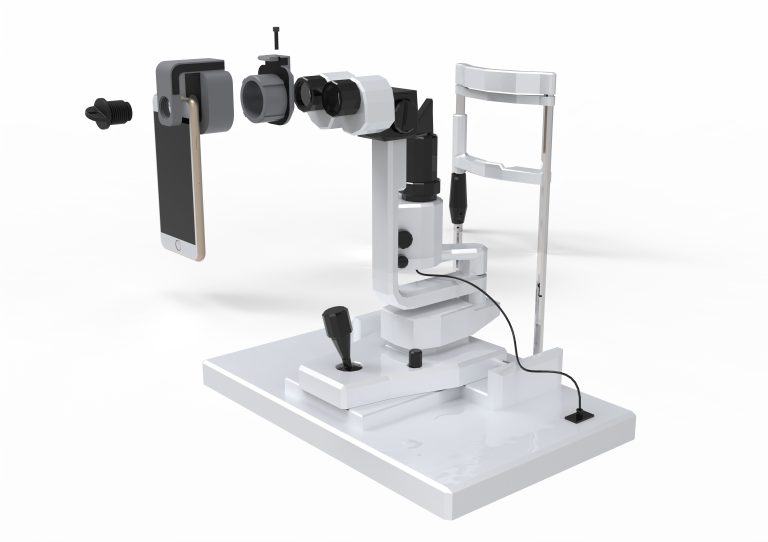
All-fit Slit-Lamp Adapter
Record and share exactly what you see at the slit lamp. One adapter fits any slit lamp or surgical microscope — and any smartphone.
From Choroida — the team behind this siteWhat Presbyopia Is Not
It is not the same process as hyperopia, where the whole eye’s optical system under-focuses light for all distances, though the two commonly coexist and can compound each other’s symptoms in the same patient.
It is not reversible by any refractive surgery that reshapes the cornea to correct a static refractive error, since the underlying problem is the lens’s loss of dynamic focusing ability rather than a fixed focusing error.
A sudden change in near vision, as opposed to the typical gradual decline of presbyopia, should prompt consideration of other causes such as an evolving cataract or a systemic condition affecting accommodation, rather than being attributed to presbyopia by default.
Epidemiology and Impact
Presbyopia affects nearly the entire population by the seventh decade of life, making it, in aggregate, the most common refractive condition an eye care provider will manage over a career.
Its global impact is substantial precisely because it is universal rather than a disease affecting a subset of the population, and in regions with limited access to reading glasses it represents a significant, correctable source of functional near-vision impairment.
The near-add power required tends to correlate closely with age in a fairly predictable, population-level pattern, which is why standard age-based add-power tables remain a reasonably reliable starting point for an initial prescription.
Correction Options
- Reading glasses, the simplest option, prescribed at a near-add power that increases gradually over the years as accommodative amplitude continues to decline
- Multifocal or progressive spectacle lenses, combining distance and near correction in a single lens for patients who also need distance correction
- Monovision, correcting one eye for distance and the other for near, using contact lenses or, in appropriately selected candidates, refractive surgery
- Multifocal or extended depth-of-focus intraocular lenses, placed during cataract surgery in patients who are having that surgery anyway and want reduced dependence on reading glasses afterward
- Pilocarpine-based miotic eye drops, a newer pharmacologic option that improves near vision by increasing depth of focus through pupillary constriction rather than restoring true accommodation
Counseling Patients
Each correction option involves trade-offs in image quality, contrast sensitivity, or adaptation that need honest discussion before a patient commits to one, particularly for monovision or multifocal intraocular lenses, which some patients tolerate poorly.
Pilocarpine-based drops work by a fundamentally different mechanism than optical correction and come with their own limitations, including a modest and sometimes inconsistent effect, dimmer vision from the constricted pupil, and the need for daily dosing.
Setting realistic expectations from the outset, rather than promising a single perfect solution, generally serves patients better than presenting any one option as suitable for everyone.
Occupation and lifestyle matter as much as the refractive numbers when choosing an approach, since a patient who spends the day at a computer screen has different priorities than one who does fine near work like sewing or reads for pleasure at night.
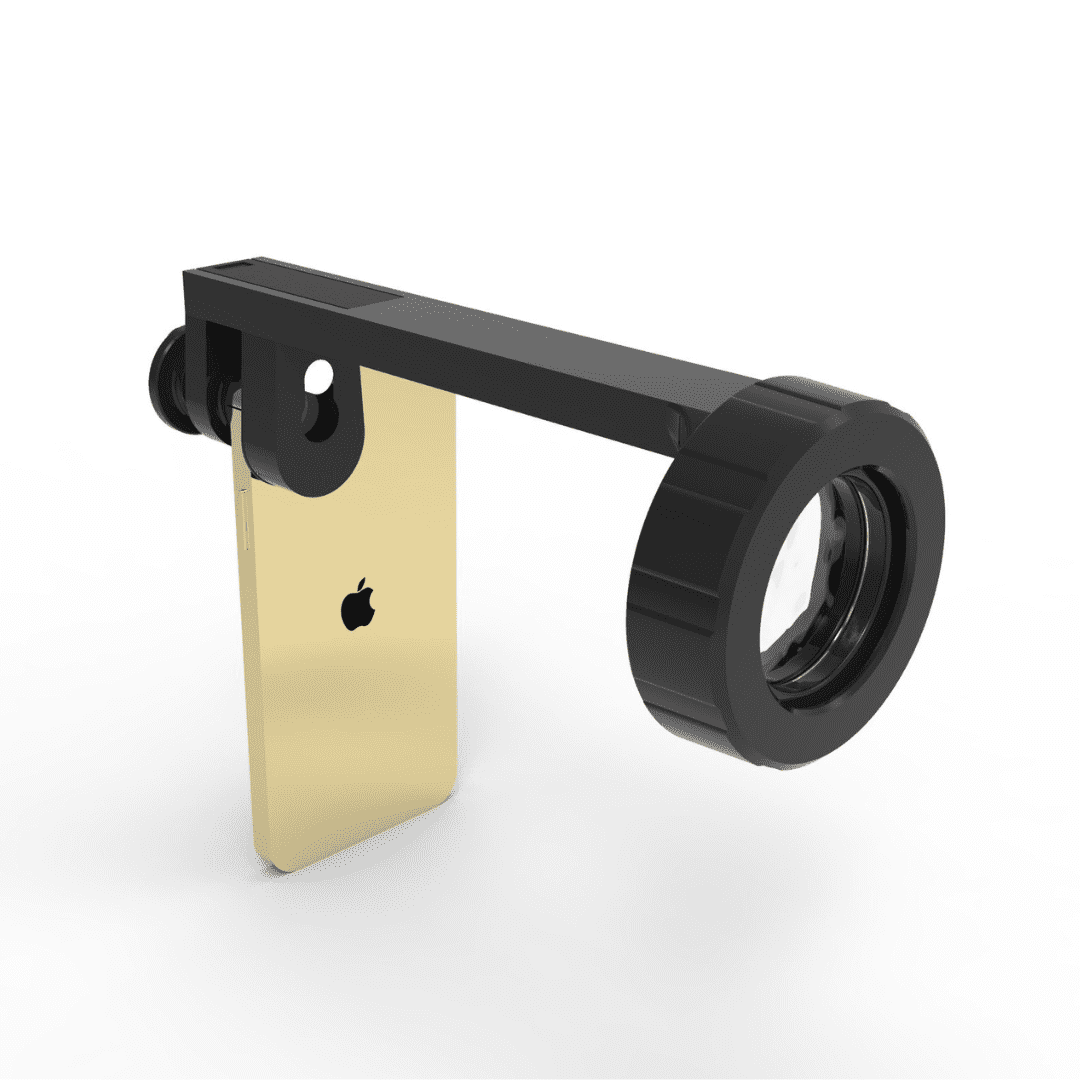
Document what you see
Two smartphone imaging tools built for everyday clinic use — one for the slit lamp, one for the fundus.
From Choroida — the team behind this siteReferences
- American Academy of Ophthalmology. Basic and Clinical Science Course, Section 3: Clinical Optics.
- Glasser A, Kaufman PL. The mechanism of accommodation in primates. Ophthalmology.
- Duane A. Studies in monocular and binocular accommodation with their clinical application. American Journal of Ophthalmology.
