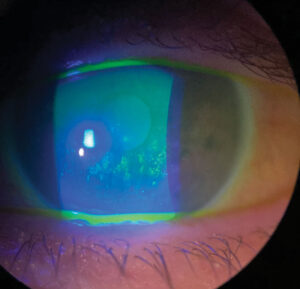
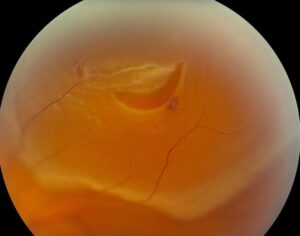
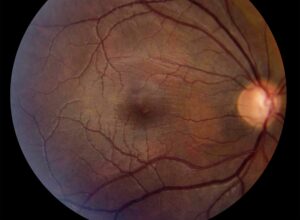
Glaucoma vs cataract is a frequent question, because both conditions cause gradual vision loss in older adults.
However, they affect different structures and carry very different prognoses, because cataract clouds the lens while glaucoma damages the optic nerve. As a result, cataract loss is usually reversible, while glaucoma loss is permanent.
Why Patients Confuse Glaucoma vs Cataract
Both conditions are age related and often coexist in the same eye, and patients often hear both words during the same clinic visit. Therefore, many assume they describe one disease at different stages. A clear explanation at the first visit prevents later confusion.
Symptoms in Glaucoma vs Cataract
Cataract causes blur, glare, halos and faded colors (see cataract symptoms). Patients notice these changes early, because central vision is affected.
In contrast, open-angle glaucoma stays silent until late disease. The peripheral field fails first, and the fellow eye masks the gaps.
All-fit Slit-Lamp Adapter
Record and share exactly what you see at the slit lamp. One adapter fits any slit lamp or surgical microscope — and any smartphone.
From Choroida — the team behind this siteAcute Presentations
Most cataracts and most glaucoma progress slowly over years. However, acute angle closure causes pain, redness, halos and nausea.
A swollen intumescent lens can also close the angle. Therefore, a painful red eye with a mid-dilated pupil needs same-day assessment.
Reversibility in Glaucoma vs Cataract
Vision lost to cataract usually returns after surgery, provided the retina and nerve are healthy. Glaucoma, however, destroys retinal ganglion cells and their axons, and these cells do not regenerate, so treatment aims only to slow further loss.
Slit Lamp Findings
At the slit lamp, cataract appears as nuclear sclerosis, cortical spokes or posterior subcapsular plaques, and retroillumination against the red reflex outlines cortical and posterior opacities. In open-angle glaucoma, the anterior segment often looks normal. However, look for a shallow chamber, pseudoexfoliation material and pigment dispersion.
Gonioscopy and Pressure
Every glaucoma suspect needs gonioscopy to classify the angle (see open-angle vs angle-closure glaucoma), while applanation tonometry measures pressure and pachymetry helps interpret the reading. A cataract alone does not raise pressure unless it narrows the angle or leaks protein.
Optic Disc Signs in Glaucoma vs Cataract
Glaucoma produces cup enlargement, rim thinning, notching and disc hemorrhages, and nerve fiber layer defects also appear as dark wedges on red-free photography. Cataract leaves the disc normal, although a dense lens blurs the view.
Imaging Artifacts in Glaucoma vs Cataract
Cataract depresses visual field sensitivity diffusely and lowers OCT signal strength, so a field may worsen without true glaucomatous progression. Therefore, review pattern deviation plots and OCT signal quality before changing treatment.
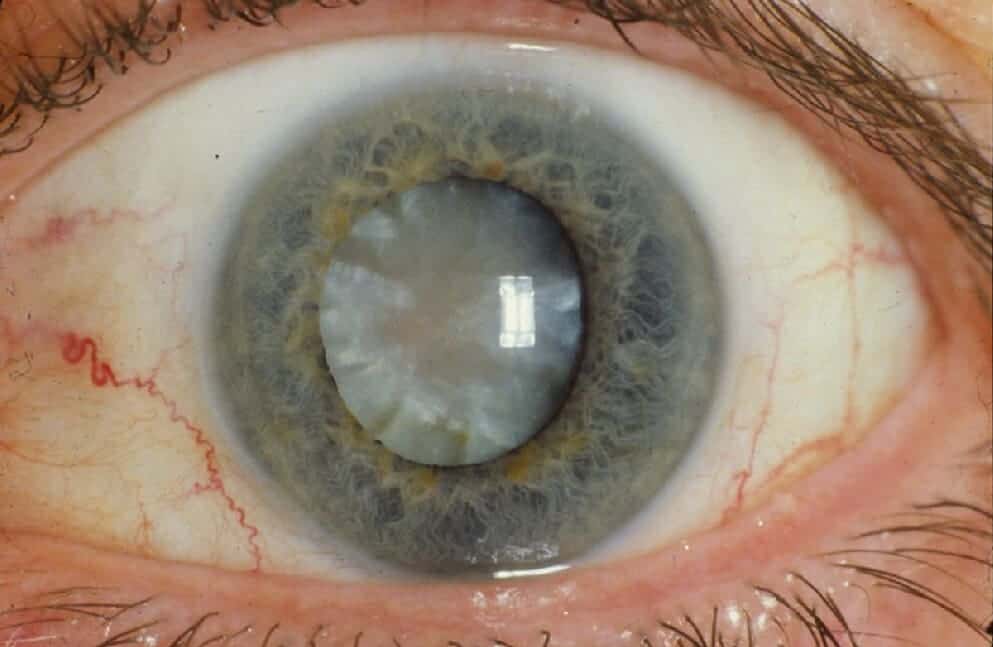
Treatment of Cataract
Phacoemulsification with lens implantation is the only effective treatment for visually significant cataract, and no eye drop reverses lens opacity. Offer surgery once symptoms limit driving, reading or work. Serious complications are uncommon, but include capsule rupture, endophthalmitis and macular edema.
Treatment of Glaucoma
Glaucoma treatment lowers intraocular pressure with drops, laser or surgery, and the Early Manifest Glaucoma Trial showed that lowering pressure slows progression. First-line options include prostaglandin analogues and selective laser trabeculoplasty, but no treatment restores lost field.
How Cataract Affects Glaucoma
An enlarging lens crowds the angle, especially in short hyperopic eyes. In the EAGLE trial, clear lens extraction gave better outcomes than laser iridotomy in selected angle closure, while rarely a leaking hypermature lens causes phacolytic glaucoma.
How Glaucoma Affects Cataract
Trabeculectomy accelerates cataract formation in many eyes, and long-term topical therapy may also contribute, although the evidence is less consistent.
Pseudoexfoliation also links both diseases and weakens the zonules. Therefore, surgeons plan for zonular instability in these eyes.
Combined Surgery in Glaucoma vs Cataract
Cataract extraction alone may lower pressure modestly in ocular hypertension and open-angle glaucoma. When control is poor, surgeons may add a glaucoma procedure (see combined cataract-glaucoma surgery). The choice depends on target pressure, disease stage and medication burden.
Counseling in Glaucoma vs Cataract
Explain that cataract surgery restores clarity, while glaucoma care protects remaining vision. Also, warn that lens surgery does not cure glaucoma, and existing field loss persists after a successful cataract operation.
Follow-Up Priorities
After cataract surgery, check pressure, because steroids and retained viscoelastic can raise it. Next, obtain new baseline fields and OCT scans once the media clear, and finally keep glaucoma visits on schedule even when vision feels excellent.
Pitfalls to Avoid
- Do not attribute all vision loss to cataract without examining the disc
- Never skip gonioscopy when a dense lens sits behind a shallow chamber
- Do not call field progression before checking OCT signal and media clarity
- Avoid promising better fields after cataract surgery in advanced glaucoma
- Remember that normal pressure does not exclude glaucoma


Document what you see
Two smartphone imaging tools built for everyday clinic use — one for the slit lamp, one for the fundus.
From Choroida — the team behind this siteReferences
- Weinreb RN, Aung T, Medeiros FA. The pathophysiology and treatment of glaucoma: a review. JAMA. 2014;311:1901-1911.
- Asbell PA, Dualan I, Mindel J, et al. Age-related cataract. Lancet. 2005;365:599-609.
- Heijl A, Leske MC, Bengtsson B, et al. Reduction of intraocular pressure and glaucoma progression: results from the Early Manifest Glaucoma Trial. Arch Ophthalmol. 2002;120:1268-1279.
- Azuara-Blanco A, Burr J, Ramsay C, et al. Effectiveness of early lens extraction for the treatment of primary angle-closure glaucoma (EAGLE): a randomised controlled trial. Lancet. 2016;388:1389-1397.
- Mansberger SL, Gordon MO, Jampel H, et al. Reduction in intraocular pressure after cataract extraction: the Ocular Hypertension Treatment Study. Ophthalmology. 2012;119:1826-1831.

Writes and reviews the clinical articles on Educate. Every post is checked against peer-reviewed sources before it goes live.