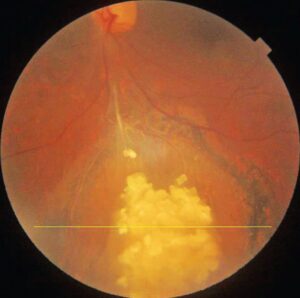
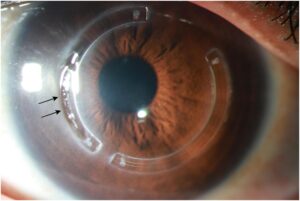
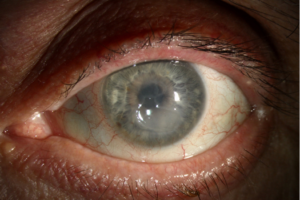
Pepper spray eye describes acute chemical irritation of the ocular surface after exposure to oleoresin capsicum.
Most patients recover within hours, because the agent mainly causes neurogenic pain.
However, a corneal abrasion, an unidentified co-agent or a close-range blast can change the picture.
Therefore, irrigation and a careful corneal examination guide the visit.
What Causes Pepper Spray Eye
Capsaicinoids activate TRPV1 receptors on corneal and conjunctival sensory nerves.
As a result, nerve endings release substance P, which promotes vasodilation and pain.
Some products also contain solvents, propellants or tear gas agents.
Expected Symptoms of Pepper Spray Eye
Patients report severe burning, tearing, photophobia and difficulty opening the eyes.
Vision may blur because of tears and spasm, and it improves as the lids relax.
Pain often eases within the first hour, while redness may last longer.
All-fit Slit-Lamp Adapter
Record and share exactly what you see at the slit lamp. One adapter fits any slit lamp or surgical microscope — and any smartphone.
From Choroida — the team behind this siteFirst Aid at the Scene
First, the patient should move to fresh air.
Next, contact lenses should come out.
Patients should avoid rubbing, because rubbing spreads resin and may abrade the epithelium.
Contaminated clothing also needs removal, since it can continue to release the irritant.
Irrigation for Pepper Spray Eye
Copious irrigation with clean water or saline is the practical first step.
It dilutes residual resin, although capsaicin is lipophilic and may not wash away completely.
When the product is unknown, check the fornix pH after irrigation.
A topical anesthetic eases irrigation by overcoming blepharospasm.
What the Evidence Shows
In a randomized volunteer trial, Barry and colleagues compared several topical regimens for facial pepper spray pain.
No regimen clearly outperformed the others.
However, that trial addressed skin pain, so it does not establish the best ocular rinse.
Milk and antacid remedies have no proven role in the eye.
History That Changes Management
Ask about the product, spray distance, time since exposure and prior irrigation.
A close-range discharge raises concern for mechanical injury.
Also ask about contact lens wear, previous corneal surgery and asthma.
Respiratory symptoms take priority, because severe bronchospasm can threaten life.
Corneal Examination in Pepper Spray Eye
Record visual acuity first, using topical anesthesia if the patient cannot open the eyes.
Then measure the pH and examine both eyes, with lid eversion to find retained particles.
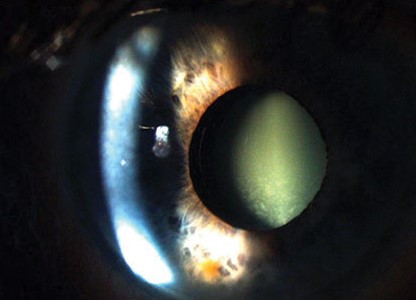
Fluorescein at the slit lamp shows punctate staining or a frank abrasion.
Next, assess the limbus for blanching and the anterior chamber for cells or blood.
Findings and Recovery
Conjunctival injection, chemosis and lid erythema are common.
Zollman and colleagues found little corneal change in exposed volunteers, while Brown and colleagues reported abrasions after real-world exposures.
Differences in dose, distance and setting may explain this gap.
Vesaluoma and colleagues found temporary reductions in corneal sensitivity on confocal microscopy.
Reduced sensation may also hide a persistent epithelial defect.
Treating Pepper Spray Eye
Mild irritation usually needs only preservative-free lubricants and reassurance.
These drops improve comfort, although they do not neutralize capsaicin.
For a true abrasion, add a topical antibiotic and review healing.
A cycloplegic may help marked photophobia, but it blurs near vision.
Never send patients home with anesthetic drops, because repeated use delays healing.
Routine topical steroids have little justification in uncomplicated exposure.
Differential Diagnosis
Persistent pain or unusual findings should prompt a wider search.
For example, consider these alternatives:
- Alkali or acid burn from an unidentified product
- Tear gas exposure with CS or CN agents
- Retained foreign body under the upper lid
- Contact lens related microbial keratitis
- Traumatic iritis or hyphema after a blast
Urgent Signs After Pepper Spray Eye
Same-day ophthalmic review is appropriate for any of the following:
- Reduced vision that persists after irrigation
- Severe pain beyond the early period
- Abnormal pH or limbal blanching
- A corneal defect, infiltrate or haze
- Hyphema or suspected penetrating injury
Counseling the Patient
Explain that intense burning is expected and usually improves without lasting damage.
Advise the patient to wash the skin separately, keeping contaminated water away from the eyes.
Lens wear should wait until the eye is comfortable and clear.
Finally, give return precautions for worsening pain, discharge or falling vision.
Follow-Up Plan
A patient with normal vision and minimal staining rarely needs long follow-up.
However, an abrasion needs review until the epithelium closes.
Late scarring or new vessels suggest a deeper injury (see corneal vascularization).
In that case, reassess the original diagnosis and test for limbal damage.
Pitfalls to Avoid
- Do not assume every spray contains only capsaicin
- Never skip fluorescein because symptoms are improving
- Do not miss a mechanical injury after close-range exposure


Document what you see
Two smartphone imaging tools built for everyday clinic use — one for the slit lamp, one for the fundus.
From Choroida — the team behind this siteReferences
- Zollman TM, Bragg RM, Harrison DA. Clinical effects of oleoresin capsicum (pepper spray) on the human cornea and conjunctiva. Ophthalmology. 2000;107:2186-2189.
- Vesaluoma M, Muller L, Gallar J, et al. Effects of oleoresin capsicum pepper spray on human corneal morphology and sensitivity. Invest Ophthalmol Vis Sci. 2000;41:2138-2147.
- Brown L, Takeuchi D, Challoner K. Corneal abrasions associated with pepper spray exposure. Am J Emerg Med. 2000;18:271-272.
- Barry JD, Hennessy R, McManus JG. A randomized controlled trial comparing treatment regimens for acute pain for topical oleoresin capsaicin (pepper spray) exposure in adult volunteers. Prehosp Emerg Care. 2008;12:432-437.
- Olajos EJ, Salem H. Riot control agents: pharmacology, toxicology, biochemistry and chemistry. J Appl Toxicol. 2001;21:355-391.

Writes and reviews the clinical articles on Educate. Every post is checked against peer-reviewed sources before it goes live.