Polihexanide for Acanthamoeba keratitis is the backbone of treatment for a painful, sight-threatening infection that is hard to eradicate.
The amoeba exists as an active trophozoite and as a resistant cyst, so treatment lasts months.
Recent work has tested whether a stronger single drug can do as well as older combinations (see Acanthamoeba keratitis).
Acanthamoeba Keratitis and the Role of Polihexanide
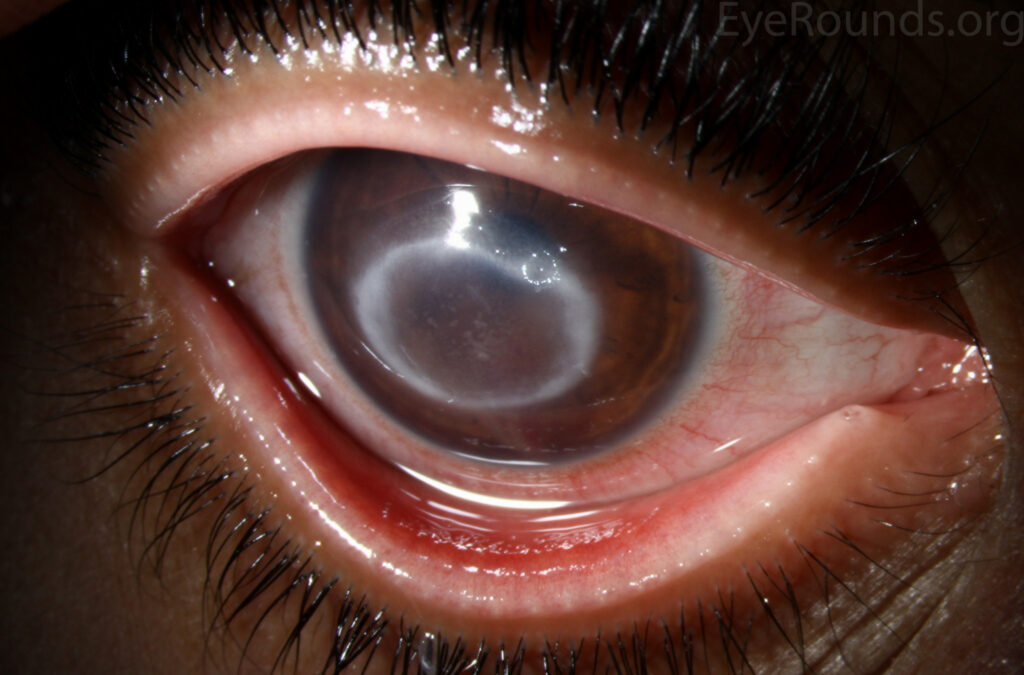
Acanthamoeba keratitis occurs mainly in contact lens wearers exposed to contaminated water, and less often after trauma.
- Severe pain out of proportion to signs is typical
- A ring-shaped infiltrate, perineural infiltrates, and an epithelial irregularity are classic findings (see Acanthamoeba ring infiltrate)
- Misdiagnosis as herpes or bacterial keratitis is common, and delays raise the risk of vision loss
Diagnosis uses confocal microscopy, culture, and PCR on corneal scrapings.
Polihexanide for Acanthamoeba Keratitis: The Drug Class
Biguanides, polihexanide (also called PHMB) and chlorhexidine, disrupt the amoeba cell membranes and are active against both trophozoites and cysts.
They have been the main drugs for decades, at concentrations of 0.02 percent, and often used with a diamidine, such as propamidine or hexamidine (see the references).
All-fit Slit-Lamp Adapter
Record and share exactly what you see at the slit lamp. One adapter fits any slit lamp or surgical microscope — and any smartphone.
From Choroida — the team behind this sitePolihexanide for Acanthamoeba Keratitis: Combination Versus Monotherapy
Many protocols give a biguanide with a diamidine, on the idea that two drugs attack the amoeba in different ways.
A randomized trial in the United Kingdom, known as ODAK, compared polihexanide at a higher concentration of 0.08 percent as a single drug with the standard combination of polihexanide 0.02 percent and propamidine.
The results suggested that monotherapy was as effective for clinical cure, with a simpler regimen, and a polihexanide product at this higher concentration has been approved for this use in Europe.
Dosing and Duration
- Hourly dosing, day and night at first, for the first one to three days
- Then hourly by day for several days, with tapering over weeks
- Total treatment is usually several months, and often six months or more
- Stop only after the eye has been quiet for some time, to avoid recurrence from cysts
Preparation and sources of the drops vary, and pharmacies may compound drops where products are unavailable.
Polihexanide for Acanthamoeba Keratitis: Adjunctive Care
- Pain control, with oral analgesics and cycloplegics
- Avoid steroids at the start, since they can worsen the infection, and consider them only after the amoeba is controlled and inflammation persists
- Stop contact lens wear, and do not use lenses until the eye heals
- Avoid corneal surgery during active disease when possible
Complications of Polihexanide for Acanthamoeba Keratitis
- Scleritis and stromal melt, which may need systemic treatment
- Cataract and glaucoma, from inflammation and drugs
- Toxicity of drops to the epithelium, which can delay healing, so dosing is reduced when toxicity appears
- Corneal scarring that may need a graft after the infection is cured (see penetrating keratoplasty)
Prevention
- Never use tap water, swimming pools, or hot tubs with contact lenses
- Do not sleep in lenses, and use fresh solution each day
- Clean and replace the case often
- Seek urgent care for pain, redness, or reduced vision in a lens wearer
Counselling
Explain that treatment is long, that the drops can irritate the eye, and that stopping early can cause relapse.
Give a clear schedule, and arrange frequent review at the start.
Monitoring During Treatment
Review every few days at first, and then weekly, with measurements of the infiltrate and the epithelium.
Pain, the ring infiltrate, and perineural signs should improve over weeks, and watch for toxicity from drops, since it can mimic worsening.
Repeat confocal microscopy can show clearing of cysts and help to decide when to stop.
An Example Case
A 29-year-old contact lens wearer who swam with lenses presents with severe pain and a ring infiltrate, after a week of treatment as bacterial keratitis.
Confocal microscopy shows cysts, and treatment with a biguanide starts at once, with hourly dosing for several days.
At six months the eye is quiet, with a faint scar, and the doctor advises him never to use lenses in water.
Looking Ahead
Faster diagnosis with PCR, shorter regimens, and drugs that kill cysts more quickly would improve outcomes.
Education of lens wearers remains the most effective way to reduce the disease.
Key Messages for Colleagues
Suspect Acanthamoeba in any lens wearer with pain out of proportion to the findings, and scrape early, before starting steroids.
Refer early to a cornea service, since outcomes are much better when treatment starts within weeks of onset.
Warn patients that the course is long and that stopping drops too soon can lead to relapse.


Document what you see
Two smartphone imaging tools built for everyday clinic use — one for the slit lamp, one for the fundus.
From Choroida — the team behind this siteReferences
- Dart JKG, Saw VPJ, Kilvington S. Acanthamoeba keratitis: diagnosis and treatment update 2009. Am J Ophthalmol. 2009;148:487-499.
- Carnt N, Robaei D, Minassian DC, Dart JKG. Acanthamoeba keratitis in 194 patients: risk factors for bad outcomes and severe inflammatory complications. Br J Ophthalmol. 2018;102:1431-1435.
- Lorenzo-Morales J, Khan NA, Walochnik J. An update on Acanthamoeba keratitis: diagnosis, pathogenesis and treatment. Parasite. 2015;22:10.
- American Academy of Ophthalmology. Basic and Clinical Science Course, Section 8: External Disease and Cornea. AAO; current edition.

Writes and reviews the clinical articles on Educate. Every post is checked against peer-reviewed sources before it goes live.