Myopia control has become a routine part of pediatric eye care.
Myopia is rising worldwide, and high myopia raises the risk of blinding disease.
Several strategies now slow progression in children.
Why Myopia Control Matters
Each diopter of myopia raises the risk of retinal disease later.
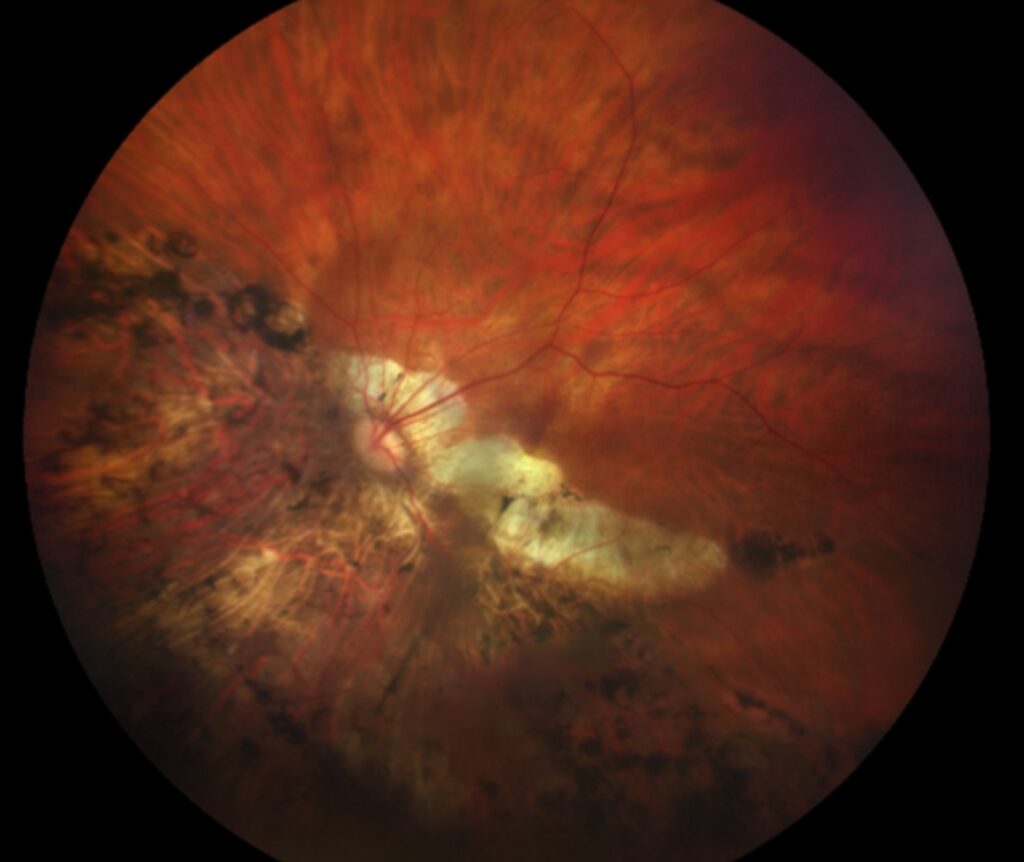
High myopia increases the chance of detachment, glaucoma and maculopathy.
Slowing growth lowers that risk.
Therefore, treat myopia as a disease of the growing eye (see pathologic myopia).
Prevalence and Trends
Predictions suggest that about half of the world will be myopic by 2050.
East Asia has the highest rates.
Rates in Western countries are also rising.
So prevention matters everywhere.
All-fit Slit-Lamp Adapter
Record and share exactly what you see at the slit lamp. One adapter fits any slit lamp or surgical microscope — and any smartphone.
From Choroida — the team behind this siteOutdoor Time and Myopia Control
Time outdoors reduces the onset of myopia in children.
A trial in China added 40 minutes of outdoor activity at school.
The incidence of myopia fell compared with control schools.
Also, outdoor light seems to protect the eye.
Near Work and Myopia Control
Prolonged close reading and screen use associate with myopia.
Evidence for causation is mixed.
Breaks and outdoor play are sensible advice.
Therefore, encourage balanced habits.
Low-Dose Atropine for Myopia Control
Atropine 0.01 to 0.05 percent slows myopia progression.
The ATOM2 and LAMP trials showed dose-dependent effects.
Low doses cause little glare or blur.
So atropine is a common first-line option.
Atropine Safety
Light sensitivity and near blur are the main side effects.
Rebound after stopping can occur.
Long-term data suggest a good safety profile.
Also monitor axial length during treatment.
Orthokeratology for Myopia Control
Overnight rigid lenses reshape the cornea.
They slow axial elongation by a modest amount (see orthokeratology).
Infection risk exists, so hygiene is vital.
Therefore, choose motivated families.
Multifocal Lenses for Myopia Control
Dual-focus and high-add multifocal lenses reduce myopic shift.
The BLINK trial showed slower progression with high-add lenses.
Fitting is simple in most centers.
So they suit children who like contact lenses.
Spectacle Lens Designs
Defocus-incorporated lenses and other designs slow progression in trials.
Effects are smaller than with atropine in some studies.
They avoid drops and contact lenses.
Also, they suit young children.
Combination Treatment
Atropine with orthokeratology or lenses may add benefit.
Data are limited.
Combination therapy suits fast progressors.
Therefore, consider it after single treatments fail.
Red-Light Therapy
Low-level red-light therapy shows strong effects in short trials.
Safety questions remain.
Long-term data are lacking.
So treat it as investigational.
Monitoring Progression
Measure cycloplegic refraction and axial length every six months.
Use charts to compare growth to norms.
Adjust treatment if progression continues.
Also check the retina periodically.
Counseling Parents
Explain that treatment slows but does not stop myopia.
Set realistic goals.
Discuss costs, time and risks.
Because adherence matters, review at each visit.
Myopia Control: Practical Summary
Encourage outdoor time, check axial length and offer atropine, lenses or orthokeratology.
If progression is rapid, combine therapies.
Because high myopia causes disease, act early.
Finally, review treatment every year.
Pitfalls to Avoid
- Do not rely on glasses alone for a progressing child
- Never skip hygiene counseling for contact lens options
- Avoid stopping atropine abruptly without a plan
- Do not ignore axial length trends
Age at Onset
Children who become myopic early progress faster and reach higher levels.
If the first signs appear before age ten, start treatment sooner.
Because early onset predicts high myopia, monitor closely.
Therefore, examine children with myopic parents earlier.
Axial Length Targets
Axial length rises normally with growth, so compare it with age norms.
When growth exceeds the norm, treatment is advised.
Because refraction alone can mislead, use both numbers.
So record axial length at every visit.
Stopping Treatment
Most clinicians continue treatment until the early teenage years.
If progression slows, taper atropine slowly.
Because rebound can occur, review after stopping.
Then continue annual checks.
Costs and Access
Atropine drops, special lenses and orthokeratology differ in price.
Insurance seldom covers them.
If cost limits treatment, outdoor time is free.
Therefore, discuss all options openly.
Myopia Control: Key Message
Myopia in children is a progressive disease, and treatment can slow it.
If a child progresses quickly, act without delay.
Because every diopter counts, review the plan often.
Finally, support families with clear advice.
For the latest studies, see the PubMed results for myopia control.


Document what you see
Two smartphone imaging tools built for everyday clinic use — one for the slit lamp, one for the fundus.
From Choroida — the team behind this siteReferences
- Holden BA, Fricke TR, Wilson DA, et al. Global prevalence of myopia and high myopia and temporal trends from 2000 through 2050. Ophthalmology. 2016;123:1036-1042.
- Wildsoet CF, Chia A, Cho P, et al. IMI: interventions for controlling myopia onset and progression report. Invest Ophthalmol Vis Sci. 2019;60:M106-M131.
- He M, Xiang F, Zeng Y, et al. Effect of time spent outdoors at school on the development of myopia among children in China: a randomized clinical trial. JAMA. 2015;314:1142-1148.
- Chia A, Lu QS, Tan D. Five-year clinical trial on atropine for the treatment of myopia 2: myopia control with atropine 0.01% eyedrops. Ophthalmology. 2016;123:391-399.
- Walline JJ, Walker MK, Mutti DO, et al. Effect of high add power, medium add power, or single-vision contact lenses on myopia progression in children: the BLINK randomized clinical trial. JAMA. 2020;324:571-580.

Writes and reviews the clinical articles on Educate. Every post is checked against peer-reviewed sources before it goes live.