Emerging therapies for Stargardt disease aim to slow the build-up of toxic vitamin A byproducts in the retina.
Also, the disease, caused by mutations in ABCA4, is the most common inherited macular dystrophy, and it begins in childhood or young adulthood.
No treatment has been proven in large trials, but researchers are testing several approaches (see Stargardt disease).
What Emerging Therapies for Stargardt Disease Target
ABCA4 encodes a transporter in photoreceptors that clears byproducts of the visual cycle.
When it fails, bisretinoids such as A2E build up in the retinal pigment epithelium, where they form lipofuscin, damage the cells, and trigger atrophy and loss of photoreceptors (see the references).
Also, therapies aim at reducing the supply of these compounds, protecting cells, or replacing the missing gene.
Emerging Therapies for Stargardt Disease: Reducing the Supply of Vitamin A Byproducts
- RBP4 antagonists, such as tinlarebant, lower the delivery of retinol to the eye, and so reduce the visual cycle load
- Visual cycle modulators, such as emixustat, slow the cycle, though the results were disappointing in earlier studies
- Deuterated vitamin A (gildeuretinol), replaces vitamin A with a form that forms toxic dimers more slowly, and has been tested in trials
Patients also take these drugs by mouth, and side effects include delayed dark adaptation and difficulty in dim light.
Fundus Explorer Pro
Photograph the retinal findings described here with the phone already in your pocket — 22 D optics and built-in illumination in one handheld unit.
From Choroida — the team behind this siteComplement and Inflammation
Complement activation may add to damage of the pigment epithelium, and researchers are studying complement inhibitors approved for geographic atrophy (see complement inhibitors for geographic atrophy).
Emerging Therapies for Stargardt Disease: Gene Therapy
The ABCA4 gene is too large for a single standard AAV vector, so researchers use dual vectors, lentiviral vectors, or gene editing.
Sponsors stopped a lentiviral trial, and other approaches are also in preclinical or early clinical studies.
Cell Therapy
Investigators first tested pigment epithelium cells derived from stem cells in patients with Stargardt disease and dry AMD, with early signs of safety (see stem cell therapy for retinal disease).
Larger trials are also needed to show any benefit.
Emerging Therapies for Stargardt Disease: What to Do Now
- Confirm the diagnosis with genetic testing, and distinguish it from other macular diseases (see differential of fundus flavimaculatus)
- Advise sunglasses and a brimmed hat to reduce light exposure
- Avoid vitamin A supplements at high doses, since they may increase lipofuscin
- Monitor with OCT and autofluorescence, and enroll in a registry or trial
- Provide low vision support and school or work adjustments
Example Case
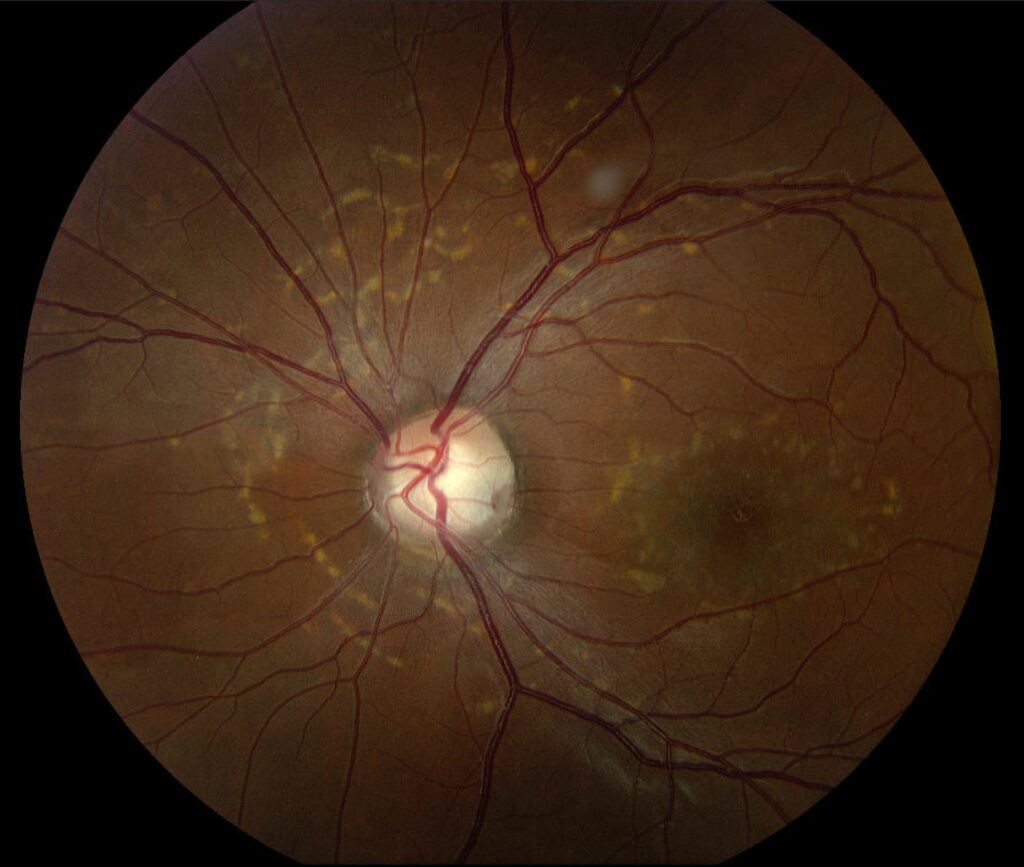
A 17-year-old girl with decreased central vision and flecks on fundus exam has two ABCA4 variants on testing.
She wears sunglasses, avoids high-dose vitamin A, and her doctor refers her to a clinical trial of an oral drug that targets retinol delivery.
The team monitors her vision with visual acuity, OCT, and autofluorescence every six months.
Emerging Therapies for Stargardt Disease: Counselling
Explain that the disease usually progresses slowly, that peripheral vision is preserved, and that researchers are testing many therapies.
In addition, support from family and a good care team helps young patients to plan their education and work.
Monitoring Disease Progress
- Fundus autofluorescence shows the area of atrophy and the hyperautofluorescent flecks
- OCT follows the foveal structure and the ellipsoid zone
- Microperimetry measures retinal sensitivity (see microperimetry)
- Visual acuity and reading speed track function
Trials use these measures as endpoints, so the clinic records can help later enrollment.
Dark Adaptation Effects of Visual Cycle Drugs
Drugs that slow the visual cycle can cause delayed dark adaptation, color changes, and trouble in dim light.
Inform patients about these side effects and about night driving.
Lifestyle and Safety
- Wear UV-blocking sunglasses outdoors
- Avoid smoking, which may worsen retinal degeneration
- Keep a healthy diet, without megadose vitamin A
- Use low vision aids early, to keep school performance
Clinical Trial Readiness
Keep records of acuity, OCT, autofluorescence, and genetic results in an organized file, so that a patient who becomes eligible for a trial can enroll without delay.
Encourage patients to join registries, since their data help to design studies that measure slow progression.
Education and Work
Young patients benefit from early planning for school, such as large print, digital tools, and extra time, and from career counselling that fits their vision.
Psychological Support
A diagnosis in adolescence can be hard, and young patients benefit from counselling, peer groups, and honest information about the likely course.
Teachers and family can also be part of the plan, and the team should check in at each visit about school, work, and mood.
Reassure them that most keep peripheral vision and can also lead independent lives.


Document what you see
Two smartphone imaging tools built for everyday clinic use — one for the slit lamp, one for the fundus.
From Choroida — the team behind this siteReferences
- Allikmets R, Singh N, Sun H, et al. Mutations in the photoreceptor cell-specific ATP-binding transporter gene (ABCR) cause recessive Stargardt macular dystrophy. Nat Genet. 1997;15:236-246.
- Tanna P, Strauss RW, Fujinami K, Michaelides M. Stargardt disease: clinical features, molecular genetics, animal models and therapeutic options. Br J Ophthalmol. 2017;101:25-30.
- Cremers FPM, Lee W, Collin RWJ, Allikmets R. Clinical spectrum, genetic complexity and therapeutic approaches for retinal disease caused by ABCA4 mutations. Prog Retin Eye Res. 2020;79:100861.
- American Academy of Ophthalmology. Basic and Clinical Science Course, Section 12: Retina and Vitreous. AAO; current edition.

Writes and reviews the clinical articles on Educate. Every post is checked against peer-reviewed sources before it goes live.