Complement inhibitors for geographic atrophy are the first drugs to slow the loss of retinal tissue in advanced dry age-related macular degeneration.
They are also given by intravitreal injection, they reduce the rate of growth of atrophic lesions, and they have not been shown to improve vision.
In addition, the decision to treat involves a careful look at benefits, risks, and burden.
Why Complement Inhibitors for Geographic Atrophy?
Genetic studies have shown that variants in complement pathway genes are strongly linked to AMD (see AMD genetics).
Overactivation of the complement system, a part of innate immunity, is also thought to damage the retinal pigment epithelium and the photoreceptors, leading to atrophy.
Drugs that block complement components at the level of C3 or C5 were designed to calm this process and so slow the growth of geographic atrophy (see geographic atrophy treatment).
Complement Inhibitors for Geographic Atrophy: Pegcetacoplan
Pegcetacoplan is a C3 inhibitor given by intravitreal injection monthly or every other month.
Also, two phase 3 trials, OAKS and DERBY, randomized patients to monthly or every-other-month injections or sham.
In OAKS, the growth of atrophic lesions at 12 months was reduced by about 21 percent with monthly treatment and about 16 percent with every-other-month treatment, compared with sham, and the effect was larger in the second year (see the references).
DERBY showed smaller effects at 12 months, which were not statistically significant for the primary endpoint, but the combined data led to approval in some regions.
Fundus Explorer Pro
Photograph the retinal findings described here with the phone already in your pocket — 22 D optics and built-in illumination in one handheld unit.
From Choroida — the team behind this siteAvacincaptad Pegol
Avacincaptad pegol is a C5 inhibitor, also given by intravitreal injection.
In the GATHER2 trial, monthly treatment for a year reduced the growth of atrophy by about 14 percent compared with sham, and in the second year, with continued or every-other-month dosing, the effect was greater (see the references).
Some regions approved it for geographic atrophy secondary to AMD.
Complement Inhibitors for Geographic Atrophy: What the Drugs Do Not Do
- They do not improve vision: the trials did not show an advantage in visual acuity, since the benefit is a slower loss of tissue
- They do not reverse atrophy, and lost tissue does not return
- These do not cure the disease, so patients must continue treatment to keep the effect
- They do not treat neovascular AMD, and they may also add to its risk
The practical gain is a delay in the expansion of the lesion toward the fovea, and the clinical value for the patient is uncertain in the short term.
Complement Inhibitors for Geographic Atrophy: Risks and Safety
- Conversion to neovascular AMD: more frequent in treated eyes in the trials, around 6 to 12 percent compared with about 3 percent in sham eyes, and this needs vigilance
- Intraocular inflammation, including uveitis and, rarely, retinal vasculitis, particularly reported after the launch of pegcetacoplan
- Raised intraocular pressure and injection-related events
- Endophthalmitis, as with any intravitreal injection (see post-injection endophthalmitis)
Patients need regular monitoring with OCT and examination, and an Amsler grid for home use (see Amsler grid).
Who Might Be Treated?
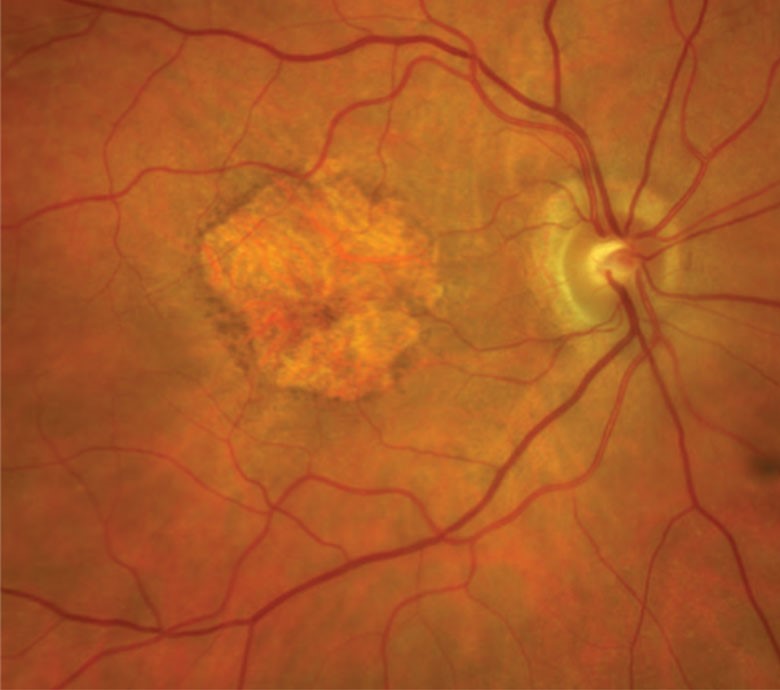
- Patients with geographic atrophy that does not involve or threaten the fovea, in whom slowing growth may also preserve central vision
- Those with good vision in at least one eye, who want to preserve what they have
- Those who understand the nature of the benefit, the need for repeated injections, and the risks
- People who have no active neovascular AMD, or who have it under control
Patients with advanced foveal atrophy and little vision may gain little from treatment, and the burden may outweigh the benefit.
Practical Pointers
- Document the baseline atrophy area with autofluorescence and OCT (see geographic atrophy growth)
- Check for macular neovascularization before and during treatment
- Explain the schedule, including the possible need for monthly visits
- Review costs and access, since these drugs are expensive
- Offer low vision services in parallel (see low vision rehabilitation in AMD)
Counselling
Be honest: these drugs slow the progression, but they do not restore sight.
Also, allow patients to decide with full information, and do not pressure either way.
Continue to promote other measures, such as stopping smoking and taking AREDS2 supplements when indicated (see AREDS2 supplements).
Questions Patients Ask
- Will it bring my vision back? No, the drugs slow further loss of tissue but do not restore it
- How long do I need it? The benefit seems to depend on continued treatment, and the best duration is not known
- Are there side effects? Injection risks, inflammation, and a higher chance of wet AMD are the main concerns
- Is it worth it? That depends on the location of the atrophy, the vision in the other eye, and the patient’s wishes
A balanced discussion allows patients to make the choice that fits their situation.
For the latest studies, see the PubMed results for complement inhibitors for geographic atrophy.


Document what you see
Two smartphone imaging tools built for everyday clinic use — one for the slit lamp, one for the fundus.
From Choroida — the team behind this siteReferences
- Heier JS, Lad EM, Holz FG, et al. Pegcetacoplan for the treatment of geographic atrophy secondary to age-related macular degeneration (OAKS and DERBY): two multicentre, randomised, double-masked, sham-controlled, phase 3 trials. Lancet. 2023;402:1434-1448.
- Patel SS, Lally DR, Hsu J, et al. Avacincaptad pegol for geographic atrophy secondary to age-related macular degeneration: 18-month findings from the GATHER2 trial. Eye. 2023;37:3551-3557.
- Ryan SJ, Schachat AP, Wilkinson CP, et al, eds. Retina. 6th ed. Elsevier; 2018.
- American Academy of Ophthalmology. Basic and Clinical Science Course, Section 12: Retina and Vitreous. AAO; current edition.

Writes and reviews the clinical articles on Educate. Every post is checked against peer-reviewed sources before it goes live.