The ETDRS diabetic retinopathy trial, the Early Treatment Diabetic Retinopathy Study, shaped how every clinician treats diabetic eye disease.
It gave us the definition of clinically significant macular edema, the proof that focal laser protects vision, and the retinopathy severity scale that is still used in trials.
Many of its conclusions remained standard of care until anti-VEGF drugs arrived.
Why the ETDRS Diabetic Retinopathy Trial Was Needed
The earlier Diabetic Retinopathy Study showed that scatter laser helps eyes with high-risk proliferative disease, but it left open whether treatment should start earlier (see panretinal photocoagulation).
Nobody knew whether laser helped macular edema, and whether aspirin could slow retinopathy.
The ETDRS enrolled more than 3,700 patients with mild to severe nonproliferative or early proliferative retinopathy, in 22 centers, and followed them for years.
ETDRS Diabetic Retinopathy: The Design
- Investigators randomized eyes to early photocoagulation, either scatter or focal, or to deferral until high-risk disease developed
- Investigators also randomized patients to aspirin 650 milligrams daily or placebo
- The study measured visual acuity with the new logarithmic chart, which became the standard for later trials
- The study graded fundus photographs centrally, using stereoscopic fields
Fundus Explorer Pro
Photograph the retinal findings described here with the phone already in your pocket — 22 D optics and built-in illumination in one handheld unit.
From Choroida — the team behind this siteETDRS Diabetic Retinopathy: Results for Macular Edema
Focal and grid laser reduced the risk of moderate visual loss, defined as a doubling of the visual angle, by about half at three years. The rate fell from roughly 24 percent to 12 percent (see the references).
The benefit was greatest when edema involved or threatened the center of the macula.
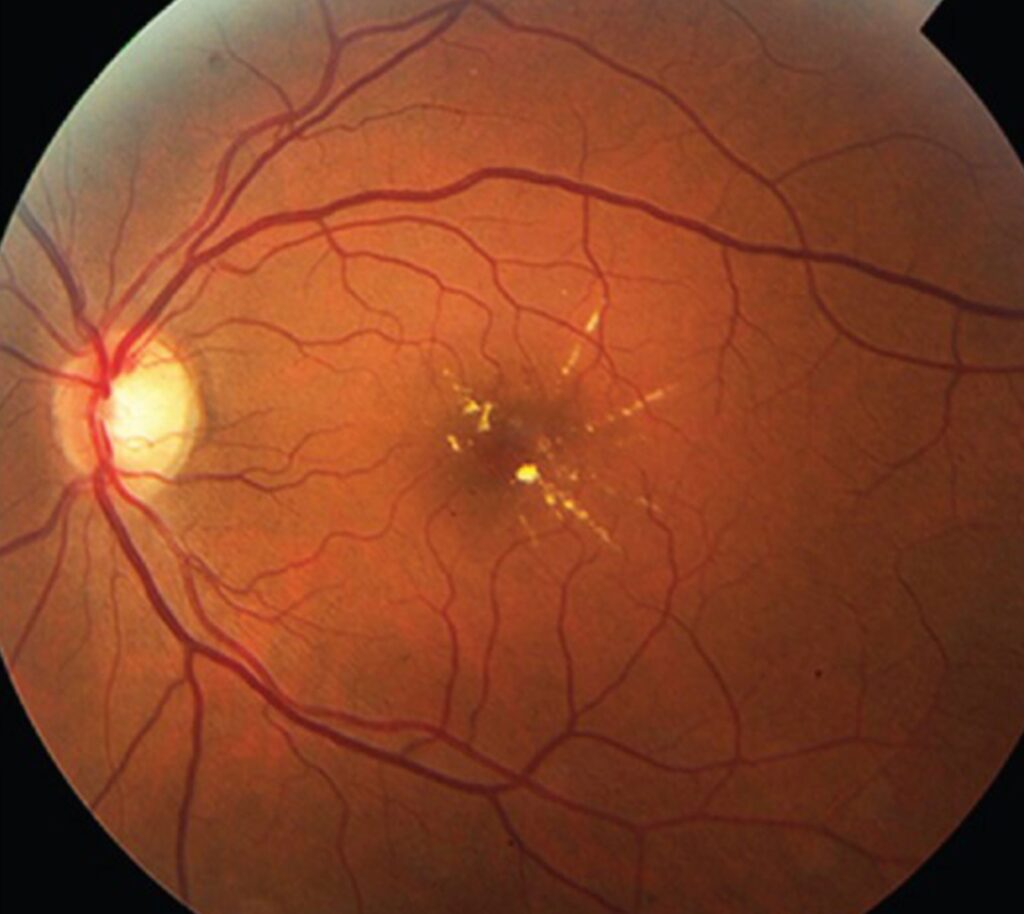
This led to the definition of clinically significant macular edema, which has three criteria. The first is thickening at or within 500 micrometers of the center. The second is hard exudates with adjacent thickening there. The third is a zone of thickening one disc area in size within one disc diameter of the center (see diabetic macular edema).
ETDRS Diabetic Retinopathy: Results for Scatter Laser
Early scatter treatment in mild or moderate nonproliferative disease gave little benefit.
In severe nonproliferative and early proliferative disease, early treatment reduced the risk of severe visual loss and vitrectomy, though only by a small absolute amount.
The practical rule that came out of the study was to consider scatter laser at the severe nonproliferative stage, especially in type 2 diabetes. It also advised following milder disease closely.
The Aspirin Result
Aspirin did not slow the progression of retinopathy, and did not reduce the risk of vitreous hemorrhage (see the references).
It also did not increase serious bleeding in the eye, which let patients who needed aspirin for heart disease continue it.
ETDRS Diabetic Retinopathy: The Severity Scale
Graders assigned each eye a step on the ETDRS scale, from no retinopathy to advanced proliferative disease.
This scale became the base of the Diabetic Retinopathy Severity Scale. Trials of anti-VEGF drugs use a two-step improvement as an endpoint (see diabetic retinopathy classification).
What Changed in Practice
- Focal and grid laser became the first-line treatment for center-involving edema for about two decades
- Investigators timed scatter laser to the stage of retinopathy and the type of diabetes
- The logarithmic chart replaced Snellen testing in research
- Aspirin was no longer withheld for fear of bleeding
Limits
- Laser prevents loss of vision more often than it restores it, with a modest chance of improvement
- Investigators ran it before OCT, so they judged thickness on stereoscopic biomicroscopy
- Anti-VEGF therapy later outperformed laser for center-involving edema, so laser now plays a supporting role (see DRCR Protocol T)
Counselling
Explain that treatment aims to protect the vision the patient has, and that control of blood sugar and blood pressure remains the base.
Tell patients that regular examinations are needed even when the eyes feel fine.
How the Trial Is Used Today
The ETDRS visual acuity chart, with five letters on each line and logarithmic spacing, is now the reference for research and for many clinics. It measures vision more reliably than a Snellen chart (see diabetic retinopathy).
The severity scale guides risk estimates: eyes with severe nonproliferative disease have a high chance of progressing to proliferative disease within a year.
Focal and grid laser techniques, with spot size and spacing as described in the study, are still taught.
The method is useful when injections are not available or not tolerated.
A Typical Application
A 58-year-old man with type 2 diabetes has retinal thickening within 500 micrometers of the center, with hard exudates, and 20/40 vision.
Under the ETDRS criteria, this is clinically significant macular edema, and in the trial era he would have received focal laser.
Today he is more likely to receive anti-VEGF injections first, with laser to treat leaking microaneurysms later if the thickening persists.
Why It Still Matters
The trial taught the field to define outcomes by the doubling of the visual angle, to grade photographs centrally, and to follow patients for years.
These methods shaped the trials that followed.


Document what you see
Two smartphone imaging tools built for everyday clinic use — one for the slit lamp, one for the fundus.
From Choroida — the team behind this siteReferences
- Early Treatment Diabetic Retinopathy Study Research Group. Photocoagulation for diabetic macular edema: ETDRS report number 1. Arch Ophthalmol. 1985;103:1796-1806.
- Early Treatment Diabetic Retinopathy Study Research Group. Early photocoagulation for diabetic retinopathy: ETDRS report number 9. Ophthalmology. 1991;98:766-785.
- Early Treatment Diabetic Retinopathy Study Research Group. Effects of aspirin treatment on diabetic retinopathy: ETDRS report number 8. Ophthalmology. 1991;98:757-765.
- American Academy of Ophthalmology. Basic and Clinical Science Course, Section 12: Retina and Vitreous. AAO; current edition.

Writes and reviews the clinical articles on Educate. Every post is checked against peer-reviewed sources before it goes live.