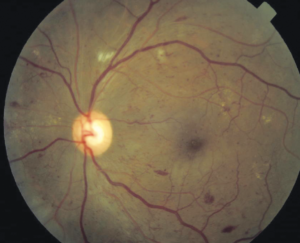
The fundoscopic findings of diabetic retinopathy are the retinal changes you see through a dilated pupil: microaneurysms, dot and blot hemorrhages, hard exudates, cotton wool spots, venous beading, intraretinal microvascular abnormalities, and new vessels. Early disease shows only a few red dots, while advanced disease shows neovascularization and preretinal or vitreous hemorrhage. Stage and macular involvement decide who needs treatment.
Diabetic retinopathy is a common complication of diabetes and a major cause of vision impairment and blindness. Chronic hyperglycemia damages retinal capillaries, so vessels become leaky or blocked. Abnormal new vessels can then grow, bleed, and scar the retina, leading to permanent vision loss.
Vision impairment most often comes from thickening of the central retina, called diabetic macular edema. Visual acuity can stay normal until late, so a normal chart result never rules out retinopathy. Dilated examination or retinal imaging finds disease early.
Fundoscopic findings of diabetic retinopathy by stage
Nonproliferative changes
Nonproliferative disease stays within the retina. Microaneurysms appear first, as tiny red dots at the capillary level, and they cannot be told apart from small dot hemorrhages without fluorescein angiography. As disease advances, you see the following signs:
- Dot and blot hemorrhages: round red spots in the deeper retinal layers; blots are larger than dots.
- Flame hemorrhages: feathery bleeds in the nerve fiber layer, often with hypertension.
- Hard exudates: yellow lipid deposits with sharp edges, often in a circinate ring around leaking microaneurysms.
- Cotton wool spots: pale, fluffy patches from nerve fiber layer infarcts.
- Venous beading and loops: irregular caliber of retinal veins, a sign of significant ischemia.
- Intraretinal microvascular abnormalities (IRMA): shunt vessels within the retina that signal severe ischemia and precede new vessels.
The ICDR scale grades these signs. Mild disease has microaneurysms only. Severe nonproliferative disease meets the 4-2-1 rule: any one of hemorrhages in four quadrants, venous beading in two, or IRMA in one. Our guide to diabetic retinopathy classification covers the ICDR and ETDRS scales.
Proliferative changes
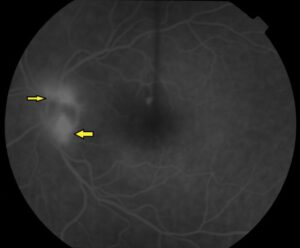
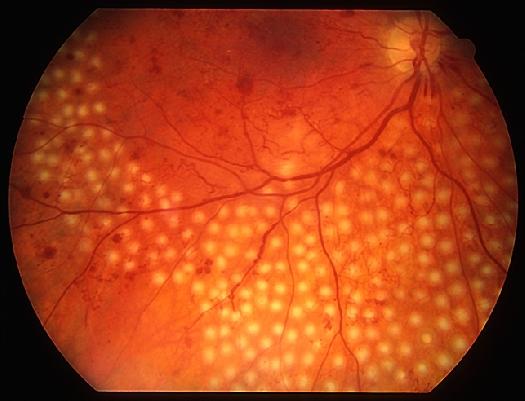
Proliferative disease means new vessels have grown. Neovascularization of the disc (NVD) and neovascularization elsewhere (NVE) appear as fine, looping vessels on the optic disc or retina, and they leak heavily on fluorescein angiography. High-risk features include NVD covering a quarter to a third of the disc area, or any NVD with preretinal or vitreous hemorrhage.
Fibrovascular proliferation can contract and pull on the retina. This causes preretinal hemorrhage, vitreous hemorrhage, and tractional retinal detachment, and new vessels on the iris (rubeosis) can raise eye pressure and cause neovascular glaucoma. Our article on proliferative diabetic retinopathy compares PRP and anti-VEGF.
Diabetic maculopathy on fundoscopy
Diabetic maculopathy shows as retinal thickening, hard exudates, and microaneurysms or hemorrhages near the fovea. Thickening is easiest to see with stereoscopic slit-lamp viewing, because on direct ophthalmoscopy a mildly edematous macula can look nearly normal. Ischemic maculopathy is different: the macula looks fairly normal while vision falls, and fluorescein angiography shows an enlarged foveal avascular zone.
Clinically significant macular edema (CSME), defined in the ETDRS trial, meets one of three criteria: thickening within 500 microns of the center, hard exudates within 500 microns of the center with adjacent thickening, or thickening one disc area or larger with part of it within one disc diameter of the center.
Fundus Explorer Pro
Photograph the retinal findings described here with the phone already in your pocket — 22 D optics and built-in illumination in one handheld unit.
From Choroida — the team behind this siteReading fundoscopy images of diabetic retinopathy
On a color fundus photograph, microaneurysms and hemorrhages look dark red, exudates look yellow, and cotton wool spots look white. Red-free (green) light makes hemorrhages and new vessels stand out, and a wide-field image shows peripheral disease that a single posterior pole view misses.
Diabetic retinopathy fundoscopy: choosing an examination method
Several tests screen for diabetic retinopathy, and each trades performance against cost and ease of use. Sensitivity also depends on who examines and how well they are trained, which matters most for direct ophthalmoscopy. Whatever the method, dilate the pupil unless you use a nonmydriatic camera, and document what you see.

Direct ophthalmoscopy for diabetic retinopathy
Direct ophthalmoscopy gives an upright, highly magnified view of a small area of retina. It is portable and cheap, which suits bedside and community use, but it demands skill and misses subtle disease. Microaneurysms and small hemorrhages are the signs most often missed.
Advantages:
- Mobile
- Relatively inexpensive
- Needs no special facilities
Disadvantages:
- Requires pupil dilation
- Only a small field of the retina can be examined
- Low sensitivity: even with a trained practitioner, small microvascular abnormalities may be difficult to detect
- Less effective than slit-lamp biomicroscopy through dilated pupils
- No ability to audit retrospectively
Indirect ophthalmoscopy for diabetic retinopathy

Indirect ophthalmoscopy with a head-mounted light and a handheld condensing lens gives a wider, stereoscopic view, which helps you inspect the periphery for neovascularization and tractional changes. It has a learning curve and lower magnification than the direct instrument.
Advantages:
- Mobile
- Large fields of the retina can be examined
- Relatively inexpensive
Disadvantages:
- Requires pupil dilation
- Even with a trained practitioner, small microvascular abnormalities will be difficult to detect
- Less effective than slit-lamp biomicroscopy through dilated pupils
- No ability to audit retrospectively
Slit lamp biomicroscopy for diabetic retinopathy
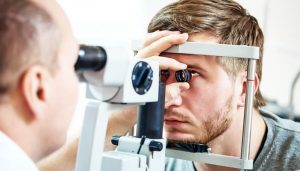
Slit-lamp biomicroscopy with a 78D or 90D lens or a contact lens gives a magnified, stereoscopic view of the posterior pole. It shows macular thickening and exudates in depth, and the same visit lets you check the iris for neovascularization.
Advantages:
- Large field of the retina can be examined
- Gold standard for training health professionals in retinal examination
- Mobile table-top versions are available
Disadvantages:
- Relatively expensive
- Most types are desk-based
- Requires pupil dilation
- Requires special lenses
- Usually unable to retrospectively audit results, although it is possible to photograph findings
Optical coherence tomography (OCT) for diabetic retinopathy
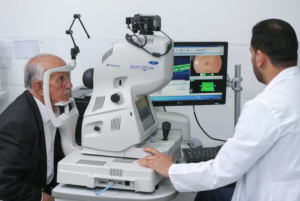
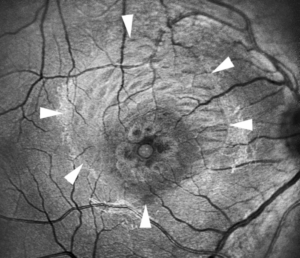
OCT gives cross-sectional images of the retina. In diabetic macular edema it shows retinal thickening, intraretinal cysts, subretinal fluid, and vitreomacular traction, and it tracks response to treatment. Hard exudates appear as hyperreflective deposits in the outer retina.
Advantages:
- One of the best ways to assess macular edema (retinal thickening and intraretinal edema)
Disadvantages:
- Needs to be used alongside other screening tests such as slit-lamp or retinal photography to detect diabetic retinopathy
- Relatively expensive


Document what you see
Two smartphone imaging tools built for everyday clinic use — one for the slit lamp, one for the fundus.
From Choroida — the team behind this siteMobile fundoscopy with the Choroida Fundus Explorer
After weighing these methods, we at Choroida built a tool that combines their advantages and avoids their disadvantages. We present the Choroida Fundus Explorer:

Mobile fundoscopy (Choroida Fundus Explorer): press here
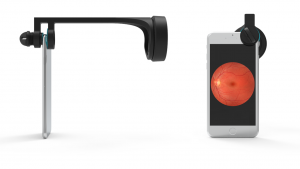
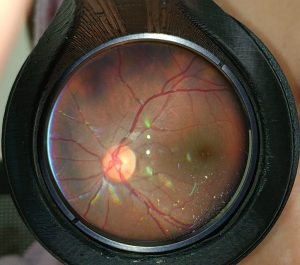
- Simple, easy, and affordable
- Suitable for all mobile phones
- 3D printed
- Portable
- Lightweight, 60 g
- Compatible with many fundus lenses: Volk 20D, Volk 28D, Nikon 20D, Occular 20D, Opticlear 20D
- Uses the phone’s LED flashlight as the light source
- Very cheap
- Captures images and records video
With the Fundus Explorer you can record a video of the lesions you find, including their size, color, shape, and the count of hard exudates or dots and blots. You can also connect the phone to a larger screen and show the signs live in a conference or meeting.
You can document a patient’s full exam as a video and upload it to hospital records. Any other professional can then continue the treatment plan for diabetic retinopathy with all the data about the patient. This also helps teaching, because trainees see the same fundus view you do.
You can examine patients at their homes or in other hospital departments and recognize other conditions, such as Bietti Crystalline Dystrophy, Valsalva Retinopathy, Commotio Retinae.

Test yourself
A few questions straight from this article.
-
What most commonly causes vision impairment in diabetic retinopathy?
Vision impairment most commonly occurs from thickening of the central retina, that is diabetic macular edema, which can lead to irreversible visual loss. -
What happens to retinal blood vessels in diabetic retinopathy?
Diabetic retinopathy is caused by diabetes damaging the retinal blood vessels, which become leaky or blocked. -
What is the consequence of abnormal new vessels growing from the retina in diabetic retinopathy?
Abnormal vessels growing from the retina can bleed or cause scarring of the retina, resulting in permanent vision impairment or blindness. -
Which is a stated disadvantage of direct ophthalmoscopy for diabetic retinopathy screening?
Direct ophthalmoscopy is mobile and inexpensive but views only a small retinal field, has low sensitivity for small microvascular abnormalities, and allows no retrospective audit. -
What advantage does indirect ophthalmoscopy hold over direct ophthalmoscopy in diabetic retinopathy screening?
Indirect ophthalmoscopy is mobile, relatively inexpensive, and allows large fields of the retina to be examined, although it still requires dilation and permits no retrospective audit. -
Slit-lamp biomicroscopy is described as the gold standard for which purpose in diabetic retinopathy?
Slit-lamp biomicroscopy examines a large retinal field and is the gold standard for training health professionals in retinal examination, though it is expensive and mostly desk-based. -
Which test is described as one of the best ways to assess macular edema in diabetic retinopathy?
OCT is one of the best ways to assess macular edema, meaning retinal thickening and intraretinal edema. -
What is a stated limitation of OCT when used for diabetic retinopathy screening?
OCT needs to be used alongside other screening tests such as slit-lamp examination or retinal photography to detect diabetic retinopathy, and it is relatively expensive. -
Which factor makes the sensitivity of diabetic retinopathy screening tests vary?
Sensitivity varies according to who does the examination and how well trained they are, which matters particularly for tests such as direct ophthalmoscopy.

Writes and reviews the clinical articles on Educate. Every post is checked against peer-reviewed sources before it goes live.