
Refsum disease is a rare autosomal recessive disorder of peroxisomal fatty acid metabolism causing progressive accumulation of phytanic acid in tissues throughout the body.
It holds a distinctive place among the inherited causes of retinitis pigmentosa: it is one of the few where dietary modification — specifically, restricting dietary phytanic acid intake — has real, demonstrated potential to slow disease progression, making accurate diagnosis directly and meaningfully actionable rather than purely informative.
Pathophysiology
Deficiency of phytanoyl-CoA hydroxylase (or, in a smaller subset of cases, a related peroxisomal protein) impairs the normal alpha-oxidation pathway responsible for breaking down phytanic acid, a fatty acid obtained entirely from dietary sources (found in ruminant animal fats and certain fish) rather than synthesized by the body.
Because phytanic acid is exclusively dietary in origin, restricting its intake genuinely reduces the ongoing accumulation driving progressive tissue damage — a mechanistic fact that directly explains why dietary management, unusually among inherited retinal dystrophies, has real disease-modifying potential in this specific condition.
Ocular Findings
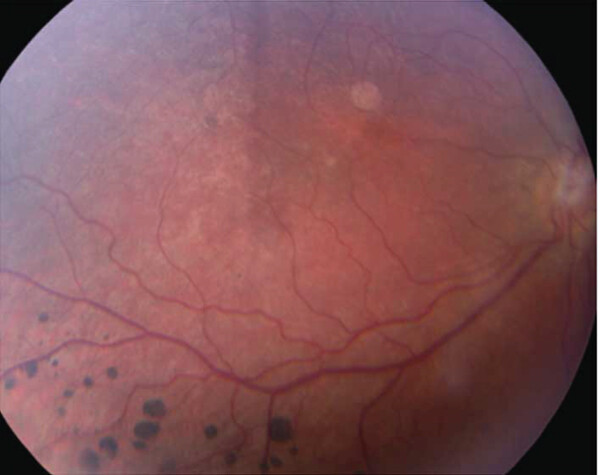
- Retinitis pigmentosa — following the classic rod-cone pattern of early night blindness and peripheral field constriction, discussed in more detail in this site’s dedicated article on that condition, though in Refsum disease this retinal degeneration occurs as one manifestation of a broader systemic metabolic disorder rather than as an isolated ocular finding
- Cataract, developing in many affected individuals over the disease course
- Miosis and other pupillary abnormalities in some patients
Fundus Explorer Pro
Photograph the retinal findings described here with the phone already in your pocket — 22 D optics and built-in illumination in one handheld unit.
From Choroida — the team behind this siteSystemic Findings
- Peripheral neuropathy — typically a progressive, predominantly sensorimotor polyneuropathy, often a prominent and functionally significant feature of the disease
- Sensorineural hearing loss, progressive over the disease course
- Cerebellar ataxia, contributing to gait and coordination difficulties
- Anosmia (loss of smell), a genuinely characteristic and relatively distinctive feature worth specifically asking about
- Ichthyosis (dry, scaling skin), present in a subset of patients
- Cardiac arrhythmia, related to phytanic acid deposition affecting cardiac conduction tissue — a potentially serious complication that warrants cardiac monitoring given its associated risk
- Skeletal abnormalities, including shortened fourth metatarsals and other findings, in some patients
Clinical Pattern and Diagnosis Timing
Symptoms typically begin in childhood or adolescence with the retinitis pigmentosa often being the earliest-recognized manifestation, with the other systemic features — neuropathy, hearing loss, ataxia — developing and becoming more apparent over subsequent years.
Because retinitis pigmentosa is a common final pathway for many distinct genetic conditions, the additional, more specific systemic findings (anosmia, peripheral neuropathy, ichthyosis, cardiac involvement) are what should prompt specific consideration of Refsum disease rather than one of the many other syndromic or non-syndromic causes of retinitis pigmentosa.
Differential Diagnosis
- Non-syndromic retinitis pigmentosa — an isolated retinal finding without the characteristic additional systemic features of Refsum disease, discussed in this site’s general coverage of retinitis pigmentosa
- Usher syndrome — combines retinitis pigmentosa with sensorineural hearing loss, similar in some respects to Refsum disease, but without the characteristic anosmia, ichthyosis, or elevated phytanic acid level, and with a different underlying genetic cause, discussed in its own dedicated article on this site
- Bardet-Biedl syndrome and Alström syndrome — other syndromic causes of retinal dystrophy with their own distinct associated systemic findings (obesity, polydactyly, cardiomyopathy depending on the specific syndrome), discussed in their own dedicated articles on this site, each distinguishable from Refsum disease by their particular constellation of additional features
- Other peroxisomal disorders — a broader category with overlapping but generally distinguishable clinical and biochemical features
Diagnostic Evaluation
Elevated plasma phytanic acid level is the key diagnostic biochemical test.
Genetic testing for PHYH (or the related, less common causative gene) confirms the molecular diagnosis, and can also be useful for confirming carrier status in unaffected family members considering their own recurrence risk.
Given the range of systemic involvement, a comprehensive workup including audiometry, nerve conduction studies, cardiac evaluation (including ECG given the arrhythmia risk), and dermatologic assessment is appropriate once the diagnosis is confirmed or strongly suspected, to fully characterize the extent of multi-organ involvement in that individual patient.
Management
Dietary restriction of phytanic acid — avoiding ruminant animal fats, certain fish, and other dietary sources — is the cornerstone of management and has real, demonstrated potential to slow disease progression and, in some cases, produce partial clinical improvement, for the neuropathy and skin findings, making this one of the more actionable diagnoses within the broader category of syndromic retinitis pigmentosa.
In more severe or acute exacerbations, plasmapheresis or lipapheresis can be used to more rapidly reduce circulating phytanic acid levels, generally reserved for significant symptomatic flares rather than used as ongoing routine management.
Beyond dietary management, care remains supportive and coordinated across the multiple affected organ systems — low vision services for the progressive retinal disease, hearing amplification, physical therapy for ataxia and neuropathy, and cardiac monitoring given the arrhythmia risk — with genetic counseling addressing recurrence risk given the autosomal recessive inheritance.
Because the cardiac arrhythmia risk carries real acute danger and the retinal disease often draws the most clinical attention, deliberately ensuring cardiology remains part of the ongoing care team, rather than being overshadowed by the more visually obvious ophthalmic findings, is a genuinely important part of comprehensive management.

Document what you see
Two smartphone imaging tools built for everyday clinic use — one for the slit lamp, one for the fundus.
From Choroida — the team behind this siteReferences
- Wierzbicki AS, Lloyd MD, Schofield CJ, et al. Refsum’s disease: a peroxisomal disorder affecting phytanic acid alpha-oxidation. Journal of Neurochemistry.
- Baldwin EJ, Gibberd FB, Harley C, et al. The effectiveness of long-term dietary therapy in the treatment of adult Refsum disease. Journal of Neurology, Neurosurgery & Psychiatry.
- American Academy of Ophthalmology. Basic and Clinical Science Course, Section 12: Retina and Vitreous.
