Corneal transplant types differ mainly in which corneal layers the surgeon replaces.
Penetrating keratoplasty (PK) replaces the full thickness. In contrast, lamellar techniques replace only the diseased layer and keep healthy host tissue, so the first clinical question is always which layer has failed.
Choosing Among Corneal Transplant Types
First, decide whether the disease sits in the stroma, the endothelium, or both, and next look for edema, guttae, scarring, thinning and vascularization at the slit lamp. Sclerotic scatter and retroillumination help separate scar from edema (see slit lamp illumination), and then you can match the operation to the layer you see.
Penetrating Keratoplasty (PK)
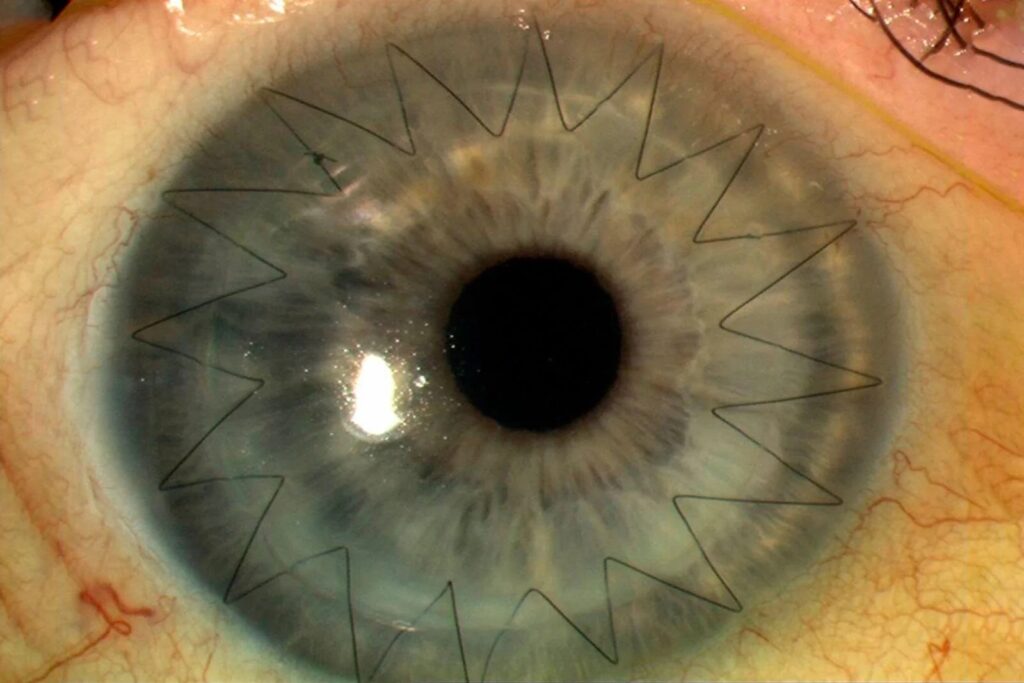
PK removes a full-thickness host button and sutures a full-thickness donor disc in place. It suits disease involving every layer, for example dense scars with endothelial failure, and surgeons also use it for large perforations and many failed previous grafts. However, the open-sky step carries a small risk of suprachoroidal hemorrhage.
All-fit Slit-Lamp Adapter
Record and share exactly what you see at the slit lamp. One adapter fits any slit lamp or surgical microscope — and any smartphone.
From Choroida — the team behind this siteWhat PK Cannot Fix
The full-circumference wound never regains normal strength, so blunt trauma can rupture the eye years later. Sutures also induce astigmatism, so stable refraction often takes many months, and PK in addition exposes the patient to every form of graft rejection.
Deep Anterior Lamellar Keratoplasty (DALK)
DALK replaces the epithelium and stroma down to Descemet membrane, and the big-bubble technique uses air to separate Descemet membrane from the stroma. Keratoconus, stromal scars and stromal dystrophies with healthy endothelium are typical indications, so assess the endothelium carefully before choosing DALK.
Limits of DALK
DALK cannot rescue a failing endothelium, and the dissection is demanding, so a Descemet tear may force conversion to PK. Sutures remain, so astigmatism and slow refractive recovery persist as with PK. However, keeping the host endothelium removes endothelial rejection and may favor long-term graft survival.
Endothelial Keratoplasty: DSAEK and DMEK
Both operations treat endothelial disease while the stroma remains clear enough, and Fuchs dystrophy and pseudophakic bullous keratopathy are the main indications. The surgeon strips host Descemet membrane and inserts donor tissue through a small incision, and then an air or gas bubble presses the graft against the host stroma.
DSAEK in Corneal Transplant Types
DSAEK carries donor endothelium on a thin layer of posterior stroma, and the extra stroma makes the tissue easier to handle. Therefore, it suits complex eyes, such as those with glaucoma tubes or prior vitrectomy. However, the stromal interface may limit final acuity, and a mild hyperopic shift can occur.
DMEK in Corneal Transplant Types
DMEK transplants only Descemet membrane and endothelium, and as a result it restores near-normal anatomy and usually gives faster visual recovery. However, the scrolled tissue is fragile, and partial detachment often needs rebubbling (see DMEK versus DSAEK outcomes), while donor preparation also takes skill, although prestripped tissue from eye banks helps.
What Endothelial Keratoplasty Cannot Fix
EK does not remove stromal scars, and longstanding edema can also leave subepithelial fibrosis that limits vision after the graft clears. Furthermore, shallow chambers, aniridia and unstable lenses make graft attachment harder. Therefore, chronic cases may still need PK or a later anterior procedure.
Rejection Risk Across Corneal Transplant Types
Endothelial rejection matters most, because donor endothelium cannot regenerate. PK carries the highest overall rejection risk, and DALK avoids endothelial rejection, although epithelial and stromal rejection can still occur.
Among endothelial techniques, Anshu and colleagues reported significantly fewer rejection episodes after DMEK. Teach every patient the warning signs (see graft rejection signs).
Recovery Time in Corneal Transplant Types
After PK or DALK, refraction stabilizes slowly, and suture adjustment continues for a long time. In contrast, EK avoids corneal sutures and induces little astigmatism. DSAEK falls in between, with steady but slightly slower visual gains, while DMEK often gives the quickest return of useful vision, provided the graft attaches.
Postoperative Care in Corneal Transplant Types
All grafts need topical steroids, usually tapered over months. However, steroids raise intraocular pressure and promote cataract in phakic eyes, so check pressure at every visit. After EK, patients usually lie supine for a period to support attachment.
Counseling Patients About Corneal Transplant Types
Patients often ask which transplant is best, so explain that the best operation replaces the diseased layer and spares healthy tissue. Also, discuss realistic visual goals, the need for glasses or contact lenses, and lifelong follow-up.
Finally, stress urgent review for redness, light sensitivity, reduced vision or pain. Any graft can fail, and regrafting carries a higher risk each time.
Pitfalls to Avoid
- Offering DALK when the endothelium is already compromised
- Expecting EK to clear a chronically scarred stroma
- Missing steroid-induced pressure rise at follow-up
- Tapering steroids too early in high-risk eyes
- Treating a red graft as simple conjunctivitis


Document what you see
Two smartphone imaging tools built for everyday clinic use — one for the slit lamp, one for the fundus.
From Choroida — the team behind this siteReferences
- Melles GR, Ong TS, Ververs B, van der Wees J. Descemet membrane endothelial keratoplasty (DMEK). Cornea. 2006;25:987-990.
- Anshu A, Price MO, Price FW Jr. Risk of corneal transplant rejection significantly reduced with Descemet’s membrane endothelial keratoplasty. Ophthalmology. 2012;119:536-540.
- Anwar M, Teichmann KD. Big-bubble technique to bare Descemet’s membrane in anterior lamellar keratoplasty. J Cataract Refract Surg. 2002;28:398-403.
- Price FW Jr, Price MO. Descemet’s stripping with endothelial keratoplasty in 50 eyes: a refractive neutral corneal transplant. J Refract Surg. 2005;21:339-345.
- American Academy of Ophthalmology. Basic and Clinical Science Course, Section 8: External Disease and Cornea. San Francisco: AAO; 2023.

Writes and reviews the clinical articles on Educate. Every post is checked against peer-reviewed sources before it goes live.