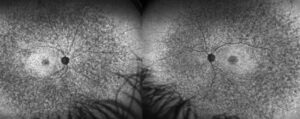
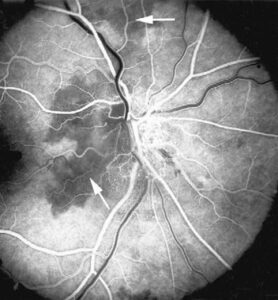
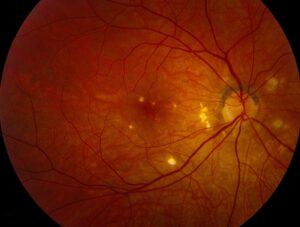
Protocol V asked whether eyes with center-involved diabetic macular edema and good vision need treatment at once.
The Diabetic Retinopathy Clinical Research Network randomized 702 adults to aflibercept, laser, or observation.
Therefore, it supports a watchful approach for many patients with acuity of 20/25 or better.
Why Protocol V Was Needed
Anti-VEGF drugs and laser help eyes with reduced vision, but many patients with edema still see well.
Also, monthly injections are costly, burdensome, and not risk free.
The ETDRS had shown that focal laser reduces moderate vision loss (see diabetic macular edema).
As a result, clinicians needed evidence for the large group with good acuity.
Design of Protocol V
Eyes had center-involved edema on OCT and acuity of 20/25 or better.
Participants received aflibercept 2.0 mg, laser photocoagulation, or observation.
Also, rescue rules allowed aflibercept in the laser and observation groups when vision fell.
Baker and colleagues set the primary outcome as a loss of at least five letters at two years.
Fundus Explorer Pro
Photograph the retinal findings described here with the phone already in your pocket — 22 D optics and built-in illumination in one handheld unit.
From Choroida — the team behind this sitePrimary Results of Protocol V
Vision loss of five letters or more occurred in 16 percent with aflibercept, 17 percent with laser, and 19 percent with observation.
The differences were not statistically significant.
Also, mean vision stayed near 20/20 in every group.
Therefore, early injections gave no visual advantage at two years.
Rescue Treatment in Protocol V
- About one third of the observation group received aflibercept during follow-up
- About a quarter of the laser group received aflibercept
- Rescue was triggered by a fall in vision
Glassman and colleagues described how this observation approach worked in practice (see anti-VEGF therapy).
Because rescue worked well, vision recovered in most eyes that needed it.
Applying Protocol V in Practice
First, confirm that vision is truly 20/25 or better and that the macula is thickened.
Then explain that watching is a treatment plan, and schedule frequent visits.
Also, treat risk factors, including glucose and blood pressure.
Start injections if vision falls or if the edema worsens quickly.
Limits of Protocol V
The trial excluded eyes with poor vision, so the results do not apply to them.
Also, it did not compare observation with anti-VEGF over many years.
However, two-year safety was reassuring, and the rescue strategy was effective.
Therefore, treat each patient as an individual, and revisit the plan often.
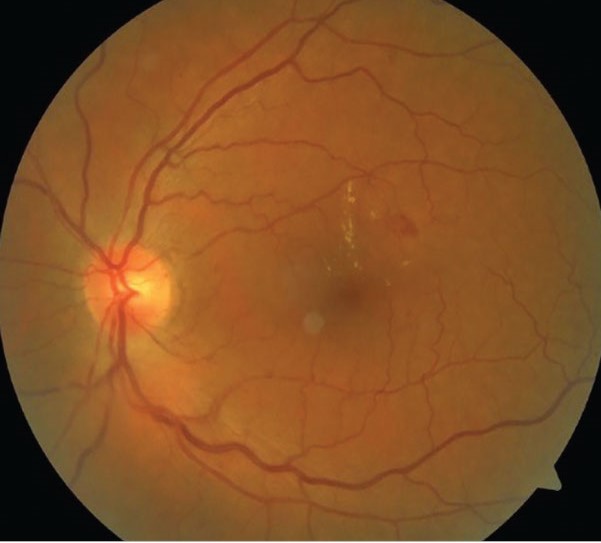
Monitoring While Observing
Examine the patient every one to three months, depending on the level of edema.
Also record acuity, OCT thickness, and the fundus at each visit.
Because rescue depends on timely detection, avoid long gaps between visits.
Then use clear triggers, such as a drop of five or more letters, to start treatment.
Patient Counselling
Many patients expect treatment at the first visit, so explain the reason for waiting.
Also reassure them that the plan is evidence based and that treatment remains available.
Because glucose control affects the edema, review the latest hemoglobin A1c together.
Finally, ask the patient to report new blur or distortion at once.
Key Points for the Clinician
Eyes with good vision can be observed safely under close follow-up.
Also, rescue with aflibercept restored vision in most eyes that worsened.
Because costs and visits matter, watching offers real benefit.
Safety Findings
Rates of serious adverse events were similar in the three groups.
Also, the aflibercept group had a few more systemic events, but the numbers were small.
Because injections carry a low but real risk of endophthalmitis, fewer injections mean fewer exposures.
Therefore, observation offers an advantage in eyes that do well.
How to Combine the Evidence
Use the results of earlier protocols for eyes with worse vision, where anti-VEGF drugs give clear gains.
Also use Protocol V for eyes with acuity of 20/25 or better and a thickened macula.
Then reassess at every visit, because eyes move between these groups.
As a result, the same patient may start with observation and later need injections.
Practical Tip for the Clinic
Record the OCT thickness map at each visit, so that a small rise is visible at a glance.
Also keep the same device, because values differ between machines.
Then compare the current scan with the baseline and the previous visit before the patient leaves.
For the latest studies, see the PubMed results for Protocol V.


Document what you see
Two smartphone imaging tools built for everyday clinic use — one for the slit lamp, one for the fundus.
From Choroida — the team behind this siteReferences
- Baker CW, Glassman AR, Beaulieu WT, et al. Effect of initial management with aflibercept vs laser photocoagulation vs observation on vision loss among patients with diabetic macular edema involving the center of the macula and good visual acuity: a randomized clinical trial. JAMA. 2019;321:1880-1894.
- Glassman AR, Baker CW, Beaulieu WT, et al. Assessment of the DRCR Retina Network approach to management with initial observation for eyes with center-involved diabetic macular edema and good visual acuity: a secondary analysis of a randomized clinical trial. JAMA Ophthalmol. 2020;138:341-349.
- Early Treatment Diabetic Retinopathy Study Research Group. Photocoagulation for diabetic macular edema: ETDRS report number 1. Arch Ophthalmol. 1985;103:1796-1806.
- Elman MJ, Aiello LP, Beck RW, et al. Randomized trial evaluating ranibizumab plus prompt or deferred laser or triamcinolone plus prompt laser for diabetic macular edema. Ophthalmology. 2010;117:1064-1077.

Writes and reviews the clinical articles on Educate. Every post is checked against peer-reviewed sources before it goes live.