The CLARITY trial compared intravitreal aflibercept with panretinal photocoagulation in proliferative diabetic retinopathy.
It was a UK noninferiority trial published in the Lancet in 2017.
Therefore, it added to the DRCR Protocol S evidence on anti-VEGF therapy as a first-line option.
Why the CLARITY Trial Was Done
Panretinal photocoagulation has protected vision in proliferative disease for decades.
However, it causes peripheral field loss, night vision loss and macular edema in some eyes.
Also, anti-VEGF drugs regress new vessels without destroying peripheral retina.
As a result, a direct comparison was needed.
CLARITY Trial Design
The trial enrolled 232 patients with active proliferative diabetic retinopathy and good visual acuity.
Patients received aflibercept 2 mg or panretinal photocoagulation.
Aflibercept followed three monthly loading doses and then was given as needed.
In addition, laser was applied in the standard way over one to three sessions.
Fundus Explorer Pro
Photograph the retinal findings described here with the phone already in your pocket — 22 D optics and built-in illumination in one handheld unit.
From Choroida — the team behind this sitePrimary Outcome of the CLARITY Trial
The primary outcome was the change in best-corrected acuity at 52 weeks.
Aflibercept was noninferior and also superior, with a mean acuity advantage of about four letters.
Also, the effect grew over the first year.
Therefore, anti-VEGF therapy matched laser for vision, and the difference favored the injection.
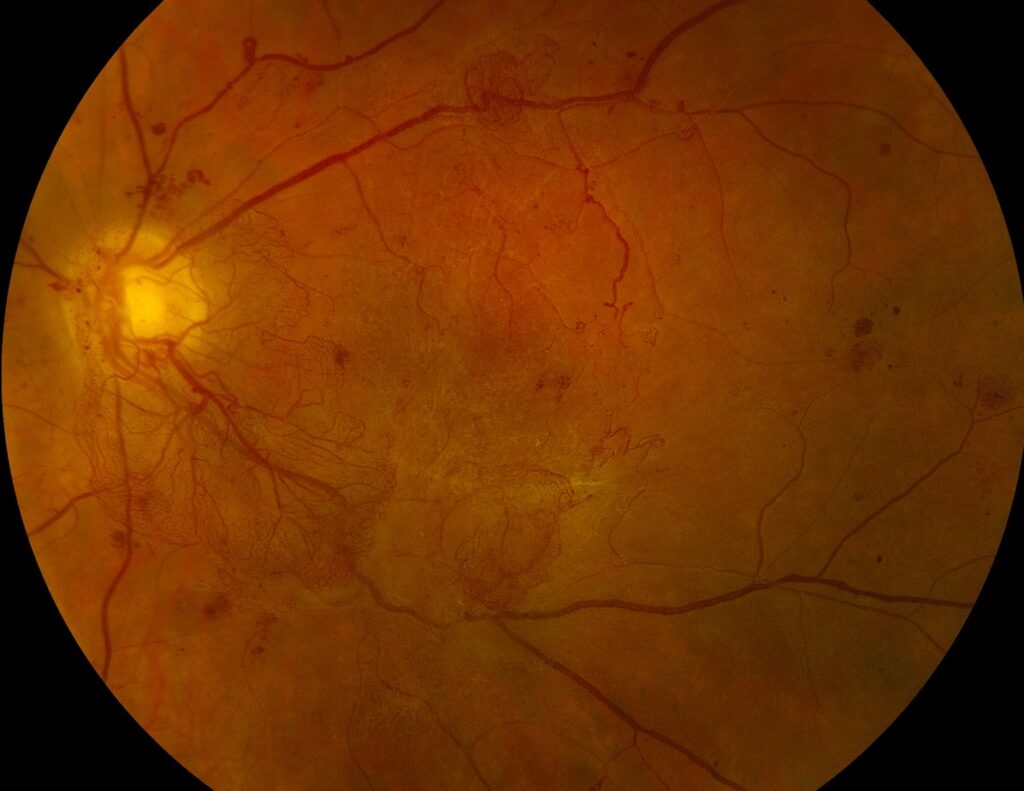
Regression of Neovascularization
Neovascularization regressed in a higher share of aflibercept eyes at week 12 and week 52.
Fluorescein angiography confirmed this finding.
In addition, regression happened faster with the injection.
Because of this, patients needed less time with active disease.
Macular Edema and Vitrectomy
Fewer aflibercept eyes developed center-involving macular edema.
Also, fewer needed vitrectomy for vitreous hemorrhage.
Laser eyes more often developed edema and needed more treatment for it.
Therefore, anti-VEGF therapy lowered key late complications in the first year.
Visual Field and Quality of Life
Panretinal photocoagulation reduced the visual field more than aflibercept did.
Patients also reported more problems with driving and daily tasks in the laser group.
Also, laser eyes had more peripheral scotomas.
As a result, the injection performed better on measures that matter to patients.
Comparison with Protocol S
DRCR Protocol S used ranibizumab and reached similar conclusions (see DRCR Protocol S).
Both trials showed that anti-VEGF therapy is a valid alternative to laser at one and two years.
In addition, both found less field loss and fewer cases of macular edema with injections.
Finally, neither trial followed patients long enough to settle very late outcomes.
Adherence and Loss to Follow-Up
Anti-VEGF therapy works only if patients return for injections.
In diabetic care, missed visits are common, and the effect fades when treatment stops.
Also, laser gives a lasting effect that does not depend on repeated visits.
Therefore, adherence should guide the choice (see panretinal photocoagulation).
Safety in the CLARITY Trial
Serious adverse events occurred at similar rates in both arms.
There were no cases of endophthalmitis in the aflibercept group.
Also, systemic events were balanced.
Because of this, the injection looked acceptably safe in the trial setting.
Practical Use of the Results
Choose aflibercept for patients with good vision, macular edema or a likely need for cataract surgery.
Choose laser for patients who cannot return reliably.
Also, combine both in selected eyes with high-risk features.
In addition, monitor closely after stopping injections.
Limits of the CLARITY Trial
The trial lasted one year and enrolled patients with good vision.
It did not include eyes with extensive fibrosis or traction.
Also, laser sessions were limited in number and extent.
As a result, the findings apply best to eyes with active vessels and no major traction.
Pitfalls to Avoid
- Do not stop injections without a plan for follow-up
- Never use anti-VEGF alone in eyes with traction detachment risk and fibrovascular tissue
- Do not skip laser in patients who miss visits
- Never forget the rapid fibrosis risk after a sudden anti-VEGF effect
Patient Selection
The trial enrolled adults with type 1 or type 2 diabetes and active new vessels.
Visual acuity had to be good at baseline.
Also, eyes with dense vitreous hemorrhage were excluded.
Therefore, the results apply to early proliferative disease.
Treatment Schedule
Aflibercept followed three monthly doses and then was given according to activity.
Patients needed a modest number of injections after the loading phase.
Also, laser patients had one to three sessions.
As a result, the visit load stayed below that of fixed monthly dosing.
For the latest studies, see the PubMed results for CLARITY trial.


Document what you see
Two smartphone imaging tools built for everyday clinic use — one for the slit lamp, one for the fundus.
From Choroida — the team behind this siteReferences
- Sivaprasad S, Prevost AT, Vasconcelos JC, et al. Clinical efficacy of intravitreal aflibercept versus panretinal photocoagulation for best corrected visual acuity in patients with proliferative diabetic retinopathy at 52 weeks (CLARITY): a multicentre, single-blinded, randomised, controlled, phase 2b, non-inferiority trial. Lancet. 2017;389:2193-2203.
- Writing Committee for the Diabetic Retinopathy Clinical Research Network. Panretinal photocoagulation vs intravitreous ranibizumab for proliferative diabetic retinopathy: a randomized clinical trial. JAMA. 2015;314:2137-2146.
- Gross JG, Glassman AR, Liu D, et al. Five-year outcomes of panretinal photocoagulation vs intravitreous ranibizumab for proliferative diabetic retinopathy: a randomized clinical trial. JAMA Ophthalmol. 2018;136:1138-1148.
- Flaxel CJ, Adelman RA, Bailey ST, et al. Diabetic retinopathy preferred practice pattern. Ophthalmology. 2020;127:P66-P145.

Writes and reviews the clinical articles on Educate. Every post is checked against peer-reviewed sources before it goes live.