Color vision deficiency is common and usually inherited.
It affects about 8 percent of men and far fewer women.
Early testing helps families and schools adapt.
What Is Color Vision Deficiency
Cone photoreceptors detect red, green and blue light.
A deficiency arises when one cone type is missing or abnormal.
Most people can still see colors but confuse some shades.
Therefore, true color blindness is rare.
Inheritance of Color Vision Deficiency
Red-green defects are X-linked recessive.
Males are more often affected.
Carrier mothers pass the gene to sons.
So ask about family history.
Fundus Explorer Pro
Photograph the retinal findings described here with the phone already in your pocket — 22 D optics and built-in illumination in one handheld unit.
From Choroida — the team behind this siteTypes of Color Vision Deficiency
Protan defects affect long-wavelength cones.
Deutan defects affect middle-wavelength cones.
Tritan defects affect short-wavelength cones and are rare.
Also, deutan defects are the most common.
Acquired Color Vision Deficiency
Optic nerve disease, macular disease and some drugs cause color loss.
Acquired defects are often unilateral or asymmetric.
They may progress.
Therefore, always consider acquired causes in new complaints (see optic neuritis).
Ishihara Plates for Color Vision Deficiency
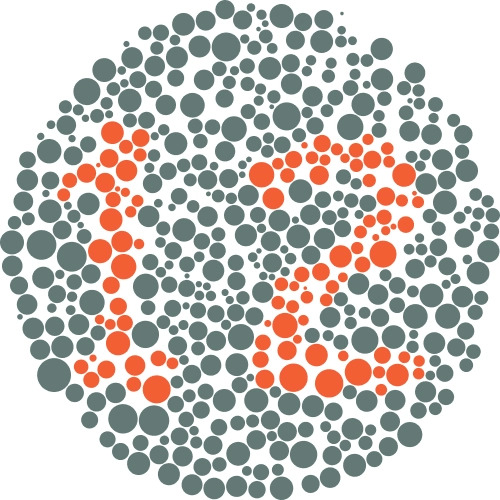
Ishihara plates are used for screening.
They detect red-green defects quickly.
They do not grade severity well.
So follow with other tests when needed.
Other Tests for Color Vision Deficiency
Farnsworth D-15 and Hardy-Rand-Rittler tests classify defects.
The anomaloscope is the reference standard.
Tests need good lighting and standard conditions.
Also use the right distance.
Testing Children
Test children from about four to five years.
Use picture-based plates for young ones.
Early detection helps schools adapt.
Therefore, include color testing in screening.
Career Implications of Color Vision Deficiency
Pilots, electricians and some military roles require normal color vision.
Standards differ between countries.
Mild defects may be acceptable.
So advise families early.
Everyday Challenges
Traffic lights, ripe fruit and color-coded charts can cause trouble.
Learning strategies helps.
Position of lights often helps with signals.
Also share tips on clothing selection.
School and Learning
Color-coded materials can disadvantage children.
Teachers should know about the deficiency.
Use labels and patterns.
Therefore, communicate with schools.
Assistive Tools
Smartphone apps identify colors.
Filters and tinted lenses may help some tasks.
They do not restore normal color vision.
So set realistic expectations.
Gene Therapy and Research
Research on gene therapy for color deficiency is under way.
No approved treatment exists.
Advances may change care.
However, current care is supportive.
Counseling Families
Explain the cause and the genetics.
Reassure parents that vision is otherwise normal.
Provide practical tips.
Also discuss career planning.
Color Vision Deficiency: Practical Summary
Test boys at school age, classify defects when needed and rule out acquired causes.
If color loss is new, look for optic nerve or retinal disease.
Because inheritance is X-linked, explain it to families.
Finally, help patients adapt.
Pitfalls to Avoid
- Do not call everyone colorblind
- Never ignore new color loss in adults
- Avoid testing under poor lighting
- Do not forget career counseling
Color Vision Deficiency in Women
Women are carriers in most families.
Some carriers show mild color errors.
Because X-linked inheritance is complex, draw a pedigree.
Therefore, counsel mothers about their sons.
Color Vision Deficiency and Driving
Most people with red-green defects drive safely.
They rely on the position and brightness of signals.
Because rules vary, check local regulations.
So reassure drivers and discuss tips.
Color Vision Deficiency in the Classroom
Teachers should avoid relying on color alone.
Use patterns, labels and high-contrast materials.
Because early support helps learning, inform the school.
Therefore, write a short letter for parents.
Color Vision Deficiency and Health Care
Doctors and nurses read color charts and skin changes.
Mild defects rarely prevent practice.
Because some tasks need care, use tools and double checks.
Then plan accommodations.
Color Vision Deficiency in Industry
Electricians and wiring jobs rely on color codes.
Employers may require testing.
If standards are strict, discuss alternative roles.
So advise students early.
Color Vision Deficiency Tests in Clinic
Perform tests with standard lighting.
Use each eye separately for acquired disease.
Because results can vary, repeat abnormal tests.
Then record the type and severity.
Color Vision Deficiency and Retinal Disease
Cone dystrophies and macular disease reduce color discrimination.
Optic neuropathies cause red desaturation.
Because early signs matter, test color when vision falls.
Therefore, color testing aids diagnosis.
Color Vision Deficiency: Key Message
Most patients live normal lives.
Early awareness helps schools and employers.
Because new loss is different, evaluate it.
Finally, support patients with information.
Color Vision Deficiency: Information for Teachers
Teachers can label crayons and charts by name.
They should avoid asking the child to guess colors in public.
Because children adapt well, support is usually simple.
Therefore, share a one-page guide.
For the latest studies, see the PubMed results for color vision deficiency.


Document what you see
Two smartphone imaging tools built for everyday clinic use — one for the slit lamp, one for the fundus.
From Choroida — the team behind this siteReferences
- Birch J. Worldwide prevalence of red-green color deficiency. J Opt Soc Am A Opt Image Sci Vis. 2012;29:313-320.
- Neitz J, Neitz M. The genetics of normal and defective color vision. Vision Res. 2011;51:633-651.
- Simunovic MP. Colour vision deficiency. Eye. 2010;24:747-755.
- Deeb SS. The molecular basis of variation in human color vision. Clin Genet. 2005;67:369-377.

Writes and reviews the clinical articles on Educate. Every post is checked against peer-reviewed sources before it goes live.