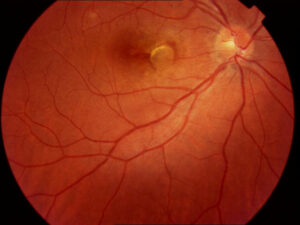
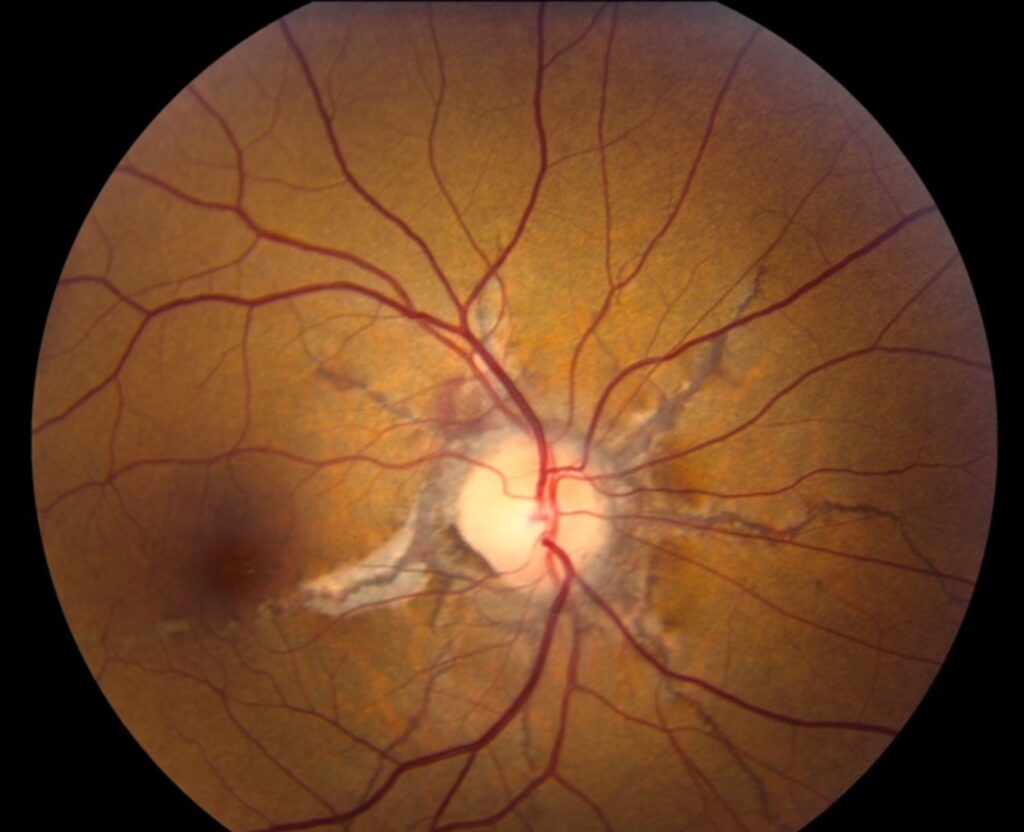
The Submacular Surgery Trials (SST) were randomized trials that tested whether surgical removal of subfoveal choroidal neovascularization or thick submacular blood improves vision.
Investigators ran them in the era before anti-VEGF therapy, and their results ended the routine use of submacular surgery for age-related macular degeneration (see submacular hemorrhage management).
Design of the Submacular Surgery Trials
The program had three parts, called groups (see the references).
- Group N: new subfoveal neovascularization in AMD, surgery versus observation, 454 patients
- Group B: large submacular hemorrhage in AMD, surgery versus observation, 336 patients
- Finally, group H: subfoveal lesions from ocular histoplasmosis or idiopathic causes, surgery versus observation, 225 patients
Also, the main outcome was a change in acuity at two years.
Submacular Surgery Trials: Results in New Neovascularization
Vision outcomes were similar after surgery and observation, and surgery brought more complications such as retinal detachment and cataract (see the references).
Also, removal of the lesion often damaged the retinal pigment epithelium, and the surgery did not preserve central vision.
Fundus Explorer Pro
Photograph the retinal findings described here with the phone already in your pocket — 22 D optics and built-in illumination in one handheld unit.
From Choroida — the team behind this siteSubmacular Surgery Trials: Results in Submacular Hemorrhage
Surgery to remove blood and the underlying lesion did not improve vision compared with observation, and complications were frequent (see the references).
In addition, the trial dealt with large hemorrhages from AMD.
Its results do not apply to blood displaced with gas and tissue plasminogen activator, which the trials did not test.
Submacular Surgery Trials: Results in Histoplasmosis
In the histoplasmosis and idiopathic group, patients with poor starting vision gained a modest benefit from surgery, while those with better acuity did not.
The effect was also small, and photocoagulation and anti-VEGF therapy later became standard (see presumed ocular histoplasmosis syndrome).
Submacular Surgery Trials: Why the Trials Still Matter
- They showed how a well-designed surgical trial can prevent widespread use of an ineffective procedure
- They set standards for outcome measures in macular disease
- These gave natural history data on untreated lesions
- They gave a base for later pneumatic displacement of blood
Quality of Life
Vision-related quality of life scores were not better after surgery, which supports the finding that surgery gave no advantage.
Practical Use
Today, anti-VEGF therapy is the main treatment for neovascular AMD, and surgeons manage large submacular hemorrhages with gas displacement with or without tissue plasminogen activator, or by vitrectomy (see macular neovascularization types 1 2 3).
An Example Case
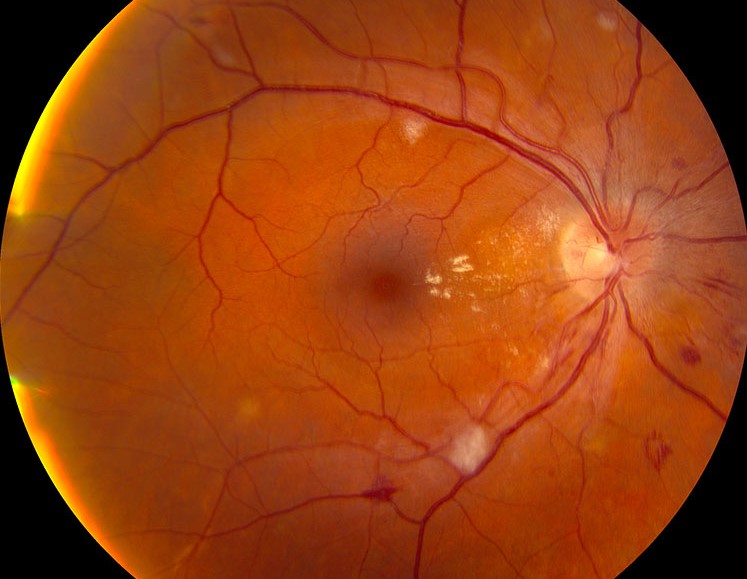
A 78-year-old man has a thick submacular hemorrhage after a recent subfoveal neovascular AMD complication and an acuity of hand motion.
Remembering that the SST did not show benefit from open removal, the surgeon uses a different approach, a vitrectomy with a subretinal injection of tissue plasminogen activator and gas displacement, followed by anti-VEGF therapy.
The blood moves from the fovea, and vision improves to 20/200 at three months.
How to Explain the Findings
Explain that surgical removal of the abnormal vessels and blood in these trials gave no better results than watching, and caused more problems, so it is not recommended for AMD.
Make clear that other treatments, such as injections, are now used.
Questions Patients Ask
- Is there an operation to remove the blood? There are procedures to move it, and they work best when done early.
- Will the vision return? That depends on how long the blood has been under the retina.
- Can it happen in the other eye? Yes, and home monitoring helps to detect it.
What Came After
Anti-VEGF trials set a new standard for neovascular AMD, and pneumatic displacement with tissue plasminogen activator became common for blood under the fovea.
The SST remains an example of how a randomized trial can prevent harm from a plausible but ineffective surgery.
Key Points to Remember
- Surgical removal of new neovascular lesions in AMD gave no visual benefit over observation
- Surgery for large hemorrhages did not help either
- Only a small group with histoplasmosis and poor vision gained
- Complications were frequent, so surgeons dropped the procedure
Why Results Differ From Modern Care
The surgery in the trials removed the tissue directly, while the modern approach uses injections to control the vessels and gas to move blood.
Also, the two approaches treat the problem differently, and the old trial results cannot be used to judge the new methods.
Newer reports of gas displacement suggest benefit in selected eyes, though randomized evidence is still limited.
Treat patients promptly, since blood damages the retina within days.
For the latest studies, see the PubMed results for Submacular Surgery Trials.

Document what you see
Two smartphone imaging tools built for everyday clinic use — one for the slit lamp, one for the fundus.
From Choroida — the team behind this siteReferences
- Submacular Surgery Trials Research Group. Surgery for hemorrhagic choroidal neovascular lesions of age-related macular degeneration: ophthalmic findings: SST report no. 13. Ophthalmology. 2004;111:1993-2006.
- Hawkins BS, Bressler NM, Miskala PH, et al. Surgery for subfoveal choroidal neovascularization in age-related macular degeneration: ophthalmic findings: SST report no. 11. Ophthalmology. 2004;111:1967-1980.
- Submacular Surgery Trials Research Group. Surgical removal vs observation for subfoveal choroidal neovascularization, either associated with the ocular histoplasmosis syndrome or idiopathic: I. Ophthalmic findings from a randomized clinical trial: SST Group H trial: SST report no. 9. Arch Ophthalmol. 2004;122:1597-1611.
- American Academy of Ophthalmology. Basic and Clinical Science Course, Section 12: Retina and Vitreous. AAO; current edition.

Writes and reviews the clinical articles on Educate. Every post is checked against peer-reviewed sources before it goes live.