The Early Manifest Glaucoma Trial (EMGT) was a Swedish randomized trial that tested whether treatment lowers the risk of progression in newly detected open-angle glaucoma.
It compared immediate treatment with no treatment.
It gave clear evidence that lowering pressure works, and that the effect depends on how much the pressure falls (see the references).
Design of the Early Manifest Glaucoma Trial
The study enrolled 255 patients aged 50 to 80 years with early glaucomatous field defects, found largely through population screening.
Half received laser trabeculoplasty and topical betaxolol, and half had observation without treatment.
Investigators added treatment to the control group when progression occurred.
Investigators defined progression by a pattern of field loss on perimetry or by disc change on photographs.
Early Manifest Glaucoma Trial: Main Results
Over a median follow-up of six years, 45 percent of treated eyes progressed against 62 percent of untreated eyes (see the references).
In addition, the treated patients had an average pressure drop of about 25 percent, from about 20 to 15 mmHg, which held for the study period.
The benefit was clear, but about half of the treated patients still progressed, which shows that lower targets may be needed in some.
All-fit Slit-Lamp Adapter
Record and share exactly what you see at the slit lamp. One adapter fits any slit lamp or surgical microscope — and any smartphone.
From Choroida — the team behind this siteEffect of Each mmHg
Each millimeter of mercury of pressure reduction at the first follow-up lowered the risk of progression by about 10 percent.
The finding supports the idea that pressure reduction is also dose-dependent, and that a larger drop gives a greater benefit.
Early Manifest Glaucoma Trial: Risk Factors for Progression
- Higher baseline pressure
- Bilateral disease
- Exfoliation
- Worse mean deviation at baseline
- Older age
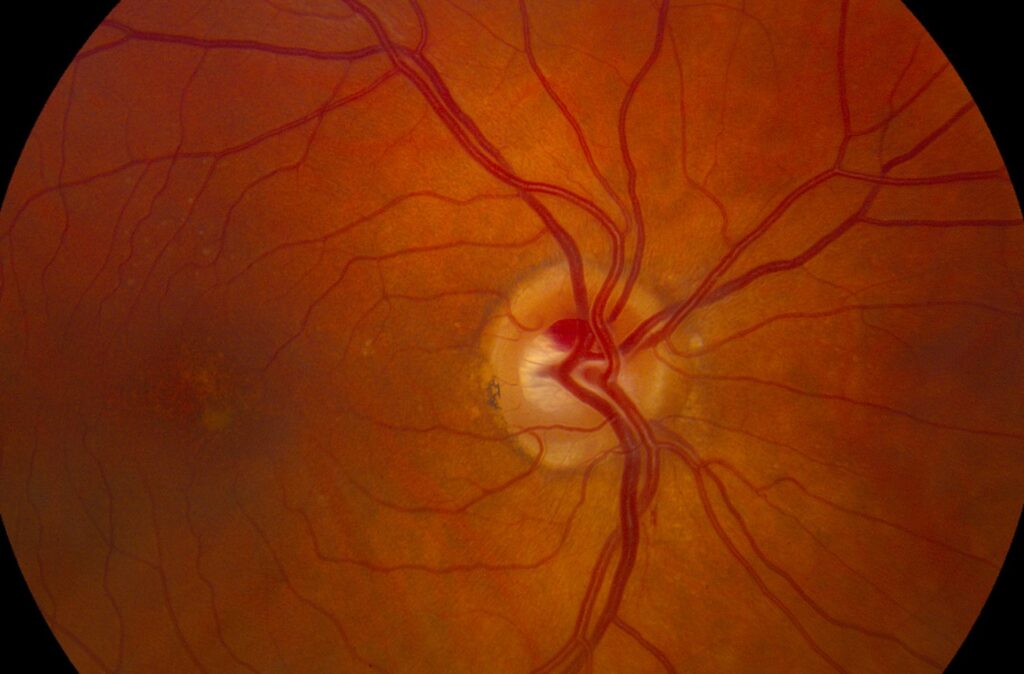
- Disc hemorrhages
The presence of disc hemorrhages was associated with a higher rate of progression.
Treatment seemed to lower the hazard (see the references).
Also, thin corneas predicted progression in eyes with a high pressure only.
Early Manifest Glaucoma Trial: Natural History
In untreated patients the field loss was slow on average, but individual courses differed widely.
Some patients progressed fast, others hardly at all, so regular testing is the only reliable way to tell them apart (see Humphrey visual field interpretation).
Early Manifest Glaucoma Trial: Limits of the Study
- Most participants had a mean baseline pressure that was lower than in many clinics
- Screening detected the patients, who may also have had slow disease
- The treatment regimen stayed fixed, with no titration to a target
- The study included normal-tension glaucoma, but analyzed it within the group
Clinical Lessons
Treatment of early glaucoma reduces progression, so do not leave patients untreated because the damage is small.
Aim for an initial pressure reduction of at least 25 to 30 percent and adjust the target when the field continues to change (see normal-tension glaucoma).
Look for disc hemorrhages and manage them as a sign of risk.
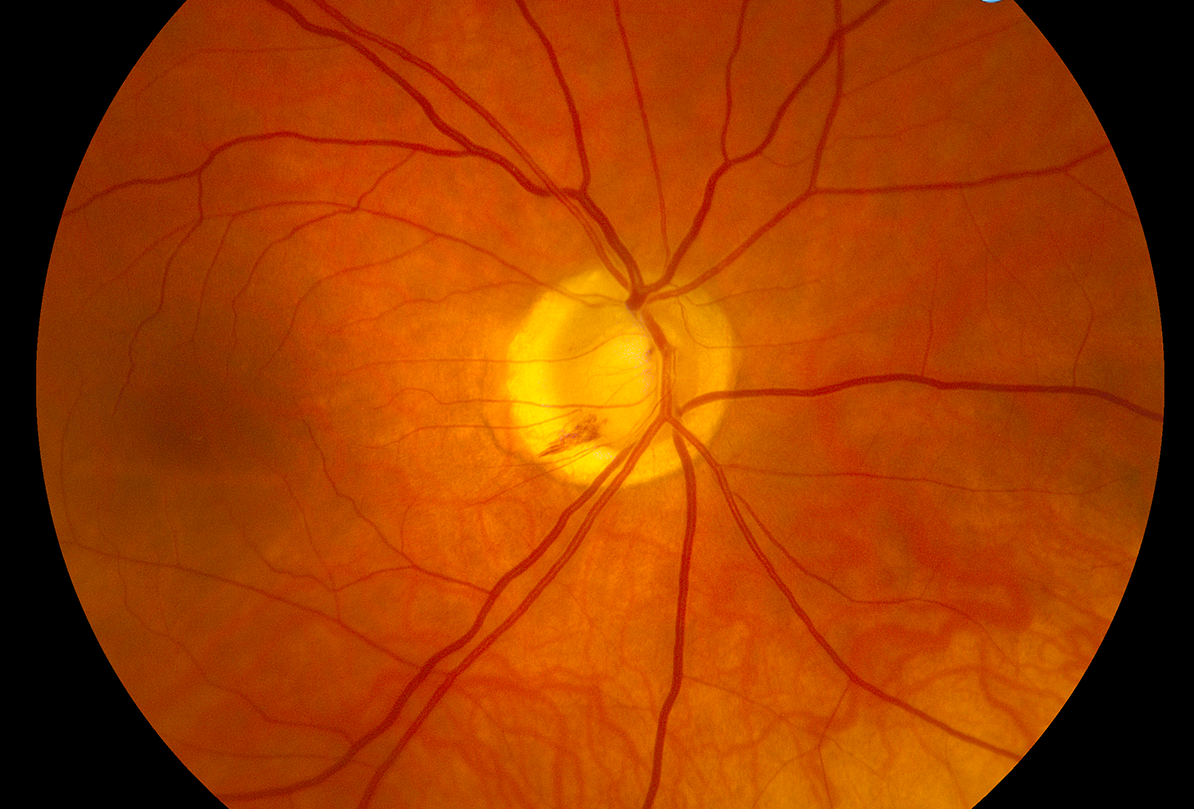
An Example Case
A 66-year-old man has early glaucoma with a mean deviation of -2.5 dB, a baseline pressure of 24 mmHg, and a disc hemorrhage in the right eye.
He starts a prostaglandin analog, and the pressure falls to 16 mmHg, a drop of about a third, in line with the aim of the EMGT.
Over three years the fields remain stable, and the plan stays, with closer follow-up because of the hemorrhage.
How to Explain the Study
Explain that patients with early damage who received treatment did better than untreated patients, and that bigger pressure drops gave greater protection.
Stress that the benefit exists even when the damage is small and vision is good, which helps with motivation to use the drops.
Questions Patients Ask
- Why treat when I see well? Because the loss cannot return, and treatment slows it.
- Will one drop be enough? Maybe, and the doctor checks the pressure to see.
- What if my field still worsens? The doctor lowers the target, and considers laser or surgery.
What Came After
Later work, such as the UK Glaucoma Treatment Study, tested treatment effects with a placebo-controlled design and showed slower field loss with latanoprost in new patients.
Treatment targets now take into account the age, the stage, and the rate of progression, and the doctor follows each patient with fields and OCT.
Key Points to Remember
- Treatment cut progression in early glaucoma
- Each millimeter of pressure drop mattered
- Disc hemorrhages and bilateral disease marked higher risk
- Many treated eyes still progressed, so review targets
Use in Clinical Practice
Document the baseline pressure and the percentage drop achieved after starting treatment, since the size of the drop is the best guide to the chance of success.


Document what you see
Two smartphone imaging tools built for everyday clinic use — one for the slit lamp, one for the fundus.
From Choroida — the team behind this siteReferences
- Heijl A, Leske MC, Bengtsson B, et al. Reduction of intraocular pressure and glaucoma progression: results from the Early Manifest Glaucoma Trial. Arch Ophthalmol. 2002;120:1268-1279.
- Leske MC, Heijl A, Hussein M, et al. Factors for glaucoma progression and the effect of treatment: the Early Manifest Glaucoma Trial. Arch Ophthalmol. 2003;121:48-56.
- Leske MC, Heijl A, Hyman L, et al. Predictors of long-term progression in the Early Manifest Glaucoma Trial. Ophthalmology. 2007;114:1965-1972.
- American Academy of Ophthalmology. Basic and Clinical Science Course, Section 10: Glaucoma. AAO; current edition.

Writes and reviews the clinical articles on Educate. Every post is checked against peer-reviewed sources before it goes live.