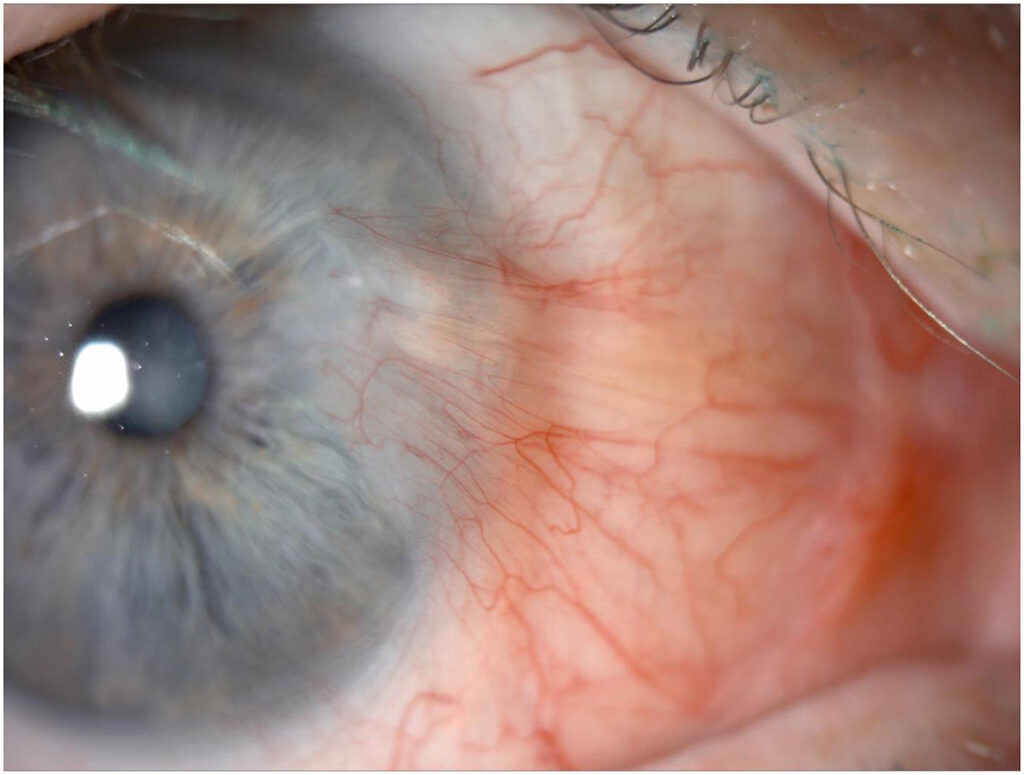
Fibrin glue in pterygium surgery is a way of fixing the conjunctival autograft without stitches.
Also, a biologic adhesive made from clotting proteins holds the graft in place, which mimics the last step of the blood clotting process.
In addition, compared with sutures, it usually means less pain, less inflammation, and a shorter operation (see conjunctival autograft for pterygium).
Why Fibrin Glue in Pterygium Surgery Was Introduced
Sutured grafts cause discomfort, foreign body sensation, and inflammation, while stitches can lead to granulomas and scarring.
Surgery with sutures takes longer, and many patients complain of pain in the first days.
Inflammation also contributes to recurrence, so reducing it is a goal (see pterygium recurrence).
Fibrin Glue in Pterygium Surgery: How Fibrin Glue Works
Commercial fibrin sealants have two components, fibrinogen and thrombin, which are mixed on the tissue to form a clot.
- The glue bonds the graft to the bare sclera within a few minutes
- The body absorbs it gradually as healing replaces it
- Some products contain antifibrinolytic agents to prolong the effect
All-fit Slit-Lamp Adapter
Record and share exactly what you see at the slit lamp. One adapter fits any slit lamp or surgical microscope — and any smartphone.
From Choroida — the team behind this siteThe Technique
- Excise the pterygium and Tenon tissue, and remove scar tissue to the limbus
- Measure the defect, and harvest a free conjunctival graft from the upper bulbar conjunctiva, with limbal tissue if wanted
- Apply a thin layer of fibrinogen to the bare sclera, then thrombin to the graft, or apply both from a dual syringe
- Place the graft epithelial side up, align it with the limbus, and smooth it out
- Hold for a few minutes, and then trim the edges
“Cut and paste” techniques use a no-suture, small-incision approach (see the references).
Fibrin Glue in Pterygium Surgery: Evidence From Studies
Randomized trials compared fibrin glue with sutures for attaching autografts.
- Surgical time was shorter with glue, by about ten to fifteen minutes (see the references)
- Postoperative pain and discomfort were lower
- Inflammation and suture-related problems were reduced
- Recurrence rates were similar or lower with glue in most studies (see the references)
Fibrin Glue in Pterygium Surgery: Risks and Drawbacks
- Graft retraction or loss: if the surgeon applies the glue badly or places the graft carelessly, it can shift or fall off in the first days
- Cost: commercial fibrin sealants are expensive, though autologous options exist
- Theoretical risk of infection: from human plasma-derived products, which are screened but not risk-free
- Surgeon skill: the surgeon must also handle the graft gently and place it correctly
Autologous Alternatives
Some surgeons make their own fibrin from the patient’s blood, or use cryoprecipitate, which reduces the cost and the risk of transmission.
Results are comparable in small studies, though the strength of the bond may be lower.
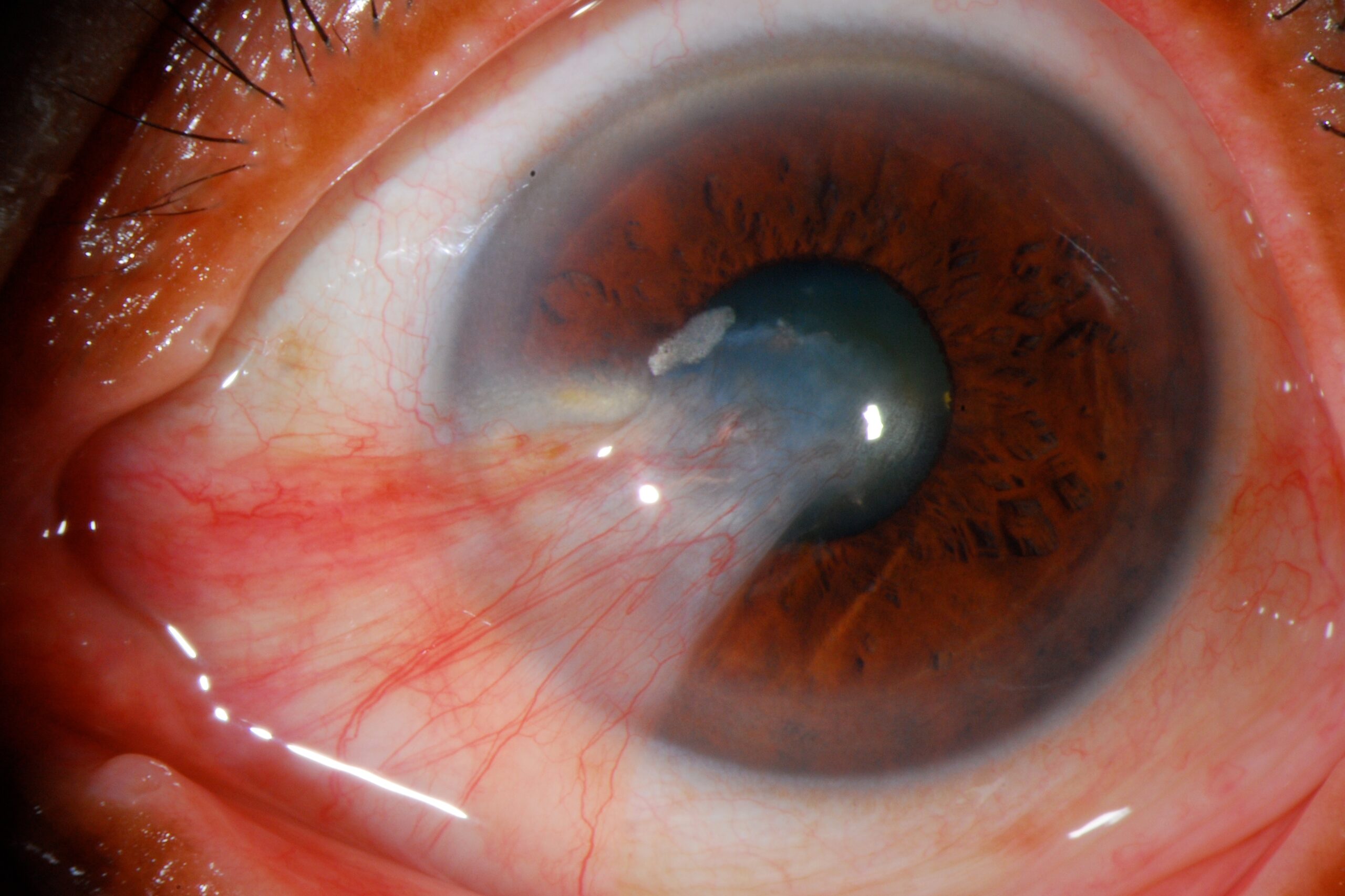
Fibrin Glue in Pterygium Surgery: Postoperative Care
- Topical steroid and antibiotic drops, tapered over weeks
- Lubricants and avoidance of eye rubbing
- Review at one day, one week, and one month, with attention to graft position
- Treat inflammation promptly, since recurrence risk is higher when inflammation persists
Counselling
Explain that surgery has a high success rate, that recurrence can still happen, and that sun protection and drops help.
Mention that the glue may make the first days more comfortable.
An Example Case
A 52-year-old farmer has a recurrent pterygium that reaches the visual axis, with irritation and blur.
The surgeon removes the lesion and fixes a conjunctival autograft from the upper bulbar conjunctiva with fibrin glue, without sutures, with an operating time of about fifteen minutes (see pterygium recurrence).
He has little pain, the graft is in place at one week, and at six months there is no recurrence, with advice to wear sunglasses.
Choosing the Technique
Glue suits most primary and recurrent pterygia when a conjunctival autograft is used.
Clinicians still use sutures when glue is not available, or in eyes with very mobile conjunctiva, where the graft needs mechanical support, and some surgeons use a combination in difficult cases.
Tips to Avoid Graft Problems
- Keep the graft orientation correct, with the epithelial side up
- Dry the bed before applying the glue, and avoid blood on the surface
- Press gently for a few minutes, without sliding the graft
- Protect the eye with a patch for a day, and warn the patient not to rub
These steps reduce loss of the graft and so improve results.
Key Messages for Colleagues
Use glue when it is available, and keep the surgical steps constant: careful excision, a well-fitted graft, a dry bed, and gentle pressure.
Also, track recurrence and graft loss rates in your own practice, and counsel patients on sun protection and follow-up.


Document what you see
Two smartphone imaging tools built for everyday clinic use — one for the slit lamp, one for the fundus.
From Choroida — the team behind this siteReferences
- Koranyi G, Seregard S, Kopp ED. Cut and paste: a no suture, small incision approach to pterygium surgery. Br J Ophthalmol. 2004;88:911-914.
- Srinivasan S, Dollin M, McAllum P, et al. Fibrin glue versus sutures for attaching the conjunctival autograft in pterygium surgery: a prospective observer masked clinical trial. Br J Ophthalmol. 2009;93:215-218.
- Hall RC, Logan AJ, Wells AP. Comparison of fibrin glue with sutures for pterygium excision surgery with conjunctival autografts. Clin Exp Ophthalmol. 2009;37:584-589.
- American Academy of Ophthalmology. Basic and Clinical Science Course, Section 8: External Disease and Cornea. AAO; current edition.

Writes and reviews the clinical articles on Educate. Every post is checked against peer-reviewed sources before it goes live.